Blog

  • What is AI SEO? The Complete Guide to GEO, AEO & LLMO (2026)

    What is AI SEO? The Complete Guide to GEO, AEO & LLMO (2026)

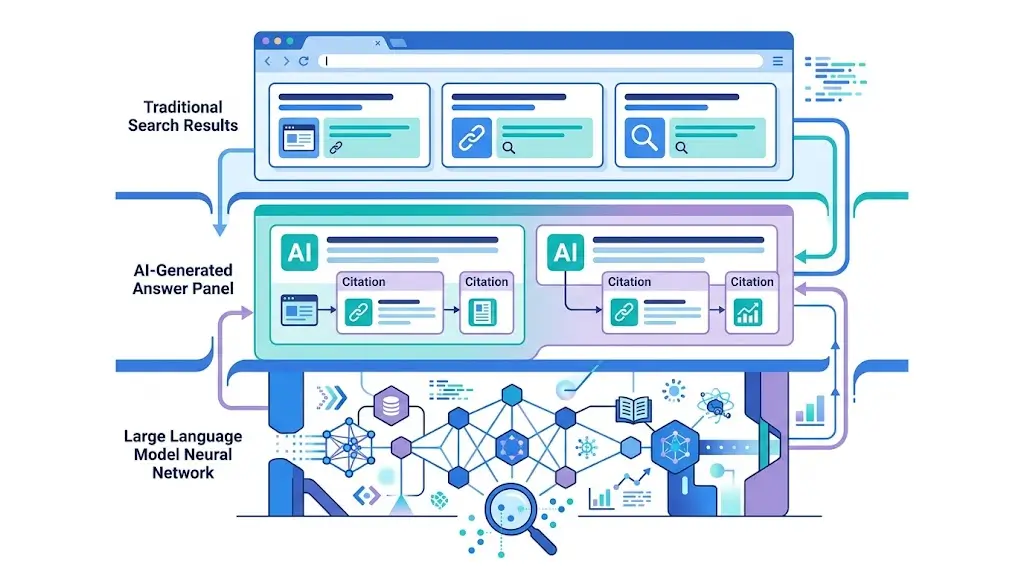
    AI SEO diagram showing the three layers of AI search optimization — traditional SEO, GEO, AEO, and LLMO — as a unified strategy stack
    AI SEO is not a replacement for traditional SEO — it is a new optimization layer built on top of it, targeting citation visibility across ChatGPT, Perplexity, and Google AI Overviews.
    📅 Last Reviewed: June 14, 2026. All statistics in this article have been verified against primary sources. The AI search landscape is shifting fast — this pillar guide is updated quarterly. Data from BrightEdge, Ahrefs, Semrush, Conductor, ConvertMate, Pew Research Center, and the Princeton/KDD 2024 academic study are cited inline with source and year throughout.

    📌 Key Takeaways

    • AI SEO is the umbrella term for optimizing content across AI-powered search surfaces — it contains three sub-disciplines: GEO, AEO, and LLMO.
    • Google AI Overviews now reach over 2 billion monthly users (BrightEdge, 2026), and organic CTR drops 34–61% when an AI Overview is present — making AI citation the primary mechanism for recovering lost visibility.
    • AI-referred traffic converts at 4.4x the rate of standard organic search (Semrush, 2026) — and Ahrefs internal data shows AI visitors representing just 0.5% of traffic drove 12.1% of all signups.
    • GEO, AEO, and LLMO share approximately 90% of their optimization tactics (Contently, 2026) — the differences are about where your content appears and which layer of AI systems you are targeting.
    • The right sequence: SEO foundation first, then AEO for direct answers, then GEO for AI-generated citations, then LLMO for brand-level model awareness — one layered stack, not four separate strategies.


    What is AI SEO?

    AI SEO is the practice of optimizing your website and content to earn visibility across AI-powered search surfaces — not just traditional Google rankings. It is the umbrella strategy that contains three specific sub-disciplines: GEO (Generative Engine Optimization), AEO (Answer Engine Optimization), and LLMO (Large Language Model Optimization).

    Here is why the distinction matters. When someone typed “best project management tool” into Google in 2022, they saw ten blue links and clicked one. When someone asks the same question in ChatGPT, Perplexity, or Google AI Mode in 2026, they receive a synthesized answer that cites two or three specific sources. Your content either gets cited — or it does not exist for that user.

    Traditional SEO optimized for the first scenario. AI SEO optimizes for both.

    The term itself is not yet fully standardized. Some practitioners use “AI SEO” to mean using AI tools to do SEO faster. Others use it to mean optimizing for AI search platforms. This guide focuses on the second definition — the one with real strategic implications for your content and business visibility.

    “The practitioners who are struggling are those who still define SEO purely as keyword ranking. Those who have expanded their definition to include AI visibility and multi-surface presence are finding more opportunities, not fewer.”

    — GoodFirms AI SEO Statistics Report, 2026[2]

    💬 According to EverydayOnAI

    The practical reading of the research cited throughout this guide is that the shift isn’t gradual — it’s binary at the page level. A page either has the self-contained, extractable structure that GEO and AEO reward, or it doesn’t, and the gap in citation rates between those two groups (documented in the ConvertMate and Princeton/KDD studies below) is widening faster than most editorial calendars adapt to. The implementation checklist in Section 7 isn’t a “nice to have” backlog item. Based on the citation-rate gaps the cited research documents, it’s closer to a pass/fail gate for whether a page exists to AI systems at all.

    The Origin of Each Term

    The sub-disciplines within AI SEO each have formal origins. GEO was formalized in a peer-reviewed paper by Princeton University, Georgia Tech, Allen Institute for AI, and IIT Delhi, published at ACM KDD 2024 — the first controlled experimental study measuring content visibility inside AI-generated responses across 10,000 queries.[1] AEO predates GEO, emerging from early voice search and featured snippet optimization practices around 2018 and has since expanded to cover AI answer surfaces. LLMO emerged from practitioner communities in 2023–2024, initially among SEO professionals experimenting with ChatGPT’s citation behavior.

    The important thing to note: these are not competing strategies. They are three perspectives on the same goal — making sure AI systems select and surface your content when users ask questions in your domain.

    📋 Section Summary

    • AI SEO is the umbrella term for optimizing content across AI-powered search surfaces, containing three sub-disciplines: GEO, AEO, and LLMO.
    • The term has two common meanings — using AI tools for SEO (workflow), and optimizing for AI search platforms (strategy). This guide covers the second, strategically significant definition.
    • GEO was formalized at ACM KDD 2024 (Princeton/Georgia Tech/IIT Delhi); AEO originated in voice search optimization circa 2018; LLMO emerged from practitioner communities in 2023–2024.


    Why AI SEO Matters in 2026: The Numbers

    Before investing in any new strategy, you want evidence. The evidence for AI SEO is now substantial — from academic research, large-scale industry studies, and documented real-world results. Here is what the data actually says.
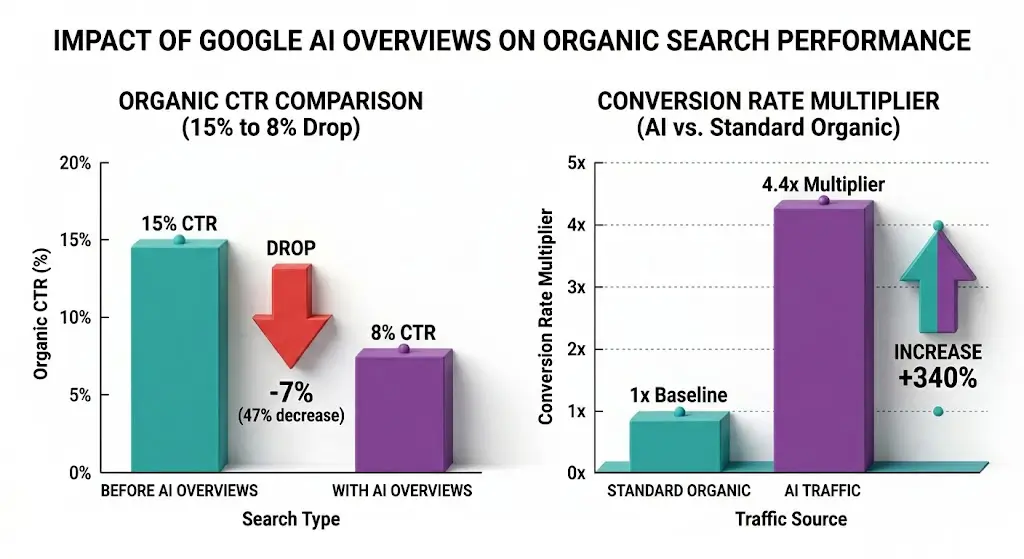
    Bar chart comparing organic CTR with and without AI Overviews, and conversion rate advantage of AI-referred traffic versus standard organic traffic, 2026 data
    Two effects dominate the AI SEO data: AI Overviews cut organic CTR by up to 61% (Ahrefs, 2026) — while the AI traffic that does arrive converts at 4.4x the organic baseline (Semrush, 2026).

    The Scale of the Shift

    Google AI Overviews now reach over 2 billion monthly users globally — a platform larger than any individual social network — according to BrightEdge’s 2026 analysis.[3] Depending on query type and geography, AI Overviews appear on 25–48% of all Google searches.[4] ChatGPT processes over 1 billion queries per week. Perplexity generates approximately 20 million AI-synthesized answers per day.

    Every one of those AI-generated answers cites specific sources. The question is not whether AI search matters for your content. It is whether your content appears in those citations.

    2B

    monthly users engage with Google AI Overviews globally[3]

    61%

    drop in organic CTR when AI Overviews appear — from 1.76% to 0.61% for affected queries[5]

    4.4×

    higher conversion rate from AI-referred traffic versus standard organic search visitors[6]

    527%

    growth in AI search sessions year-over-year comparing January–May 2024 to January–May 2025[7]

    6.82%

    of ChatGPT citations come from Google’s top 10 pages — meaning ranking #1 does not guarantee AI citation[8]

    +91%

    more paid clicks earned by brands cited in AI Overviews vs. non-cited brands on the same queries[9]

    The Conversion Argument

    The most important number above is not the traffic figure — it is the 4.4x conversion advantage from AI-referred visitors. Here is why this matters even though AI referral traffic is currently small in absolute volume.

    Ahrefs’ internal data makes the math stark: AI visitors who represented just 0.5% of total traffic drove 12.1% of all signups — a 23x conversion multiplier.[6] As AI search adoption grows at 527% year-over-year, that multiplier compounds on an expanding base.

    The window for early-mover advantage is real, but it is narrowing. Sites building AI citation authority now are establishing reference status with AI models while competition for those citations is still relatively low. By 2028, $750 billion of U.S. revenue is expected to run through AI-powered search[10] — the brands positioned for AI citation now are building toward that market.

    ▲ Why act now

    83% of AI Overview citations come from outside Google’s organic top 10 (ConvertMate, 2026). The floor for citation eligibility is structural quality — not domain authority alone. A well-structured page on a mid-authority site can outperform a top-10 organic ranker in AI citation share, today, if it is optimized for extractability.

    ▼ The honest caveat

    AI search referral traffic is still small in absolute volume for most sites. The 4.4x conversion advantage is real, but 4.4x of a small number is still a small number. AI SEO is a multi-quarter investment, not a quick traffic win. Measurement requires new setup — GA4 filters, manual citation testing — that takes time to build.

    📋 Section Summary

    • Google AI Overviews reach 2 billion monthly users (BrightEdge, 2026) and reduce organic CTR by 34–61% when present — making AI citation the primary mechanism for recovering lost click-through.
    • AI search sessions grew 527% year-over-year (Previsible, 2025), while AI-referred visitors convert at 4.4x the rate of standard organic visitors (Semrush, 2026).
    • Only 6.82% of ChatGPT citations come from Google’s top 10 pages (ConvertMate, 2026) — confirming that traditional SEO rank alone does not produce AI visibility.


    The Four Layers: SEO → AEO → GEO → LLMO

    The most useful mental model for AI SEO is a layered stack — not four competing strategies, but four levels of optimization that build on each other. Each layer assumes the previous one is already in place. Start from the bottom up.

    The four-layer AI SEO stack: SEO foundation at base, then AEO for direct answers, then GEO for AI-generated citations, then LLMO for brand-level model awareness at the top

    The AI SEO stack is not four separate strategies — it is four optimization layers built in sequence, each depending on the layer beneath it being solid.

    Layer 1: Traditional SEO — The Non-Negotiable Foundation

    Traditional SEO is not dead. Google still processes an estimated 8.5 billion searches per day and holds approximately 89% of the global search market.[11] Organic search drives roughly 53% of all website traffic across the web. You still need this.

    More importantly for AI SEO: the AI platforms that power Overviews, ChatGPT Search, and Perplexity are all built on top of traditional web indexes. GPTBot crawls pages that are crawlable. Google AI Overviews draw from the same Knowledge Graph that powers regular search. A page blocked to AI crawlers cannot be cited regardless of content quality — it simply does not exist to the AI.

    This means traditional SEO creates the floor. Everything above it depends on this foundation: clean crawlability, fast Core Web Vitals, correct canonicalization, and strong E-E-A-T signals. If your robots.txt blocks GPTBot, PerplexityBot, or Google-Extended — intentionally or accidentally — no other AI SEO investment will matter.

    Layer 2: AEO — Optimizing for Direct Answers

    AEO is the practice of structuring content to be directly extracted as a short, authoritative answer to a specific question — in featured snippets, voice search responses, People Also Ask boxes, and AI-powered answer cards. AEO optimizes for precision.

    The content format AEO favors is concise: a direct definition or answer in the first sentence of each section, followed by structured supporting detail. The query type it targets is specific and question-based — “what is”, “how to”, “why does”, “what’s the difference between”. Importantly, AEO is the right starting point for most content teams because it improves clarity for human readers and extractability for AI systems simultaneously — one change, two payoffs.

    As Neil Patel’s analysis of AEO confirms, content optimized for featured snippets is often the same content that earns AI-generated citations — the underlying mechanism is extractability, and both surfaces reward the same structural choices.[12]

    Layer 3: GEO — Optimizing for AI-Generated Citations

    GEO targets the longer, synthesized answers that AI platforms generate — the paragraphs of text that ChatGPT, Perplexity, or Google AI Overviews produce when a user asks a complex question. In these responses, the AI draws from multiple sources and cites them explicitly. GEO optimizes your content to be one of those cited sources.

    GEO operates at a different scale than AEO: where AEO is about being the single direct answer to a specific question, GEO is about being one of the trusted sources that an AI weaves into a multi-paragraph synthesized response. GEO-optimized content is typically longer, more data-rich, and structured with strict heading hierarchies that allow AI crawlers to extract specific passages independently of their surrounding context.

    The Princeton/KDD 2024 study found that content structure changes — adding authoritative citations, quotation-style formatting, and fluency optimizations — increased citation rates in AI responses by up to 30–40% in controlled experiments.[1] ConvertMate’s 2026 industry benchmark extended these findings: pages above 20,000 characters earn 4.3x more AI citations than shorter content across a sample of 10,000+ tracked pages.[8]

    Layer 4: LLMO — Optimizing Brand Presence Inside LLMs

    LLMO is the deepest layer and the hardest to control directly. It addresses how large language models — the underlying models powering ChatGPT, Claude, Gemini, and others — represent your brand and expertise in their parameters. This operates independently of live web retrieval.

    The key practical distinction: GEO and AEO optimize for what happens when a user triggers a live web search and an AI cites your page. LLMO addresses what happens when a user prompts an AI in a context where no live web retrieval occurs — asking ChatGPT about your brand, or asking an AI agent which vendors to recommend in a specific category.

    For most brands, LLMO influence comes from the same mechanisms that drive GEO: consistent, high-quality content with strong E-E-A-T signals, widely cited across authoritative third-party publications. You build LLMO authority as a side effect of doing GEO well. As Contently’s 2026 analysis notes, “the optimization tactics overlap by roughly 90 percent. Most teams will never encounter the rare cases where the difference is real.”[13]

    📋 Section Summary

    • The AI SEO stack has four layers: SEO foundation, AEO (direct answers), GEO (AI-generated citations), LLMO (brand in LLMs) — each layer assumes the previous one is solid before building on top.
    • Traditional SEO remains non-negotiable because all AI search platforms are built on traditional web indexes — a page blocked to AI crawlers cannot be cited regardless of content quality.
    • GEO, AEO, and LLMO share approximately 90% of their optimization tactics (Contently, 2026); the differences are about which layer of AI systems you are targeting, not which tactics to use.


    GEO, AEO, LLMO Compared: Full Breakdown

    The table below is organized by decision-making criteria — not just definitions. Use it to determine which layer to prioritize, which metric to track, and which schema to implement.

    Dimension AEO GEO LLMO
    What it targets Featured snippets, voice search, answer boxes, PAA AI-generated citations in ChatGPT, Perplexity, AI Overviews Brand representation inside LLM parameters and AI agents
    Primary platforms Google (snippets), Siri, Alexa, Google AI Mode ChatGPT Search, Perplexity, Google AI Overviews, Copilot GPT-4o, Claude, Gemini (model-level), AI agents
    Query type Specific: “what is X”, “how to Y”, “define Z” Exploratory: “explain X”, “compare A vs B”, “best way to do Y” Conversational: open-ended prompts inside AI tools
    Ideal content format Concise Q&A, direct definitions, FAQ sections Long-form, data-rich, structured headings, inline source citations Comprehensive guides, consistent brand entity signals, third-party mentions
    Primary schema FAQPage, HowTo Speakable, FAQPage, Article Organization, Person, Product (entity clarity)
    Measurable metric Snippet appearance rate, voice answer rate Citation rate, Response Inclusion Rate, AI referral traffic in GA4 Brand mention rate in AI responses without web search prompt
    Time to visibility 2–8 weeks (pages with existing authority) 4–12 weeks from structural optimization Months to years (training cycle dependent)
    Your degree of control High — direct formatting changes High — structural and schema changes Low — indirect, through content + third-party mentions
    Where to start First — improves all content simultaneously Second — builds on AEO foundation Last — emerges from consistent GEO execution

    Where They Genuinely Overlap

    In practice, a well-executed AEO content update — adding direct-answer sentences, FAQ sections, and proper heading structure — is simultaneously a GEO update. The content that gets selected for featured snippets (AEO) is often the same content that gets cited in AI-generated answers (GEO). The main reason to keep the terms distinct is measurement: the same optimization produces different signals in different tracking tools. Your featured snippet appearance is an AEO metric; your AI referral session in GA4 is a GEO metric. Both result from the same content change.

    When the Distinction Actually Matters

    There are three scenarios where the GEO/AEO/LLMO distinction becomes strategically relevant rather than academic:

    Content length and depth: AEO favors concise, direct answers. GEO favors comprehensive long-form content — ConvertMate’s 2026 benchmark found pages above 20,000 characters earn 4.3x more AI citations.[8] A page optimized purely for featured snippets may be too short for competitive GEO performance on broad queries.

    Schema selection: AEO uses FAQPage and HowTo schema. GEO adds Speakable schema targeting extractable content blocks. LLMO adds consistent entity markup (Organization, Person, Product schema) across all pages. You need all three layers of schema for full coverage — each layer adds something distinct.

    Measurement and attribution: If you are demonstrating ROI to a leadership team, AEO performance (snippet appearance) and GEO performance (AI referral sessions and conversion rate) require different tracking setups and different proof points. Conflating them understates the value of each.

    📋 Section Summary

    • AEO, GEO, and LLMO differ primarily in the platform they target and the metric they produce — their optimization tactics overlap by approximately 90%, making them complementary rather than competing.
    • The practical distinctions that matter operationally are content length (AEO = concise, GEO = comprehensive), schema selection (add Speakable for GEO; entity schema for LLMO), and measurement setup.
    • Start with AEO because it improves all content simultaneously; then layer GEO for depth and citations; LLMO emerges as a side effect of executing GEO consistently well over time.


    Before & After: What Changes When You Implement AI SEO

    The most common question from content teams is not “what is AI SEO” but “what does it actually look like to change a page.” Here are three concrete before-and-after examples — the exact edits that move a page from invisible to cited.

    Change 1: H3 Opening Sentences

    ✖ Before (traditional SEO approach)

    “Before we explore the specifics of AI search optimization, it is worth understanding the historical context in which these platforms emerged. Over the past three years, the search landscape has fundamentally shifted in ways that demand a rethinking of how content teams approach…”

    ✔ After (AI SEO — answer-first)

    “AI SEO is the practice of optimizing content for citation across AI-powered search surfaces including ChatGPT, Google AI Overviews, and Perplexity — in addition to traditional Google rankings.”

    The first version is not bad SEO writing. It is simply invisible to AI extraction. AI systems extract the first sentence of each section at disproportionate rates. ConvertMate’s 2026 benchmark found that 44.2% of all AI citations come from a page’s first 30% of content — and within sections, from first sentences specifically.[8] The after version is extractable on its own, even without surrounding context.

    Change 2: Statistics Without In-Text Source Attribution

    ✖ Before (hyperlink-only attribution)

    “AI-referred traffic converts significantly better than organic search traffic, as this study shows.”

    ✔ After (self-contained, GEO-optimized)

    “AI-referred traffic converts at 4.4 times the rate of standard organic search, according to Semrush’s 2026 analysis of cross-industry conversion data.”

    A hyperlink is not enough. AI systems process text — they do not follow links to retrieve source information. A statistic without the source name and year in the sentence body cannot be correctly attributed by an AI reproducing the claim. The after version works whether a human reads it, an AI cites it, or a journalist quotes it. All three audiences understand the provenance without clicking anywhere.

    Change 3: Section Endings

    ✖ Before (transition filler)

    “Now that we have covered the basics of GEO, let’s move on to the next section where we’ll discuss implementation in more detail.”

    ✔ After (Section Summary Box — extractable bullets)

    📋 Section Summary: GEO is the practice of structuring content for citation selection inside AI-generated responses, formalized at ACM KDD 2024. AI Overviews appear in 25–48% of Google searches as of Q1 2026 (Conductor / BrightEdge). Pages above 20,000 characters earn 4.3x more AI citations than shorter content (ConvertMate, 2026).

    The summary box serves three purposes simultaneously: it gives AI systems explicitly formatted extractable content, it activates Speakable schema selectors, and it helps human readers retain the key points before moving to the next section. Every H2 section in an AI-SEO-optimized article should end this way.

    📋 Section Summary

    • The three highest-impact AI SEO content changes are: answer-first H3 opening sentences, self-contained statistical statements with inline source attribution, and Section Summary Boxes at the end of every H2.
    • AI systems extract the first sentence of each section at disproportionate rates — 44.2% of all AI citations come from a page’s first 30% of content (ConvertMate, 2026).
    • A hyperlink is not sufficient source attribution for AI extraction — the organization name and year must appear in the sentence body for a statistic to be correctly attributed when an AI reproduces the claim.


    Case Study: 4,162% Organic Growth with AI SEO

    Xponent21, a digital marketing agency, published a detailed case study of their own AI SEO implementation in December 2025 — one of the most granular real-world datasets available on what the strategy actually produces when executed consistently.[14]

    📋 Case Study: AI SEO from Zero to Category Leader

    Xponent21 — Digital Marketing Agency (Published December 2025)

    Starting point (mid-2024): A newly relaunched site with minimal search presence. The team built a content strategy specifically designed around AI search citation principles from day one — not retrofitted after publication.

    Strategy: What they called the “AI SEO Content Accelerator” methodology — content architecture optimized for AI extraction, consistent schema markup, multimedia integration, and engagement signal building. The core principle: give AI-generated content something it cannot invent on its own — original expertise, verifiable data, and genuine authority signals.[15]

    Results by May 2025 (approximately 12 months):

    • 10.5 million total search impressions accumulated
    • 20,100 total clicks from search presence
    • 4,162% organic traffic growth from launch baseline
    • Top position for “Top AI SEO Agency” in both Google AI Overviews and Perplexity simultaneously — category leadership across two AI platforms for the same query

    What made it replicable: Content was built around AI citation principles from the first draft. Schema markup was treated as a priority, not an afterthought. AI citation rate was tracked manually with a fixed query set across platforms. Topical authority was built within a cluster, not through isolated articles.

    The 4,162% figure is exceptional. The methodology is not. These are the same principles documented in the Princeton/KDD 2024 academic study — the case study is a practitioner validation of research findings, not an outlier tactic. A separate case study by Digital Harvest documented a 144% increase in overall website traffic year-over-year using the same core principles — less dramatic, but more representative of what a mid-stage content operation can expect.[15]

    The common thread across both: original expertise embedded in content that AI systems can extract cleanly. Generic AI-generated content that adds nothing new does not win in AI citation competition for the same reason it struggles in traditional SEO — the systems selecting content are optimizing for authoritative, distinctive signal.

    📋 Section Summary

    • Xponent21’s AI SEO case study (December 2025) documented 4,162% organic traffic growth in 12 months and simultaneous top-position citations in Google AI Overviews and Perplexity for the same target query.
    • The methodology — answer-first content architecture, consistent schema, topical cluster structure, and manual citation tracking — is documented and replicable regardless of site size.
    • Digital Harvest’s separate case study documented a more typical 144% year-over-year traffic increase using the same core principles, representing a realistic mid-stage content operation result.


    The AI SEO Implementation Checklist

    Use this checklist in sequence. Each section builds on the previous one. Items marked with a star (★) are the highest-priority actions if you are starting from scratch.


    🎯 Interactive Tool

    AI Citation Readiness Score

    Before working through the full checklist below, get a quick directional read on where your page or website currently stands. Check every box that already applies to you, then click Calculate. Your weakest layer will be flagged with a direct link to the relevant checklist section.

    Layer 1 — SEO Foundation


    Layer 2 — AEO (Direct Answers)


    Layer 3 — GEO (AI Citations)


    Layer 4 — LLMO (Brand in Models)


    0

    This is a self-assessment tool for directional guidance only — it does not replace a full technical audit and does not guarantee AI citation, ranking, or traffic outcomes.

    ✓ Layer 1: Traditional SEO (Prerequisites — Complete Before Anything Else)

    • ★ Verify GPTBot, PerplexityBot, Google-Extended, and ClaudeBot are not blocked in robots.txt
    • ★ Check Cloudflare Bot Fight Mode — confirm AI crawlers are not blocked at CDN level
    • All pages crawlable and indexed in Google Search Console
    • Core Web Vitals passing: LCP < 2.5s, CLS < 0.1, INP < 200ms
    • Clean H1 → H2 → H3 heading hierarchy on all priority pages
    • Author bios with domain-relevant credentials on every article
    • Canonical URLs set correctly — no duplicate content issues
    • XML sitemap submitted to Google Search Console and Bing Webmaster Tools

    ✓ Layer 2: AEO — Direct Answer Optimization

    • ★ Every H3 first sentence delivers a direct answer — no preamble, no “In this section we will…”
    • ★ FAQ section present on every priority page (minimum 5 questions, minimum 2 sentences per answer)
    • ★ FAQPage schema implemented and validated in Google’s Rich Results Test
    • Each FAQ answer self-contained and readable without the question for full context
    • HowTo schema on all step-by-step instructional content
    • People Also Ask (PAA) boxes monitored in Search Console for new question opportunities
    • Headings rewritten to be question-format or definition-format where applicable

    ✓ Layer 3: GEO — AI Citation Optimization

    • ★ All statistics reformatted to self-contained structure: [Organization] [finding] ([Source, Year])
    • ★ Speakable schema targeting .key-takeaway, .section-summary, and blockquote selectors
    • ★ Section Summary Boxes at the end of every H2 (3 self-contained bullets minimum)
    • Key Takeaways box immediately after the introduction (5 bullets minimum)
    • Named entities re-introduced at the start of each new H2 section — no pronoun-only references
    • Content depth above 20,000 characters on pillar articles
    • llms.txt file created and deployed in site root
    • “Last Reviewed” date visible in article body — updated every time statistics are refreshed
    • Comparison tables present in every pillar article

    ✓ Layer 4: LLMO — Brand Model Optimization

    • Organization schema implemented sitewide with consistent name, URL, and social profiles
    • Brand mentioned consistently by full official name across all pages — no informal abbreviations
    • Author pages with Person schema linking to verifiable external profiles (LinkedIn minimum)
    • Third-party brand mentions actively built: target 5–10 authoritative external publications
    • Internal linking from all spoke articles back to relevant pillar pages (topical cluster structure)
    • ★ AI citation baseline measured: manual query test across ChatGPT, Perplexity, Google AI Overviews using 15–20 fixed target prompts. Record results now as your baseline.

    📋 Section Summary

    • The AI SEO implementation checklist has four sequential layers — start with traditional SEO prerequisites (especially AI crawler access), then AEO direct-answer formatting, then GEO structural changes, then LLMO brand entity signals.
    • The single highest-priority first action: verify that GPTBot, PerplexityBot, Google-Extended, and ClaudeBot are not blocked in your robots.txt. All other optimization is irrelevant if AI crawlers cannot access your content.
    • Establish a manual citation baseline — testing 15–20 fixed prompts across ChatGPT, Perplexity, and Google AI Overviews — before implementing any changes, so you can measure actual improvement over time.


    Common Mistakes and How to Avoid Them

    These are the five errors content teams, SEO specialists, and growth marketers make most frequently when implementing AI SEO — and what to do instead.

    Mistake 1: Treating AI SEO as a Replacement for Traditional SEO

    The most common strategic error is framing AI SEO as an either/or choice. It is not. Traditional SEO creates the authority foundation that all AI platforms rely on. Domain traffic is the strongest single predictor of AI citation frequency, according to SE Ranking’s analysis of 2.3 million pages.[2] Sites with over 32,000 referring domains are 3.5x more likely to be cited by ChatGPT (Ahrefs, 2026).[6] SEO builds the floor. AI SEO builds the walls.

    Mistake 2: Blocking AI Crawlers Without Knowing It

    Many sites have inadvertently blocked GPTBot, PerplexityBot, or Google-Extended through blanket User-agent: * Disallow: / rules, aggressive Cloudflare Bot Fight Mode settings, or CDN configurations that reject unfamiliar user agents. Check your robots.txt and your Cloudflare dashboard before any other AI SEO work. Every other optimization in this guide is irrelevant if the crawlers cannot access your content.

    Mistake 3: Treating AI SEO as a One-Time Project

    Content freshness is weighted more aggressively in AI citation selection than in traditional SEO. AI citation rates drop sharply as content ages — faster than organic ranking decay. Pages with statistics that are 18+ months old lose citation share to fresher competitors. The AI SEO checklist above is not a project to complete; it is a quarterly maintenance cycle. The “Last Reviewed” date visible in your article body is not aesthetic — it is a ranking signal for AI systems that use freshness as a citation criterion.

    Mistake 4: Optimizing Only New Content

    Your highest-ROI AI SEO targets are your existing top-traffic pages — they already have the backlink authority and indexed history that AI platforms use when evaluating source credibility. Retroactive GEO and AEO optimization of your top 10 organic traffic pages will typically produce faster AI citation results than publishing new content from scratch. Update your most authoritative existing pages first; launch new content second.

    Mistake 5: Confusing “Using AI Tools for SEO” with “Optimizing for AI Search”

    A significant portion of content labeled “AI SEO” in 2026 describes using AI writing or keyword research tools to improve traditional SEO workflows — Semrush AI, Surfer, Clearscope, and so on. That is a legitimate workflow improvement, but it is not what this guide covers. Optimizing for AI search platforms — earning citations in ChatGPT, Perplexity, and Google AI Overviews — is a distinct strategy requiring different structural changes. If you are evaluating vendor content about “AI SEO,” clarify which definition they are using before acting on it.

    📋 Section Summary

    • The five most common AI SEO mistakes are: treating it as a replacement for traditional SEO, inadvertently blocking AI crawlers, treating it as a one-time project rather than a quarterly cycle, optimizing only new content instead of retrofitting top-traffic pages, and confusing AI tools for SEO with optimization for AI search.
    • Retroactive optimization of existing top-traffic pages typically produces faster AI citation results than new content, because those pages already have the authority signals AI platforms use to evaluate source credibility.
    • Check your robots.txt and Cloudflare Bot Fight Mode before implementing any other AI SEO change — blocked crawlers render all other optimizations irrelevant.


    Frequently Asked Questions About AI SEO

    These are the questions content strategists, SEO professionals, and business owners most commonly ask. Each answer is written to be directly extractable and structured to appear in Google’s People Also Ask, featured snippets, and AI-generated responses.

    What is the difference between AI SEO, GEO, AEO, and LLMO?

    AI SEO is the umbrella term; GEO, AEO, and LLMO are its three sub-disciplines. GEO (Generative Engine Optimization) targets citation selection inside AI-generated responses from platforms like ChatGPT and Perplexity. AEO (Answer Engine Optimization) targets direct-answer surfaces: featured snippets, voice search, and AI answer boxes. LLMO (Large Language Model Optimization) targets how large language models represent your brand in their parameters — independent of live web retrieval.

    In practice, the optimization tactics for all three overlap by approximately 90% (Contently, 2026).[13] The differences are primarily about which surface you are targeting and which metric you are tracking — not which editorial or structural changes to make.

    Does AI SEO replace traditional SEO?

    No — traditional SEO is the non-negotiable foundation that AI search platforms are built on. Google AI Overviews draw from the same index and E-E-A-T signals as regular search. GPTBot crawls pages that are accessible and indexable. A page blocked to AI crawlers cannot be cited in AI responses regardless of content quality. SE Ranking’s analysis of 2.3 million pages found domain traffic as the strongest single predictor of AI citation frequency — making traditional SEO performance directly predictive of AI citation potential.[2] AI SEO is an additional optimization layer on top of traditional SEO, not a substitute for it.

    How long does it take to see results from AI SEO?

    AEO improvements typically produce results in 2–8 weeks; GEO results in 4–12 weeks; LLMO improvements take months to years. Adding FAQ sections, direct-answer sentences, and FAQPage schema can produce featured snippet appearances within 2–8 weeks for pages with existing authority. GEO structural optimization — self-contained statistics, Speakable schema, Section Summary Boxes — typically takes 4–12 weeks to show in AI referral traffic, with the fastest results on Perplexity and the slowest on Google AI Overviews. Pages with established backlink profiles see faster results than new pages building authority from scratch.

    Is AI SEO relevant for small websites and blogs?

    Yes — and the competitive window is more open for smaller sites in AI citation than in traditional SEO. ConvertMate’s 2026 benchmark found that 83% of AI Overview citations come from outside the organic top 10.[8] Only 6.82% of ChatGPT citations come from Google’s top 10 pages. Structural and content quality changes can produce AI citation results on smaller sites with moderate authority — something that would be nearly impossible in traditional SEO’s top-10 competition for broad terms. The authority ceiling is still real, but the floor is substantially lower than in traditional SEO.

    Which AI platforms should I prioritize for optimization?

    Start with Google AI Overviews, then ChatGPT Search, then Perplexity AI — in that order, based on user scale and traffic referral potential. Google AI Overviews reaches 2 billion monthly users (BrightEdge, 2026).[3] ChatGPT processes over 1 billion weekly queries (OpenAI, February 2026). Perplexity is smaller but has the highest citation transparency for users — inline source cards with excerpts — making its citation behavior measurable and its traffic quality demonstrably high. Universal GEO and AEO principles apply across all platforms and should be implemented as the baseline before any platform-specific work.

    What are the most important AI SEO metrics to track?

    The four primary AI SEO KPIs are: AI Citation Rate, Response Inclusion Rate, AI Referral Sessions in GA4, and AI Referral Conversion Rate. AI Citation Rate (pages cited ÷ pages tracked) measures how frequently AI platforms select your content as a citation source. Response Inclusion Rate (prompts where your brand appears ÷ total prompts tested) measures share of voice in AI responses. AI Referral Sessions in GA4 requires filtering for traffic from chat.openai.com, perplexity.ai, and gemini.google.com. AI Referral Conversion Rate should be compared against your organic baseline — the 4.4x advantage documented by Semrush (2026) is the benchmark to beat.[6]


    Conclusion: The Window for AI Citation Authority Is Open — But It Is Closing

    Five Actions to Take This Week

    AI SEO is not a trend to monitor. It is the current operating environment for content that wants to earn visibility across the surfaces where people actually search in 2026. Google AI Overviews reduce organic CTR by 34–61% (Ahrefs, 2026) — but brands cited inside those Overviews earn 35% more organic clicks and 91% more paid clicks than non-cited brands (Seer Interactive, 2025).[9] The choice is not between AI SEO and traditional SEO. It is between appearing inside AI-generated answers — or having your traditional rankings cannibalized by AI Overviews that cite your competitors instead.

    First, check AI crawler access — open your robots.txt right now and verify GPTBot, PerplexityBot, Google-Extended, and ClaudeBot are not blocked. This is the prerequisite nothing else can compensate for. Second, run a citation baseline test — prompt ChatGPT, Perplexity, and Google AI Mode with 15 queries relevant to your business and document where you appear versus where competitors appear. You cannot optimize what you have not measured.

    Third, retrofit your top 10 organic traffic pages with AEO changes first — add direct-answer H3 opening sentences and FAQ sections with FAQPage schema. These are your highest-authority pages, and AEO changes on existing authority assets typically produce faster results than new content. Fourth, add Section Summary Boxes and reformatted statistics with inline source attribution to every retrofitted page. Fifth, create and deploy your llms.txt file in the site root — this takes 20 minutes and signals to AI systems exactly which pages you want them to prioritize.

    💬 According to EverydayOnAI

    Of the five actions above, the robots.txt and Cloudflare check is the one teams skip most often — precisely because it requires no creative or strategic thinking, just a five-minute technical check. It’s also the only item on this list that can silently invalidate every other investment in this guide. If a single AI crawler is blocked, the AEO formatting, the GEO statistics rewrite, the schema markup — none of it gets evaluated, because the content was never retrieved in the first place. If you do nothing else this week, do that.

    Compliance as a Competitive Moat

    The sites that will dominate AI search visibility in 2027 are building citation authority today — while competition for those citations is still relatively low. Early AI SEO is not just about traffic. It is about establishing reference status with AI models before those models calcify around incumbent citations the same way PageRank calcified around incumbent backlink profiles in the mid-2000s.

    The methodology is clear, the evidence is solid, and the implementation is accessible to any content team willing to work through the checklist above systematically. The only question is whether you start this quarter or let competitors establish the citations you should own.

    📚 References and Sources

    1. Princeton University, Georgia Tech, Allen Institute for AI, IIT Delhi — “GEO: Generative Engine Optimization,” ACM KDD 2024. First peer-reviewed controlled study measuring content visibility inside AI-generated responses; 30–40% citation rate increase from structural optimization in controlled experiments. arxiv.org
    2. GoodFirms / SE Ranking, “AI SEO Statistics 2026: 35+ Verified Stats,” 2026. Domain traffic as strongest predictor of AI citation frequency; external brand mentions correlated at 0.664 with AI Overview appearances; sites with 32,000+ referring domains 3.5x more likely to be cited by ChatGPT. goodfirms.co
    3. BrightEdge, AI SEO Statistics Report 2026. Google AI Overviews reach 2 billion monthly users globally; brands cited in AI Overviews earn 35% more organic clicks. brightedge.com
    4. Conductor, Q1 2026 analysis of 21.9 million queries. AI Overviews appear on approximately 25% of monitored Google searches; BrightEdge upper bound of 48% reflects specific query categories and US-centric sampling. conductor.com
    5. SEOmator, “30+ AI SEO Statistics for 2026: Data on AI Overviews, ChatGPT & GEO,” 2026. 61% CTR drop when AI Overviews appear (from 1.76% to 0.61%); 93% zero-click rate in AI Mode; 2 billion monthly AI Overview users. seomator.com
    6. Semrush / Ahrefs, 2025–2026. Semrush: AI-referred traffic converts at 4.4x the rate of standard organic search. Ahrefs internal: AI visitors = 0.5% of traffic, drove 12.1% of signups (23x conversion multiplier); sites with 32,000+ referring domains 3.5x more likely to be cited by ChatGPT. semrush.com / ahrefs.com
    7. Previsible, “AI Traffic Report 2025.” Tracked 19 GA4 properties; AI search sessions grew from approximately 17,000 to 107,000 comparing January–May 2024 with January–May 2025 — a 527% year-over-year increase. previsible.io
    8. ConvertMate, “GEO Benchmark Study 2026.” Pages above 20,000 characters earn 4.3x more AI citations; 44.2% of all AI citations come from a page’s first 30% of content; 83% of AI Overview citations come from outside Google’s organic top 10; only 6.82% of ChatGPT citations come from Google’s top 10 pages. convertmate.io
    9. Seer Interactive, “AI Overview Brand Visibility Study,” September 2025. Brands cited in AI Overviews earn 35% more organic clicks and 91% more paid clicks than non-cited brands on the same queries. seerinteractive.com
    10. Limelight Digital, “38+ AI SEO Statistics 2026,” April 2026. $750 billion of U.S. revenue expected to run through AI-powered search by 2028. limelightdigital.co.uk
    11. InstantPress, “SEO Statistics for 2026,” June 2026. Google holds approximately 89% of global search market; processes estimated 8.5 billion searches per day; organic search drives roughly 53% of all website traffic. instantpress.co
    12. Neil Patel Blog, “AEO vs GEO vs LLMO: Are They All SEO?,” December 2025. AEO-optimized content for featured snippets is often identical to GEO-optimized content for AI citations; extractability as shared underlying mechanism. neilpatel.com
    13. Contently, “AEO vs GEO vs LLMO: The Acronym Confusion, Settled,” April 2026. Optimization tactics across GEO, AEO, and LLMO overlap by approximately 90%; most teams will never encounter the rare cases where the distinction is practically relevant. contently.com
    14. Xponent21, “AI SEO Case Study: Engineering Top AI Ranks,” December 2025. 10.5 million impressions, 20,100 clicks, 4,162% organic traffic growth in 12 months; simultaneous top-position citation in Google AI Overviews and Perplexity for category query. xponent21.com
    15. Digital Harvest, “AI SEO Case Study: How We Grew Organic Traffic by 144% in One Year,” January 2026. 200+ blog posts in 2025 vs. 6 in 2024; AI content worked best when topics were made specific and niche; human expertise embedded in content as primary differentiator. digitalharvest.io

    Sources verified June 14, 2026. AI search statistics are moving fast — specific figures (CTR, citation rates, user counts) should be reconfirmed quarterly before use in client reporting or executive presentations. This article does not constitute professional SEO or legal advice.

    📚 Go Deeper: Complete AI SEO Hub on EverydayOnAI

    This pillar guide covers the full AI SEO framework — GEO, AEO, and LLMO as one integrated strategy. Each article below goes deep on a specific discipline or platform, with checklists, templates, and step-by-step guidance your team can use directly.

    📚 Sub-Pillar: GEO (Generative Engine Optimization)

    📚 Sub-Pillar: AEO (Answer Engine Optimization)

    📚 Sub-Pillar: LLMO (Large Language Model Optimization)

    • → What is LLMO? Who Needs It and Why
      The honest LLMO guide — what it actually means, who needs it beyond GEO, and why most SMBs should treat it as a side effect of good GEO rather than a separate workstream.
    • → llms.txt: Complete Setup Guide
      What llms.txt is, how to write it, where to deploy it, and which AI platforms actually read it — including a ready-to-use template for everydayonai.com-style content sites.
    • → AI Crawlers: GPTBot, ClaudeBot, PerplexityBot Explained
      How each AI crawler works, what it accesses, how to verify your robots.txt is configured correctly, and how to use Cloudflare settings to ensure AI crawlers are not accidentally blocked.

    📚 Sub-Pillar: Comparison & Terminology

    Start Your AI SEO Audit Today

    Download our free AI SEO Implementation Checklist — the 50-point audit covering all four layers of the AI SEO stack, built for content teams, SEO professionals, and growth marketers who want to earn citations in ChatGPT, Perplexity, and Google AI Overviews.


    Get the Free Checklist →

  • What Does a Chief AI Officer (CAIO) Actually Do? Role, Responsibilities & Why You Need One (2026)

    What Does a Chief AI Officer (CAIO) Actually Do? Role, Responsibilities & Why You Need One (2026)

    What Does a Chief AI Officer CAIO Actually Do – Role Responsibilities 2026
    The CAIO role has evolved from symbolic appointment to operational necessity — adoption nearly tripled in twelve months. In 2026, the question is no longer whether to appoint one, but what exactly they should own and how to measure success.
    📅 Last Reviewed: June 21, 2026. Major update: CAIO adoption data revised from 26% to 76% of organizations globally, reflecting the IBM CEO Study published May 2026 (2,000 CEOs, 33 countries) — the most significant single-year shift in C-suite role adoption tracked in this series. All other data points re-verified against named primary sources below.

    📌 Key Takeaways

    • 76% of organizations globally now have a CAIO as of May 2026 (IBM CEO Study, 2,000 CEOs across 33 countries) — up from 26% just one year earlier, the fastest C-suite role institutionalization curve in recent memory.
    • Organizations with a CAIO see generative AI prototypes reach production at a 44% success rate versus 36% without one, and report nearly double the longevity for AI systems staying in production beyond three years.
    • The CAIO’s defining characteristic versus every other executive who touches AI: it is their entire mandate, not a secondary responsibility — six core functions span strategy, governance, deployment oversight, organizational capability, regulatory compliance, and team/vendor leadership.
    • Average US CAIO salary is $352,612 (Glassdoor, March 2026), with Fortune 500 fully-loaded packages reaching $350,000–$650,000+, and the largest enterprises budgeting up to $1.5M for the role.
    • More than half of CAIOs report directly to the CEO or board — the highest direct-reporting rate of any technology C-suite role, reflecting AI’s elevation to strategic (not just operational) priority.

    Here’s a conversation happening in boardrooms across every industry right now. The board asks: “Who owns AI risk and strategy?” The CEO looks at the CTO. The CTO looks at the CDO. The CDO looks at the General Counsel. Nobody has a clean answer, because AI responsibility is distributed across all of them — and owned by none of them.

    The Chief AI Officer role was created to solve exactly that problem, and the pace of adoption has been extraordinary. As of the IBM Institute for Business Value’s CEO Study (May 2026, surveying 2,000 CEOs across 33 countries), 76% of organizations globally now have a CAIO — up from just 26% one year earlier.[1] Among FTSE 100 companies, nearly 48% have a CAIO or functional equivalent.[9] The role’s recruitment has roughly tripled over the past five years according to LinkedIn data.[2]

    But there’s still significant confusion about what a CAIO actually does, how it differs from existing C-suite roles, when an organization needs one, and how to measure whether one is succeeding. This guide answers all of those questions — with specifics, not generalities.

    💬 According to EverydayOnAI

    A jump from 26% to 76% adoption in twelve months deserves a moment of healthy skepticism alongside the headline. Some of that growth is almost certainly relabeling — a CTO or Chief Data Officer absorbing “AI” into an existing title without a meaningful change in mandate, budget, or authority. The data point worth weighting more heavily than the adoption percentage itself is the production success rate gap (44% vs 36%) later in this guide — because that outcome measure is harder to fake with a title change than a headcount survey is. Read the 76% as “AI governance accountability is now table stakes at the board level,” not as “76% of organizations have built genuine CAIO authority.”

    This article is part of our Enterprise AI Governance Implementation Series. For the broader context of how the CAIO function fits into enterprise AI governance operational readiness, see the pillar article.

    The CAIO: A Working Definition

    A Chief AI Officer (CAIO) is the C-suite executive responsible for an organization’s entire AI agenda — strategy, governance, implementation, risk management, and value creation. As Hunt Scanlon Media describes it, the CAIO is “the executive accountable for turning AI promise into performance.”[3]

    What distinguishes the CAIO from every other executive role that touches AI is the breadth of the mandate. The CTO builds platforms. The CIO manages infrastructure. The CDO ensures data quality. The CAIO sits across all three — owning the strategic and ethical vision for how AI creates value and manages risk across the entire organization — without being subordinate to any of their individual priorities.[3]

    “AI is on everyone’s list but nobody’s main job. The CTO thinks about architecture first, AI second. The CPO thinks about users first, AI second. The CAIO wakes up thinking: what can we do with AI? That singular focus is the difference.”

    — AmazingCTO.com, “What Is a CAIO? Chief AI Officer Role Explained [2026]”[4]

    The CAIO role emerged from two parallel pressures. On the strategic side: AI moved from isolated experiments to enterprise-wide operating layer, requiring a single accountable executive to sequence the portfolio, set standards, and drive adoption. On the governance side: AI-related risks — algorithmic bias, regulatory exposure, data privacy violations, reputational damage — became significant enough that boards demand a named owner, not distributed responsibility that dissolves in a crisis.

    As CIO.com put it in March 2026: “The CAIO role is evolving from a symbolic appointment into something far more operational and consequential. AI has gone from being a novelty to behaving like infrastructure. And infrastructure demands discipline.”[5]

    76%

    of organizations globally have a CAIO, May 2026 — up from 26% one year prior[1]

    48%

    of FTSE 100 companies have a CAIO or functional equivalent[9]

    growth in CAIO role recruitment over the past five years (LinkedIn data)[2]

    91%

    of high-AI-maturity organizations have a dedicated AI leader or centralized AI office[12]

    📋 Section Summary

    • A CAIO is the C-suite executive with AI as their entire mandate — strategy, governance, implementation, risk, and value creation — distinguishing the role from CTO, CIO, and CDO functions where AI is one priority among several.
    • CAIO adoption has accelerated dramatically: 76% of organizations globally now have one (May 2026), up from 26% a year prior, with role recruitment roughly tripling over five years.
    • The role emerged from two pressures converging: AI’s shift from experimental to enterprise-wide infrastructure, and board-level demand for a single named owner of AI risk.

    The Six Core Responsibilities

    While CAIO job descriptions vary significantly by organization and industry, six responsibility categories appear consistently across role definitions, executive search frameworks, and CAIO performance research.

    Responsibility 1: AI Strategy and Portfolio Management

    The CAIO builds and maintains the enterprise AI strategy — identifying where AI creates business value, sequencing the AI use case portfolio, setting investment priorities, and defining success metrics. This is not a one-time strategy document exercise; it is a continuous portfolio management function that evaluates AI initiatives against financial impact, feasibility, risk, and alignment with enterprise goals.

    Practically, this means: maintaining a prioritized AI use case roadmap tied to business outcomes; making and enforcing decisions about which AI initiatives proceed, which are paused, and which are retired; coordinating AI investment across business units to prevent duplication and ensure portfolio coherence; and reporting AI portfolio status and ROI to executive leadership and the board in terms of revenue impact, cost reduction, and risk exposure.[6]

    Responsibility 2: AI Governance and Risk Management

    The CAIO is the executive owner of the organization’s AI governance program — accountability structures, risk controls, compliance obligations, and ethical guardrails. This is the dimension most directly connected to regulatory requirements and the one that creates the most board-level visibility.

    AI governance responsibilities include: establishing and maintaining the AI governance framework (risk classification, accountability structures, policy framework); owning the AI governance committee and its decision-making processes; ensuring compliance with applicable AI regulations — the EU AI Act (with its newly extended December 2027 / August 2028 high-risk deadlines), Colorado AI Act, NAIC Model Bulletin, and OMB M-24-10 for federal agencies; overseeing algorithmic bias and fairness programs; and maintaining the organization’s AI incident response capability.

    For the specific governance committee structure that CAIOs typically build and lead, see our dedicated guide: How to Build an AI Governance Committee.

    Responsibility 3: AI Development and Deployment Oversight

    The CAIO oversees — not builds — AI systems. This includes setting development standards (documentation requirements, testing methodology, bias evaluation), approving high-risk AI deployments, establishing governance gates in the development pipeline, and ensuring that AI systems reach production with adequate controls and monitoring.

    The oversight function requires sufficient technical fluency to challenge engineering assumptions and assess deployment readiness, but should not require deep ML engineering expertise. As Taggd describes the role: “CAIO must understand how models, data pipelines, and deployment constraints work in practice — this fluency allows the CAIO to challenge assumptions, assess feasibility, and guide investment decisions.”[7]

    Responsibility 4: Organizational AI Capability and Culture

    IESE Business School identifies organizational transformation as one of the three critical CAIO functions — and consistently the most underestimated.[3] The CAIO must build AI literacy across the organization, lead workforce transformation (reskilling, AI tool adoption, job architecture redesign), and create the cultural conditions that make responsible AI use the organizational default rather than the exception.

    This includes partnering with the CHRO on workforce planning, designing and deploying AI literacy programs, and serving as the organizational AI spokesperson — explaining the company’s AI vision, practices, and governance to employees, customers, regulators, and media. The EU AI Act’s Article 4 requirement for AI literacy programs makes organizational capability-building a compliance obligation, not just a strategic preference — though the amended Act now requires organizations to “take measures to support the development of” AI literacy rather than strictly “ensure” it, a softened standard from the May 2026 omnibus amendments.[13]

    Responsibility 5: Regulatory Compliance and External Relations

    The CAIO owns the organization’s regulatory posture for AI — monitoring the evolving regulatory landscape, assessing which regulations apply to which AI systems, coordinating compliance programs across legal/compliance/engineering/product, and representing the organization in regulatory engagements. This responsibility has grown significantly with the EU AI Act’s phased deadlines and the proliferation of state-level AI legislation — even as the most demanding high-risk obligations have been pushed back to December 2027 and August 2028 following the May 2026 Digital Omnibus agreement.

    Responsibility 6: AI Team Leadership and Vendor Management

    The CAIO builds and leads the AI function — attracting AI talent, managing data science and AI engineering teams, and maintaining strategic vendor relationships with AI platform providers, model suppliers, and governance tooling vendors. A strong CAIO also oversees procurement of AI technology and ensures vendor contracts include appropriate governance requirements — transparency, bias testing, incident reporting, and documentation obligations that deployers need to satisfy their own compliance programs.[2]

    📋 Section Summary

    • The six core CAIO responsibilities span strategy/portfolio management, governance/risk, development oversight, organizational capability, regulatory compliance, and team/vendor leadership.
    • Governance and regulatory compliance remain the highest board-visibility responsibilities, now operating against the EU AI Act’s extended December 2027/August 2028 high-risk deadlines rather than the original August 2026 date.
    • The Article 4 AI literacy requirement — central to Responsibility 4 — was softened in the May 2026 omnibus from a strict “ensure” obligation to a “take measures to support” standard, slightly easing one specific compliance burden.

    CAIO vs. CTO, CDO, and CISO: Clean Role Separation

    Role ambiguity between the CAIO and adjacent C-suite functions is one of the most common sources of governance gap in enterprises with AI at scale. The table below maps clean role boundaries based on ownership of decisions, not capabilities:

    Role Owns AI Governance Intersection Reports AI to CAIO?
    CAIO AI strategy, governance, ethics, organizational AI transformation Owns the governance program — everyone else participates in it N/A — leads governance
    CTO Technology platforms, architecture, reliability, IT infrastructure Ensures AI can be deployed at enterprise scale; implements CAIO’s technical governance requirements Yes — for AI deployment decisions and architectural governance requirements
    CDO Data quality, stewardship, data policy, AI-ready data foundations Ensures training and inference data meets governance standards; owns data minimization and lineage Yes — for data governance decisions that affect AI systems
    CISO Information security, threat management, security architecture Implements AI-specific security controls (adversarial robustness, model security); coordinates on AI incident response Yes — for AI-specific security assessments and incident response
    General Counsel Legal advice, regulatory compliance, contracts Advises on regulatory obligations; reviews AI contracts; supports FRIA and documentation programs Yes — for legal risk assessments of AI deployments
    CHRO People strategy, compensation, culture, workforce planning Partners on AI workforce transformation; owns governance of employment-affecting AI (hiring, performance AI) Yes — for employment AI governance and workforce AI program

    “The CAIO sets AI strategy, selects high-value use cases, and leads AI governance and risk controls across functions while partnering with CIO and CDO rather than replacing them. Independent guidance stresses that the CAIO must work as a peer among the C-suite, not as a silo.”

    — Vantedge Search, “The CAIO Emergence: Why the Chief AI Officer Is Today’s Critical C-Suite Role”[6]

    📋 Section Summary

    • Clean role separation is based on decision ownership, not technical capability — six adjacent C-suite roles (CTO, CDO, CISO, GC, CHRO) each retain their core domain while reporting AI-specific decisions to the CAIO.
    • Role ambiguity between CAIO and adjacent functions is a leading cause of governance gaps in enterprises with AI at scale — the table above is designed to be used directly as a RACI starting point.
    • The CAIO functions as a peer among the C-suite, not a silo or a subordinate function — this peer status is structurally important for enforcement authority across legal, HR, and product functions.

    CAIO Operating Models: Centralized, Decentralized, Hub-and-Spoke

    How the CAIO function is structured across the enterprise has significant implications for both governance effectiveness and AI delivery speed. IBM’s 2026 research identifies three primary models, with hub-and-spoke emerging as the preferred approach for most large enterprises.[1]

    Centralized model: All AI capability sits within a dedicated AI function under the CAIO. Maximizes governance consistency and resource efficiency; enables comprehensive portfolio visibility. Risk: bottleneck effect and distance from business unit needs. Best for: organizations in early AI governance maturity stages, highly regulated industries, or enterprises where compliance consistency outweighs deployment speed.

    Decentralized model: AI capability is distributed across business units; CAIO provides coordination and governance standards rather than direct control. Maximizes responsiveness and builds AI expertise in functions. Risk: duplication, inconsistent governance standards, difficulty achieving economies of scale. Best for: large conglomerates with very distinct business lines and genuinely different AI risk profiles.

    Hub-and-spoke model: The CAIO function owns strategy, governance standards, and cross-cutting capabilities; embedded AI staff within business units own execution while complying with centrally-established governance requirements. IBM’s research shows that centralized or hub-and-spoke models yield 36% higher ROI than fully decentralized approaches.[8] This is the model most recommended for mid-to-large enterprises that need both governance consistency and business-unit responsiveness.

    CAIO KPIs and Performance Metrics

    One of the most persistent criticisms of CAIO roles is the absence of rigorous performance metrics — the role is important but difficult to measure. That criticism is less valid in 2026 than it was in 2023; the field has developed a well-structured metrics framework that applies across industries.[6]

    Metric Category Key Metrics Board-Reportable?
    Financial / ROI Revenue generated through AI-enabled products; cost savings from AI-driven automation; productivity improvement attributable to AI tools; ROI per AI initiative with baseline and counterfactual Yes — primary board metrics
    Governance / Risk % AI systems with complete governance documentation; open high-risk findings (count); average risk remediation time; bias testing compliance rate; serious AI incidents by severity Yes — board risk committee
    Compliance Regulatory compliance score against applicable regulations; % systems with required FRIA/impact assessments complete; % systems with Annex IV documentation (EU AI Act) Yes — audit committee
    Operational Time-to-deployment for AI systems; governance process adherence rate; % governance controls automated vs. manual; AI portfolio coverage (% of systems with active monitoring) Yes — operational review
    Organizational AI literacy training completion rate; employee AI tool adoption rate; AI talent retention; AI governance role vacancy fill time Yes — people committee

    The most important principle in CAIO metrics design: establish baselines and counterfactuals before build begins. Revenue contribution and cost savings are only meaningful governance metrics if you have a pre-AI baseline to compare against and a counterfactual case that isolates AI’s contribution. CAIOs who inherit AI programs without documented baselines typically spend their first six months reconstructing those baselines retrospectively — an expensive and time-consuming exercise that could be avoided with upfront measurement discipline.[6]

    📋 Section Summary

    • CAIO performance metrics fall into five board-reportable categories: financial/ROI, governance/risk, compliance, operational, and organizational — all five matter; over-indexing on financial metrics alone misses regulatory and operational risk signals.
    • The single highest-leverage metrics discipline is establishing baselines and counterfactuals before AI initiatives launch — without this, ROI attribution becomes a retrospective reconstruction exercise rather than a real-time measurement system.
    • The “role is important but unmeasurable” criticism of CAIO positions is increasingly outdated as a structured, board-reportable metrics framework has matured across the field since 2023.

    CAIO Salary and Reporting Structure

    Compensation

    CAIO compensation varies significantly by industry, company size, and AI maturity. According to Glassdoor data from March 2026, the average CAIO salary in the United States is $352,612 per year, with the 25th percentile at $264,459 and 75th percentile at $493,657.[9] For large tech firms and Fortune 500 companies, fully-loaded packages — salary, annual bonus, and equity — can reach $350,000–$650,000+ with some outliers higher.[10] A separate 2026 hiring guide places total compensation at the largest enterprises as high as $400K-$2.5M+, with most enterprise companies budgeting $750K-$1.5M and Fortune 500 firms often exceeding $1M, plus signing bonuses of $100K-$500K.[14]

    First-time CAIOs typically earn 15–25% less than experienced ones, and approximately 70% of first-time CAIO hires are external rather than internal promotions, bringing proven AI transformation experience.[14] Healthcare, financial services, and technology sectors offer the highest compensation, reflecting both the complexity of their AI programs and the regulatory exposure that requires experienced governance leadership.

    Reporting Structure

    More than half of CAIOs report directly to the CEO or board, according to IBM’s 2026 research — the highest CEO-reporting rate of any technology C-suite role.[8] This direct reporting structure signals AI as a strategic priority and ensures the CAIO has the cross-functional authority to enforce governance decisions across all business functions — something that is structurally very difficult if the CAIO reports through the CTO or CIO, where their authority over legal, HR, and product functions becomes advisory rather than authoritative.

    Approximately 25% of CAIOs report to the CTO and 15% to the COO or another executive. These reporting structures can work in organizations where the CTO has genuine enterprise-wide authority — but they create structural governance gaps in organizations where the CTO’s authority doesn’t extend beyond technology functions.

    Before & After: With and Without a CAIO

    The data throughout this guide converges on a consistent pattern. Here is what changes, concretely, when AI governance accountability moves from distributed to dedicated.

    ✖ Without Dedicated AI Leadership

    Generative AI prototypes reach production at a 36% success rate. AI governance is split across CTO, CDO, and Legal — each treating it as a secondary responsibility. Only 13% of organizations report direct revenue growth attributable to AI. When the board asks “who owns AI risk,” the honest answer takes several follow-up meetings to construct.

    ✔ With a Dedicated CAIO

    Generative AI prototypes reach production at a 44% success rate — and stay there nearly twice as long.[12] 28% of organizations report direct revenue growth from AI, more than double the rate without dedicated leadership.[12] The “who owns AI risk” question has a one-sentence answer.

    💬 According to EverydayOnAI

    The production success rate gap (44% vs 36%) is, in our reading, the single most defensible data point in the entire CAIO adoption story — more defensible than the 76% headline, because it measures an outcome rather than a title. A relabeled CTO with no real change in authority wouldn’t move that number. The fact that dedicated AI leadership correlates with meaningfully better production outcomes suggests the accountability effect is genuine, even if the adoption percentage itself is inflated by title changes that haven’t yet translated into operational authority.

    Do You Need a CAIO? Interactive Decision Tool

    The decision to create a CAIO position — vs. embedding AI governance in an existing executive role, using a fractional CAIO, or forming an AI governance committee without a named executive owner — depends on five factors.[10] Check every factor that applies to your organization.

    🎯 Interactive Tool

    Do You Need a Dedicated CAIO?

    Check every statement below that’s true for your organization, then get a directional recommendation.


    This is a directional self-assessment based on the five-factor framework above, not a formal organizational design recommendation. Organizational context (industry, growth stage, existing executive bandwidth) should inform the final decision.

    For organizations not yet ready for a full-time CAIO, a fractional CAIO — a senior AI governance expert engaged on a part-time basis — provides CAIO-level strategic and governance guidance without the full-time executive salary commitment. This is particularly valuable during the AI inventory and risk classification phase that precedes a mature governance program.

    Related articles in the Enterprise AI Governance Series:

    Frequently Asked Questions

    What does a Chief AI Officer do?

    Six core functions: AI strategy and portfolio management, AI governance and risk management, AI development and deployment oversight, organizational AI capability and culture, regulatory compliance, and AI team and vendor management. The defining characteristic of the CAIO — vs. every other executive who touches AI — is that AI is their entire mandate, not a secondary responsibility. IBM describes the CAIO as “overseeing the development, strategy and implementation of AI technologies across the business.”[11]

    What is the difference between a Chief AI Officer and a Chief Technology Officer?

    Ownership of decisions, not capabilities. The CTO owns technology platforms, architecture, and reliability. The CAIO owns AI strategy, governance, and organizational transformation. The CTO focuses on how technology works; the CAIO focuses on whether AI should be used, for what purposes, under what governance. They are peers, not a hierarchy — each brings expertise the other lacks. The governance collision happens when one role is expected to do both, and the non-primary function gets systematically deprioritized.

    What is the average salary for a Chief AI Officer?

    $352,612 average in the US (Glassdoor, March 2026), with top earners in Fortune 500 reaching $493,657–$650,000+ fully loaded.[9] At the largest enterprises, total compensation can reach $400K-$2.5M+.[14] Compensation varies significantly by industry (healthcare and financial services typically pay higher), company size, AI maturity, and whether the role carries full C-suite authority. First-time CAIOs typically earn 15–25% below experienced incumbents.

    Does my organization need a Chief AI Officer?

    If AI is central to your business model, you operate in a regulated industry, or the board is asking who owns AI risk — yes. For organizations with smaller AI portfolios, a fractional CAIO or embedded AI governance accountability in an existing executive role may be sufficient. Use the interactive decision tool in Section 8 above for a directional recommendation specific to your organization.

    How much has CAIO adoption grown in 2026?

    Substantially — from 26% to 76% of organizations globally in just one year, per the IBM CEO Study (May 2026, 2,000 CEOs across 33 countries).[1] Among FTSE 100 companies specifically, nearly 48% have a CAIO or functional equivalent.[9] The role’s recruitment has roughly tripled over five years according to LinkedIn data, and the field has moved decisively from “emerging role” to “standard C-suite expectation” within a single budget cycle.

    📚 References and Sources

    1. IBM Institute for Business Value, CEO Study, May 2026 (2,000 CEOs across 33 countries). 76% of organizations globally now have a CAIO, up from 26% one year prior. Cited via TechJack Solutions, “Chief AI Officer: Complete Guide to CAIO Role 2026,” and SpanGlobal Services, 2026. techjacksolutions.com
    2. Wikipedia, “Chief AI Officer.” LinkedIn data: CAIO positions tripled in last five years; US federal mandate for agency CAIOs; role emergence history and definition. en.wikipedia.org
    3. Agility at Scale, “Chief AI Officer (CAIO).” IESE Business School three CAIO functions; Hunt Scanlon Media definition; CAIO sits across CTO/CIO/CDO functions. agility-at-scale.com
    4. AmazingCTO.com, “What Is a CAIO? Chief AI Officer Role Explained [2026].” CAIO as singular AI focus; CTO/CPO/CIO comparison; fractional CAIO model. amazingcto.com
    5. CIO.com, “The Curious Evolution of the Chief AI Officer,” March 2026. CAIO evolution from symbolic to operational; AI as infrastructure demanding discipline. cio.com
    6. Vantedge Search, “The CAIO Emergence: Why the Chief AI Officer Is Today’s Critical C-Suite Role,” March 2026. Clean C-suite role separation; board metrics and counterfactuals; CAIO as peer not silo. vantedgesearch.com
    7. Taggd, “Chief AI Officer: Role, Skills and Why Companies Are Hiring CAIOs,” December 2025. CAIO technical fluency requirements; connecting AI capability to business value. taggd.in
    8. IBM, 2026 AI Leadership Research. Centralized/hub-and-spoke AI operating models yield 36% higher ROI; 50%+ CAIOs report to CEO or board. Cited in Edstellar. edstellar.com
    9. Glassdoor, “Chief AI Officer Salary,” March 2026; DataIQ 2025 Benchmark. Average $352,612; 25th percentile $264,459; 75th percentile $493,657. Nearly 48% of FTSE 100 have a CAIO or equivalent (DataIQ). glassdoor.com
    10. Search Services, “What Is a Chief AI Officer? Role, Salary & How to Hire,” December 2025. CAIO compensation $350K–$650K+ for large enterprises; when organizations need a CAIO; five-factor decision framework. searchsvc.com
    11. IBM Think, “Chief AI Officer (CAIO),” November 2025. IBM CAIO definition; role categories of responsibility. ibm.com
    12. C-Suite Outlook, “The Chief AI Officer (CAIO) Evolution,” February 3, 2026. 44% vs. 36% generative AI prototype-to-production success rate with vs. without a CAIO; 91% of high-maturity organizations have dedicated AI leadership; 28% vs. 13% report direct revenue growth from AI with vs. without dedicated leadership; CAIO-led projects nearly twice as likely to stay in production beyond 3 years. csuiteoutlook.com
    13. Inside Privacy (Covington & Burling), “EU AI Act Update: Timeline Relief, Targeted Simplification, and New Prohibitions,” May 18, 2026. Article 4 AI literacy requirement softened from “ensure” to “take measures to support the development of” in the May 2026 omnibus amendments. insideprivacy.com
    14. ReWork, “Chief AI Officer (CAIO) Job Description Template – Complete 2026 Hiring Guide.” Total compensation $400K-$2.5M+ at largest enterprises; enterprise budget typically $750K-$1.5M; Fortune 500 often exceeds $1M; 70% of successful first-time CAIOs are external hires with proven AI transformation experience. resources.rework.com

    Sources verified June 21, 2026. Salary data from Glassdoor as of March 2026; CAIO adoption data from IBM IBV as of May 2026. This article does not constitute recruitment or legal advice.

  • AI Governance Checklist: 25 Questions Every Organization Must Answer Before Deploying AI

    AI Governance Checklist: 25 Questions Every Organization Must Answer Before Deploying AI

    AI Governance Checklist – 25 Questions Before Deploying AI
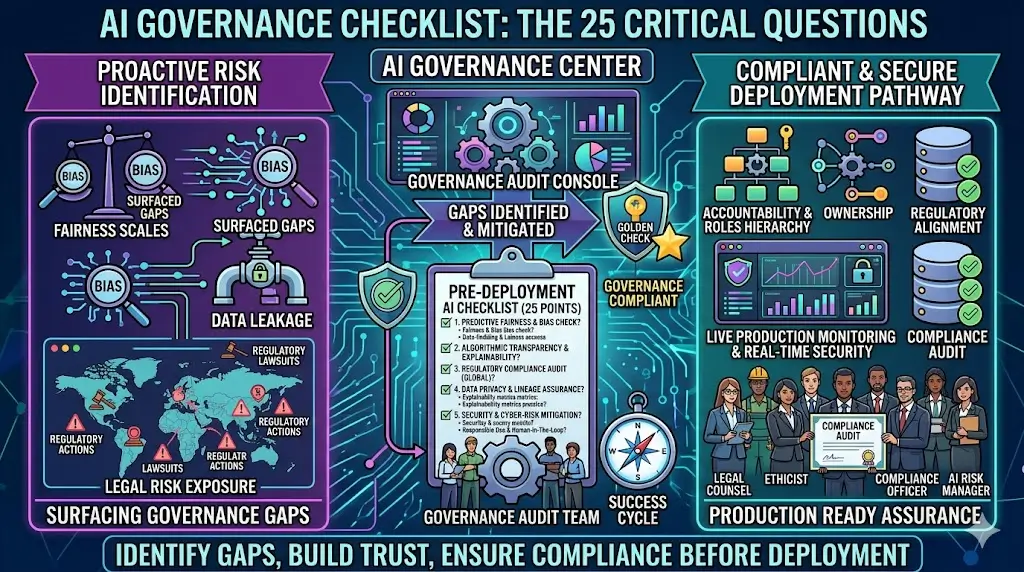
    This checklist is designed as a pre-deployment gate — 25 questions that surface governance gaps before they become regulatory incidents, discrimination lawsuits, or AI failures in production.

    Every governance failure leaves a paper trail. Not in the form of a warning — in the form of an absence. The absence of bias testing documentation. The absence of a named owner for incident response. The absence of monitoring infrastructure. The absence of a human oversight protocol. When regulators investigate an AI incident or plaintiffs’ attorneys conduct discovery in an AI discrimination lawsuit, they’re looking for that absence — and finding it.

    This checklist is designed to surface those absences before they become expensive. Twenty-five specific, binary questions across the five core governance pillars. If you can answer “yes — with documentation” to all twenty-five, your governance program is in strong shape. If you find yourself answering “yes but it’s not documented” or “we haven’t checked,” those are your gaps. If you answer “no,” those are your most urgent priorities.

    Use this checklist: before deploying any new high-risk AI system; as an annual governance review for deployed high-risk AI systems; after significant changes to high-risk AI systems; and as a board or executive reporting tool to assess program status across your full AI portfolio.

    This article is part of our Complete Guide to AI Governance. For framework guidance, see 7 AI Governance Frameworks. For implementation, see How to Build an AI Governance Framework from Scratch.

    How to Use This Checklist

    Each question has three possible answers: ✅ YES (documented) — the control exists and is documented with evidence; ⚠️ YES (undocumented) — the control exists in practice but documentation is absent or incomplete; ❌ NO or UNKNOWN — the control doesn’t exist, or you genuinely don’t know.

    For governance purposes, only the first answer is satisfactory. “Yes but undocumented” is a compliance gap: if you cannot produce evidence of a control’s existence and operation, the control does not exist from a regulatory and litigation perspective. “Unknown” is a governance gap of a different kind — it suggests the AI system is not adequately monitored or documented.

    For each “No” or “Unknown” answer, note: the gap, who should own remediating it, and a realistic target date for remediation. A checklist that produces only a score is less valuable than one that produces an action list.

    Run this checklist per AI system, not across your portfolio as a whole. Governance is system-specific — a “yes” for System A does not mean System B is covered. High-risk AI systems each need their own checklist completion.

    🕑 EU AI Act Note

    For AI systems with EU market exposure, questions where a “No” answer creates direct EU AI Act compliance violations are marked with [EU AI Act]. These should be treated as the highest-priority gaps — they carry regulatory fine exposure, not just governance quality concerns.

    Section A: Accountability (Questions 1–5)

    Accountability questions identify whether clear ownership exists for this AI system’s governance and outcomes. These are the organizational structure questions — without strong accountability, every other section of this checklist will have implementation gaps.

    🛡 Section A: Accountability

    1. Is there a named individual accountable for this AI system’s governance compliance and performance outcomes?
      Not a team or department — a named person who would appear in an enforcement action as the responsible party. Do they have the authority to stop or modify the system if problems arise?
      Governance gap if No: no named owner = no incident response accountability = enforcement/litigation vulnerability [EU AI Act Articles 16–26]
    2. Has this AI system been formally approved for its current use case by an authorized person or governance body?
      Is there a documented record of who approved this deployment, for what purpose, and when? Or was it deployed informally without formal approval?
    3. Is there a documented risk assessment for this AI system covering both technical and sociotechnical risks?
      Does the risk register include failure modes, discrimination risks, over-reliance risks, and misuse scenarios — not just technical bugs? [EU AI Act Article 9]
    4. Does executive leadership receive regular reporting on this AI system’s risk profile and governance status?
      Not a one-time briefing — ongoing reporting. Board-level visibility into AI risk is increasingly an expectation for regulated industry organizations.
    5. Is there a documented incident response process for this AI system specifying who investigates, who communicates externally, and within what timeframe?
      For EU AI Act high-risk AI: serious incident reporting timelines are 15 days (general), 10 days (death involved), 2 days (critical infrastructure) under Article 73. Does this system have a process aligned with those timelines?

    Section B: Transparency (Questions 6–10)

    Transparency questions assess whether affected individuals and regulators can understand how this AI system works and how it influences decisions that affect them.

    👁 Section B: Transparency

    1. Is there comprehensive technical documentation for this AI system covering its design, training data, performance characteristics, and known limitations?
      For EU AI Act high-risk AI: this is the Annex IV technical dossier requirement. For US organizations: this documentation is your primary defense in enforcement inquiries and litigation. [EU AI Act Article 11, Annex IV]
    2. Do deployers of this AI system have adequate Instructions for Use describing its capabilities, limitations, and required oversight measures?
      A deployer who doesn’t understand an AI system’s limitations cannot provide meaningful human oversight. Does the IFU exist, and has it been provided to all deployers? [EU AI Act Article 13]
    3. Are consumers or individuals notified when this AI system influences consequential decisions about them?
      Required by Colorado SB 24-205 for certain deployers. Required under GDPR Article 22 for automated decisions with significant effects. A standard governance expectation regardless of regulatory status.
    4. Can the AI system provide a meaningful explanation of why it produced a specific output for a specific input — at the case level, not just at the population level?
      GDPR Article 22 and EU AI Act Article 14 both require that human reviewers can understand AI outputs well enough to evaluate them. Is this technically possible for your system? Is it operationally available to reviewers?
    5. If this AI system makes or influences decisions about individuals, do those individuals have a documented path to understanding and challenging those decisions?
      Required by Colorado SB 24-205 (human review right), GDPR Article 22 (right to human review for automated decisions), and EU AI Act Article 14 (oversight mechanisms). Does an operational appeals process exist?

    Section C: Fairness (Questions 11–15)

    Fairness questions assess whether this AI system has been tested for bias and discrimination, and whether ongoing monitoring is in place to detect emerging disparate impact.

    ⚖ Section C: Fairness

    1. Was this AI system tested for demographic performance disparities before deployment, with documented disaggregated performance metrics by relevant demographic groups?
      Required by EU AI Act Annex IV Section 4; required under Colorado’s “reasonable care to prevent algorithmic discrimination” standard; expected by EEOC and FTC for employment and credit AI. Is the documentation available? [EU AI Act Annex IV §4]
    2. Were the training and test datasets reviewed for potential sources of historical bias before model training?
      If training data reflects historical discrimination (e.g., historical hiring data from companies with discriminatory practices), the model will learn those patterns. Was this assessed before training? Is it documented? [EU AI Act Annex IV §3]
    3. Was a fairness definition explicitly chosen and documented — and is there reasoning for why that definition was appropriate for this specific use case?
      Multiple valid mathematical fairness definitions exist and can conflict. Which one did you use, and why? The absence of an explicit choice is itself a governance gap — it means fairness wasn’t genuinely evaluated.
    4. Is there ongoing monitoring for emerging demographic performance disparities after deployment?
      A model that was fair at deployment can become biased as population distributions shift, as economic conditions change, or as the model encounters new patterns. Is demographic performance monitored continuously — not just at launch?
    5. If algorithmic discrimination is discovered, is there a documented process for disclosing it to affected parties and regulators within required timeframes?
      Colorado SB 24-205 requires disclosure to the AG within 90 days of discovering algorithmic discrimination. EU AI Act Article 73 requires serious incident reporting. Does a process exist — before an incident, not as an improvisation during one?

    Section D: Security (Questions 16–20)

    Security questions assess whether this AI system has been evaluated for AI-specific attack vectors — not just conventional cybersecurity threats.

    🔒 Section D: Security

    1. Was the training data for this AI system evaluated for potential data poisoning — deliberate corruption to manipulate model behavior?
      Data poisoning is an AI-specific threat that doesn’t have a direct conventional cybersecurity analog. Particularly relevant for models trained on data from external or third-party sources. Was provenance and integrity verified?
    2. Has this AI system been evaluated for adversarial robustness — resistance to inputs specifically crafted to cause misclassification or harmful outputs?
      Required under EU AI Act Article 15 for high-risk AI: “High-risk AI systems shall be resilient with regard to attempts by unauthorised third parties to alter their use, outputs or performance.” Has adversarial testing been conducted? [EU AI Act Article 15]
    3. For AI systems that process external text inputs (especially LLMs or AI agents): has prompt injection been assessed as a security risk, with mitigations in place?
      Prompt injection — manipulating AI system behavior through crafted inputs — is an emerging production security risk particularly for agentic AI. For systems that can take actions, the consequences of successful prompt injection can extend beyond the AI system itself.
    4. Are there controls preventing model inversion — extraction of sensitive training data through repeated model queries?
      Models trained on personal data may be vulnerable to model inversion attacks that reconstruct individual records from the training set. For AI trained on health records, financial data, or other sensitive personal information, has this risk been assessed and mitigated?
    5. Is there behavioral monitoring for the AI system that detects anomalous outputs suggesting adversarial interference or model compromise?
      Beyond conventional system monitoring (uptime, errors), is there monitoring for behavioral anomalies that indicate the model is being manipulated or has been compromised? For high-stakes systems, this is a critical governance control.

    Section E: Privacy (Questions 21–25)

    Privacy questions assess whether personal data is handled responsibly throughout the AI lifecycle — including the AI-specific privacy risks that GDPR compliance alone doesn’t fully address.

    👤 Section E: Privacy

    1. Was a Data Protection Impact Assessment (DPIA) completed for this AI system before deployment, where required by GDPR Article 35?
      Required when AI processing is “likely to result in a high risk to the rights and freedoms of natural persons.” For AI systems that make automated decisions about individuals, this threshold is typically met. Is the DPIA documented and up to date?
    2. For organizations subject to the EU AI Act’s FRIA requirement: has a Fundamental Rights Impact Assessment been completed before deployment?
      Required for public bodies, banks, insurers, and certain other deployers under EU AI Act Article 27 before deploying high-risk AI. Has the FRIA been completed and has the market surveillance authority been notified? [EU AI Act Article 27]
    3. Has the training data been evaluated for AI-specific privacy risks — including inference of sensitive attributes from non-sensitive inputs?
      AI systems can infer sensitive attributes (health conditions, political views, sexual orientation) from combinations of innocuous data. GDPR’s special category protections are hard to apply to inferred attributes. Has this specific risk been assessed?
    4. Are there mechanisms to honor data subject deletion requests (GDPR Article 17) despite data being encoded in model weights?
      Personal data used for AI training can persist in model parameters even after the underlying data is deleted. Is there a machine unlearning process or equivalent mechanism? Has this been legally evaluated for your specific context?
    5. Is there a policy and technical control preventing employees from sending personal data to unauthorized AI tools or services?
      Shadow AI creates GDPR Article 28 violations (unauthorized processing) every time employees send personal data to unapproved AI tools. Is there a shadow AI governance program, DLP controls for AI traffic, and a clear acceptable use policy?

    Scoring and Prioritization

    Count your answers in three categories:

    Answer Type Meaning Priority
    ✅ YES (documented) Control exists and is evidenced — genuinely compliant Maintain: schedule for annual review
    ⚠️ YES (undocumented) Control may exist in practice but cannot be proven — governance gap High priority: create documentation within 30 days
    ❌ NO or UNKNOWN Control doesn’t exist or you don’t know — regulatory and liability exposure Immediate action: assign owner and remediation timeline

    For prioritization among your “No” answers: EU AI Act [marked] questions first — these carry regulatory fine exposure. Then Section A (Accountability) questions — these are structural foundations without which other controls cannot function. Then Section C (Fairness) — because bias and discrimination create simultaneous regulatory, civil rights litigation, and reputational exposure. Then Section E (Privacy) — for GDPR and shadow AI exposure. Then Sections B and D.

    Interpretation by score range:
    20–25 documented Yes: Strong governance posture — maintain cadence and monitor for changes.
    15–19 documented Yes: Functional governance with specific gaps — prioritize remediation of No answers.
    10–14 documented Yes: Significant governance gaps — build a structured remediation program.
    Under 10 documented Yes: Governance program urgently needed — this AI system has serious unmitigated risk exposure.

    Use our complete How to Build an AI Governance Framework guide to address the gaps this checklist surfaces. For framework selection to structure your remediation, see 7 AI Governance Frameworks You Should Know in 2026.

    Frequently Asked Questions

    What should an AI governance checklist include?

    Five areas: accountability, transparency, fairness, security, and privacy. These correspond to the five core pillars of AI governance that appear consistently across NIST AI RMF, ISO 42001, the EU AI Act, and the OECD AI Principles. Each area should include questions about both whether controls exist and whether they are documented — because undocumented controls provide no regulatory protection. For organizations with EU market exposure, add EU AI Act-specific questions around Annex IV documentation, FRIA completion, and Article 73 incident response timelines. For a deeper treatment of each pillar, see our 5 Core Pillars of AI Governance guide.

    How do you assess AI governance maturity?

    Across five dimensions: inventory, risk classification, control coverage, monitoring, and accountability. A mature governance program can answer “yes, with documentation” to: Do you know all AI systems in use (including shadow AI)? Are all AI systems classified by risk level? Do high-risk systems have documented risk assessments, bias testing, human oversight, and monitoring? Are deployed systems continuously monitored for performance and bias? Is there named ownership for each system and a cross-functional governance board with real decision authority? Organizations that score “yes” across all five have mature governance; gaps in any of the five indicate specific program investment needs.

    When should an AI governance checklist be completed?

    Three occasions: pre-deployment, annually, and after significant changes. Running this checklist only at initial deployment misses the governance problem that matters most in practice: deployed AI systems that drift from their documented governance specifications over time. Annual reviews for all high-risk AI systems catch performance degradation, emerging bias issues, and governance processes that have become outdated as the system evolved. After any significant change — new training data, changed purpose, architectural update — re-run the checklist before redeployment.

    Address your checklist gaps:

    📚 References and Sources

    1. EU AI Act, Regulation (EU) 2024/1689. Articles 9, 11, 13, 14, 15, 27, 47, 72, 73; Annex IV. All EU AI Act-marked questions reference specific articles. eur-lex.europa.eu
    2. NIST AI RMF 1.0, January 2023. GOVERN-MAP-MEASURE-MANAGE functions; suggested actions across the AI lifecycle. Fairness, accountability, transparency, security, privacy as characteristics of trustworthy AI. nist.gov
    3. Colorado SB 24-205, effective June 30, 2026. 90-day discrimination disclosure obligation; impact assessment requirements; safe harbor via NIST AI RMF. leg.colorado.gov
    4. GDPR, Regulation (EU) 2016/679. Articles 17 (deletion right), 22 (automated decision-making), 28 (processor agreements), 35 (DPIA requirement). eur-lex.europa.eu
    5. SecurePrivacy, “AI Governance: Enterprise Compliance & Risk Management Guide 2026.” Five pillar framework; regulatory mapping for each pillar; 99% of organizations have experienced AI-related losses averaging $4.4 million. secureprivacy.ai

    Sources verified March 2026. This checklist does not constitute legal advice. Consult qualified legal counsel for jurisdiction-specific compliance assessment.

  • AI Governance for Enterprise: How to Move from Policy to Operational Readiness (2026)

    AI Governance for Enterprise: How to Move from Policy to Operational Readiness (2026)

    AI Governance for Enterprise – Moving from Policy to Operational Readiness 2026
    By 2026, enterprise AI governance has crossed a critical threshold: the organizations that win are not those with the best ethics policies — they are those whose governance actually runs in production, continuously, with audit-ready evidence.
    📅 Last Reviewed: June 21, 2026. This update incorporates two major developments since original publication: CAIO adoption nearly tripled (26% → 76%, IBM IBV, May 2026), and the EU AI Act’s high-risk system deadline was postponed 16 months (August 2026 → December 2027) following the May 7, 2026 Digital Omnibus agreement. All statistics verified against named primary sources below.

    📌 Key Takeaways

    • CAIO adoption nearly tripled in twelve months — from 26% of organizations (IBM IBV, 2025) to 76% (IBM CEO Study, May 2026, 2,000 CEOs across 33 countries) — making named AI executive accountability the norm, not the exception, in 2026.
    • The EU AI Act’s high-risk system deadline was postponed by 16 months following a May 7, 2026 political agreement: Annex III obligations now apply December 2, 2027 (not August 2, 2026), and Annex I obligations apply August 2, 2028. Prohibited practices and GPAI obligations remain unaffected and already in force.
    • The gap between AI policy and AI governance — not a knowledge gap but an execution gap — is where most enterprise AI risk lives. Five specific gaps separate policy-level from operational governance: inventory completeness, accountability specificity, infrastructure-embedded controls, continuous evidence generation, and scalability.
    • ModelOp reports enterprises can establish minimum viable governance frameworks in under 90 days; full operational maturity across a complete AI portfolio typically takes 12-18 months.
    • Organizations with a CAIO see generative AI prototypes reach production at a 44% success rate versus 36% without dedicated AI leadership — and report nearly double the longevity for AI systems that stay in production beyond three years.

    Twenty enterprise data and AI leaders walked into a private dinner organized by Ethyca in late 2025. What they said — off-record, frank, and consistent enough to be pattern, not anecdote — was this: their AI governance programs had stopped at policy.[1] The policies were written, reviewed, and approved. The ethics principles were articulated. The responsible AI framework was posted on the intranet. And the actual AI systems in production? Running without the controls those policies described. No one had operationalized the policy.

    This is the defining challenge of enterprise AI governance in 2026. It is not a knowledge problem — organizations understand, broadly, what good AI governance requires. It is an execution problem. The gap between what governance documents say and what governance systems do is where most enterprise AI risk actually lives.

    “A PDF, an ethics committee, or a model card doesn’t enforce anything in production. AI governance only works when it governs the real operating surface — the infrastructure where data flows, decisions are made, and risk actually lives.”

    — Ethyca, AI Governance: Framework, Compliance & Operational Guide, 2026[1]

    💬 According to EverydayOnAI

    The Ethyca dinner anecdote captures something we see repeatedly across enterprise AI governance content: the gap isn’t between organizations that “get it” and organizations that don’t. It’s between organizations whose governance lives in a document and organizations whose governance lives in their deployment pipeline. Both groups can sound identical in a board presentation. The difference only becomes visible when something goes wrong — and by then it’s a much more expensive problem to discover. This guide is built around that diagnostic distinction throughout: not “do you have a policy” but “what actually happens at 2 AM when a system misbehaves.”

    This guide is a BoFu resource for enterprise leaders who have moved past “should we do AI governance?” and are now grappling with “how do we actually make it work at scale?” It covers the organizational structures that make governance operational, the technical infrastructure that makes it continuous, the metrics that make it measurable, and the specific implementation challenges that distinguish enterprise-scale governance from project-level governance.

    Throughout this guide, you’ll find links to our dedicated deep-dives on each major implementation topic. This is the enterprise implementation hub.

    Policy vs. Operational: The Gap That Kills Enterprise AI Programs

    Every enterprise that has attempted AI governance has a policy. Almost none has fully operationalized it. Understanding the precise gap between these two states is the starting point for fixing it.

    A policy-level AI governance program has: a responsible AI policy document, an AI ethics statement, perhaps an AI risk classification framework, and possibly an AI governance committee that meets periodically. It has human beings discussing principles and reviewing proposals. What it typically does not have is the technical infrastructure to enforce those principles at the point where AI systems actually operate — in production, at scale, continuously.

    The diagnostic question is specific: if a high-risk AI system in your portfolio exhibits unexpected bias drift at 2 AM on a Sunday, what happens? Does an automated alert trigger? Does a named on-call owner receive it? Is there a documented escalation path? Can the system be paused automatically if the drift crosses a defined threshold? If the answer to any of those is “probably not” or “I’d have to check,” you have policy-level governance, not operational governance.

    “A useful AI governance framework is operational. It defines what systems exist, who owns them, what risks they create, what controls apply, and what evidence is available for oversight.”

    — IE Business School, “Responsible AI Governance in 2026: Frameworks and Failures”[2]

    The Five Dimensions of Operational Readiness

    Moving from policy to operational requires closing five specific gaps.

    Gap 1: Inventory completeness. Policy-level governance often assumes the AI inventory is known. Operational governance discovers it. Most enterprises have 2-5x more AI systems in production than their governance programs account for — including AI capabilities embedded in approved SaaS tools, AI modules used by third-party vendors, and “shadow AI” adopted by employees without formal approval. Operational governance starts with a complete, continuously updated AI register, not with the AI systems leadership knows about.

    Gap 2: Accountability specificity. Policy-level governance assigns accountability to functions (“legal and compliance will own AI governance”). Operational governance assigns it to named individuals with documented decision rights, system-level ownership, and consequences for non-compliance. The difference is measurable: when something goes wrong with a specific AI system, can you name the person responsible for the response within thirty seconds? If not, accountability is functional, not operational.

    Gap 3: Controls in the infrastructure, not in the policy document. Policy-level governance describes what controls should exist. Operational governance embeds controls in the development pipeline, the deployment infrastructure, and the production monitoring system. A bias testing requirement in a policy document that no one runs against code before deployment is not a control — it is a policy statement. A bias test that is a required gate in the CI/CD pipeline that fails the build if fairness thresholds are not met is a control.

    Gap 4: Continuous evidence generation. Policy-level governance produces documentation in response to audits. Operational governance produces audit-ready evidence continuously, as a byproduct of normal system operation. The distinction matters most when something goes wrong: organizations with operational governance can reconstruct exactly what was happening with a specific AI system at a specific time. Organizations with policy-level governance cannot.

    Gap 5: Governance that scales with the AI portfolio. Policy-level governance breaks as the AI portfolio grows — the same committee that could review five AI systems cannot review fifty. Operational governance is designed from the start to scale: automated controls handle routine governance tasks, human review focuses on exceptions and high-risk cases, and monitoring infrastructure covers the full portfolio without requiring linear staffing increases.

    Split comparison diagram showing policy-level governance as static documents versus operational governance as a live, automated monitoring system
    The five gaps compound: inventory, accountability, controls, evidence, and scalability all need to close together — closing one in isolation rarely produces operational readiness.
    Dimension Policy-Level Governance Operational Governance
    AI Inventory Known AI systems, informally tracked Complete register, continuously updated, including shadow AI
    Accountability Assigned to functions; unclear for incidents Named individuals per system; documented decision rights
    Controls Described in policy; manually applied Embedded in pipeline and infrastructure; automated enforcement
    Evidence Compiled reactively for audits Generated continuously; audit-ready at all times
    Monitoring Periodic review; manual reports Continuous automated monitoring with defined alerting thresholds
    Scalability Breaks as portfolio grows Designed to scale; automated for routine, human for exceptions
    Regulatory defense Policy statements and intentions Documented evidence of controls operating as designed

    📋 Section Summary

    • The defining failure mode of enterprise AI governance is stopping at policy — written principles with no infrastructure to enforce them in production.
    • Five specific gaps separate policy-level from operational governance: inventory completeness, accountability specificity, infrastructure-embedded controls, continuous evidence generation, and scalability design.
    • The diagnostic test is concrete: can you name the accountable person for a specific AI incident within thirty seconds, and can your system demonstrate automated response capability? If not, governance is policy-level regardless of how comprehensive the written policy is.

    The Organizational Structure: CAIO, Committee, and System Owners

    Operational governance requires a specific organizational architecture that policy-level governance typically lacks: a three-tier structure with clear decision rights at each level.

    Tier 1: Executive Ownership — The CAIO Function

    The Chief AI Officer is the executive responsible for enterprise AI strategy, governance, and implementation — translating AI capabilities into measurable business outcomes while maintaining accountability for risk and regulatory compliance.[3] This is the single fastest-moving data point in enterprise AI governance: as of an IBM Institute for Business Value CEO study covering 2,000 CEOs across 33 countries (May 2026), 76% of organizations globally now have a CAIO — up from just 26% a year earlier.[4] Among FTSE 100 companies specifically, nearly 48% have a CAIO or functional equivalent.[9]

    76%

    of organizations globally now have a CAIO (May 2026), up from 26% one year prior[4]

    44% vs 36%

    generative AI prototype-to-production success rate with vs. without a CAIO[10]

    91%

    of high-maturity organizations have a dedicated AI leader or centralized AI office[10]

    28% vs 13%

    report direct revenue growth from AI, with vs. without dedicated AI leadership[10]

    According to IESE Business School, the CAIO carries three critical functions: technological oversight (AI infrastructure, model performance, deployment readiness), ethical governance (transparency, fairness, and bias guardrails), and organizational transformation (evangelizing AI adoption and training teams across the organization).[5] The transformational dimension — building the organizational culture that makes governance self-sustaining — is consistently the most underestimated and the most determinative of long-term success.

    What distinguishes the CAIO from the CTO, CIO, or CDO is breadth of mandate. The CTO builds platforms. The CIO manages infrastructure. The CDO ensures data quality. The CAIO sits across all three, owning the strategic and ethical vision for how AI creates value and manages risk organization-wide — without being subordinate to any of those individual functions’ priorities.[5]

    💬 According to EverydayOnAI

    The jump from 26% to 76% CAIO adoption in twelve months is one of the fastest executive-role institutionalization curves we’ve seen documented. It’s worth reading skeptically as well as descriptively: a title appearing on an org chart is not the same as the operational accountability this guide is built around. Some of that 76% almost certainly reflects relabeling — a CTO or Chief Data Officer absorbing “AI” into an existing title without a meaningful change in mandate or resources. The useful question isn’t “do you have someone with CAIO in their title” but “does that person have genuine authority to pause a deployment, and a budget line to act on it.” The data on production success rates (44% vs 36%) suggests the accountability effect is real even amid the relabeling — but it’s the accountability, not the title, doing the work.

    For a comprehensive treatment of the CAIO role — responsibilities, metrics, reporting structures, and how to determine whether your organization needs one — see our dedicated guide: What Does a Chief AI Officer Actually Do?

    Tier 2: Cross-Functional Governance — The AI Governance Committee

    Below the CAIO function, operational governance requires a cross-functional AI governance committee with genuine decision authority — not an advisory body, but an operational governance body that approves AI deployments, adjudicates risk classification disputes, reviews incident reports, and sets governance standards.

    Effective committees share four structural traits: cross-functional membership spanning legal, technical, business, and risk functions; defined decision rights with documented escalation thresholds (which decisions the committee makes directly vs. which it delegates); a standing cadence separate from ad hoc crisis review; and a charter that specifies what happens when the committee is bypassed — because committees without enforcement teeth become rubber stamps under deadline pressure.

    For a complete operational design guide to the AI governance committee — charter templates, decision rights frameworks, and meeting cadence models — see: How to Build an Effective AI Governance Committee.

    Tier 3: System-Level Ownership

    The tier most frequently missing entirely. Every AI system in the portfolio needs a named individual owner — not a team, not a function, a person — accountable for that system’s risk posture, monitoring response, and incident escalation. System owners are the operational layer that makes Tier 1 and Tier 2 governance enforceable at the point where AI actually runs.

    📋 Section Summary

    • CAIO adoption jumped from 26% to 76% of organizations globally in twelve months (IBM IBV, May 2026) — named AI executive accountability has become the institutional norm faster than almost any prior C-suite role.
    • The three-tier structure (CAIO, cross-functional governance committee, system-level owners) provides decision rights at strategic, cross-functional, and operational levels respectively — all three tiers are necessary; none substitutes for the others.
    • Organizations with dedicated AI leadership show measurably better outcomes: 44% vs 36% production success rate, and 28% vs 13% reporting direct revenue growth from AI — though the title itself matters less than the genuine authority and resources behind it.

    The Technical Infrastructure of Operational Governance

    Organizational structure alone does not produce operational governance — it requires technical infrastructure that makes governance continuous rather than periodic. Four components form the technical backbone.

    Component 1: The AI System Registry

    The foundational technical artifact: a complete, continuously updated inventory of every AI system in production, including risk classification, system owner, data sources, model lineage, and deployment status. Unlike a one-time inventory exercise, an operational registry integrates with deployment pipelines so new systems are captured automatically rather than discovered during the next audit cycle.

    Component 2: Automated Bias and Performance Monitoring

    Bias monitoring that runs only at deployment is policy-level governance. Operational governance requires continuous automated monitoring that detects performance degradation, demographic disparate impact, and behavioral drift in production — and routes alerts to accountable owners within defined timeframes.

    The technical requirements: baseline performance metrics (accuracy, error rates, false positive/negative rates disaggregated by demographic group) captured at deployment; continuous comparison of production metrics against baseline with statistical significance testing; alerting infrastructure that routes anomaly notifications to system owners with enough context to assess severity; and a documented threshold framework that defines what level of performance deviation requires immediate escalation vs. review at the next governance cycle.

    Component 3: Governance-as-Code in the Development Pipeline

    The most durable technical governance infrastructure embeds governance checkpoints into the development and deployment pipeline as automated code gates — analogous to security scanning in DevSecOps. A model card requirement that blocks deployment if not completed. A bias test that fails the build if demographic performance gaps exceed defined thresholds. A risk classification check in the deployment workflow that routes high-risk systems to governance committee review before production approval.

    When governance is infrastructure rather than process, it applies consistently regardless of deadline pressure, personnel changes, or organizational growth. The organizations that achieve genuine operational readiness are consistently those that treat governance as an engineering problem — not just a legal and compliance problem.

    Component 4: Automated Evidence and Audit Trail

    Regulators and auditors don’t accept governance descriptions — they ask for evidence. Operational governance generates that evidence continuously as a byproduct of system operation: timestamped logs of AI decisions, records of governance review approvals, bias test results with dates and methodologies, monitoring alert history and response records, and change control documentation for model updates. This evidence infrastructure means that an audit response that previously took weeks of manual compilation can be produced in hours or days.

    For a survey of the specific tools and platforms that provide these technical capabilities — model registries, bias monitoring, governance-as-code, and audit trail infrastructure — see our dedicated guide: Top 8 AI Governance Tools and Platforms to Watch in 2026-2027.

    📋 Section Summary

    • Four technical components make governance operational rather than periodic: an automatically-updated AI system registry, continuous bias/performance monitoring with defined alert thresholds, governance-as-code gates embedded in CI/CD pipelines, and automated audit-ready evidence generation.
    • The common thread across all four: governance treated as engineering infrastructure, not as a legal/compliance process layered on top of unchanged technical systems.
    • Evidence generation as a continuous byproduct (vs. reactive audit compilation) is the component that most directly determines audit response time — from weeks down to hours or days.

    AI Governance Maturity: Four Stages Every Enterprise Passes Through

    Enterprise AI governance programs develop in recognizable stages. Understanding where your organization sits on the maturity curve helps prioritize investment and calibrate expectations about what “good enough” looks like at each stage.

    Four-stage AI governance maturity diagram from Ad Hoc through Policy-Level, Operationalizing, to Mature/Continuous governance

    Most enterprise governance programs stall at Stage 2 — because writing policy feels like completed work, while operationalizing it is unglamorous and resource-intensive.

    Stage 1: Ad Hoc Governance

    AI systems are deployed without formal governance structures. No AI inventory exists. Risk assessment is informal or absent. Accountability for AI outcomes is undefined. This stage is not “evil” — it’s where nearly every organization starts, and where many organizations remain for longer than they realize. The primary risk at Stage 1 is that AI systems are accumulating governance debt: the longer they run without documentation, monitoring, and defined ownership, the harder and more expensive the remediation becomes.

    Stage 2: Policy-Level Governance

    The organization has AI policies, an ethics statement, and possibly a governance committee. Documentation exists for some AI systems. Bias testing may occur informally. The primary gap: policies are not consistently enforced in production. This is where most enterprise governance programs stall — because the work of writing policies feels complete, while the work of operationalizing them is unglamorous, resource-intensive, and doesn’t produce a deliverable that looks impressive in a board presentation.

    Stage 3: Operationalizing Governance

    The organization is actively closing the gap between policy and operations. An AI inventory is being built and maintained. Named system owners are being assigned. Technical controls are being embedded in development pipelines. Monitoring infrastructure is being deployed. This stage is characterized by significant organizational friction — governance requirements impose new overhead on development teams, procurement processes, and vendor relationships. The friction is necessary and productive: it means governance is real enough to be encountered as an obstacle, not just an aspiration.

    Stage 4: Mature/Continuous Governance

    Governance is operational, continuous, and embedded in organizational culture. The AI inventory is complete and maintained automatically. Controls run in the pipeline without manual intervention. Monitoring covers the full portfolio with automated alerting. Evidence is generated as a byproduct of operations. The governance committee focuses on novel risk scenarios and strategic governance questions, not routine oversight. This stage is achievable in 12-18 months with dedicated resources; it requires ongoing investment to maintain.

    Stage Inventory Accountability Controls Monitoring Evidence
    1: Ad Hoc None or informal Undefined None None None
    2: Policy-Level Partial, manual Functional, not named Documented; inconsistently applied Periodic manual review Compiled reactively
    3: Operationalizing Building toward complete Named; decision rights in progress Embedded for priority systems Automated for priority systems Semi-automated
    4: Mature Complete; auto-maintained Named; documented; enforced Embedded across full portfolio Continuous; automated alerts Continuous; audit-ready

    📋 Section Summary

    • Four maturity stages — Ad Hoc, Policy-Level, Operationalizing, Mature/Continuous — describe a recognizable, sequential path most enterprises follow.
    • Stage 2 (Policy-Level) is where most programs stall, because policy completion feels like progress while operational work is harder to demonstrate to a board.
    • Stage 3 friction (new overhead on development, procurement, vendor processes) is a healthy sign, not a problem to avoid — it indicates governance has become real enough to be an obstacle rather than an aspiration.

    Tool: Governance Maturity Self-Assessment

    Answer based on your organization’s current state across the five operational readiness dimensions from Section 1, mapped against the four maturity stages above.

    🎯 Interactive Tool

    AI Governance Maturity Self-Assessment

    Five quick questions covering the five operational readiness dimensions. Answer based on your organization’s current state — not your target state.

    1. AI Inventory


    2. Accountability


    3. Technical Controls


    4. Monitoring & Evidence


    5. Scalability


    0

    This is a directional self-assessment, not a formal governance audit. Scores are illustrative — actual operational readiness depends on factors specific to your AI portfolio, industry, and regulatory exposure.

    Regulatory Alignment at Enterprise Scale

    Enterprise AI governance must navigate multiple regulatory frameworks simultaneously — not sequentially. The EU AI Act, Colorado’s AI Act, the NAIC Model Bulletin, NYC Local Law 144, and sector-specific requirements in healthcare, financial services, and government all apply to different subsets of an enterprise’s AI portfolio. Building separate compliance programs for each is both inefficient and unsustainable at enterprise scale.

    💬 According to EverydayOnAI

    This section required a significant update since original publication. On May 7, 2026, EU lawmakers reached a political agreement that postpones the EU AI Act’s high-risk system deadline by 16 months. If your organization built an implementation plan around the original August 2, 2026 deadline, that plan now has substantially more runway — but the right response is to use that runway for more thorough implementation, not to deprioritize the work. Regulatory delays of this kind are common during major legislative rollouts; treat the extension as risk-adjusted breathing room, not as evidence the requirements are going away.

    The operational solution is a unified compliance infrastructure that maps a single set of governance controls to multiple regulatory requirements. Databricks describes this as integrating governance with operational systems to provide “consistency and scalability” — a single data lineage and access control infrastructure that satisfies GDPR, EU AI Act Annex IV, and Colorado’s impact assessment requirements simultaneously, rather than maintaining three separate compliance programs.[6]

    What Changed: The EU AI Act’s New 2027/2028 Timeline

    On May 7, 2026, the Council of the European Union and European Parliament reached a provisional political agreement on the “Digital Omnibus on AI” — the first substantive amendment package to the AI Act since its 2024 adoption.[11] The most consequential change: high-risk AI system obligations are postponed by 16 months for stand-alone Annex III systems — from August 2, 2026 to December 2, 2027 — covering use cases like employment, biometrics, credit scoring, education, law enforcement, and border control.[12] AI embedded in regulated products under Annex I — medical devices, machinery, vehicles — now has until August 2, 2028, a 12-month extension from the original August 2027 date.[12]

    Critically, not everything moved. Prohibited AI practices under Article 5 — social scoring, subliminal manipulation, real-time biometric identification in public spaces — have been enforceable since February 2, 2025 and remain unaffected.[13] GPAI model provider obligations, in effect since August 2, 2025, are also unchanged. A new prohibition targeting AI-generated non-consensual intimate imagery and CSAM (“nudifier” applications) was added to Article 5, taking effect December 2, 2026.[13]

    Dec 2, 2027

    new deadline for Annex III high-risk AI systems — was August 2, 2026[12]

    Aug 2, 2028

    new deadline for Annex I product-embedded high-risk AI — was August 2027[12]

    €35M

    or 7% of global turnover — maximum fine, unaffected by the delay[14]

    Feb 2, 2025

    prohibited practices already enforceable — not affected by the omnibus delay[13]

    The key regulatory intersections enterprise organizations must map in 2026, updated for the new timeline:

    Regulation Scope Deadline (Updated) Key Enterprise Obligation
    EU AI Act — Annex III (high-risk, use-based) Employment, biometrics, credit, education, law enforcement December 2, 2027 (was Aug 2026) Risk management, Annex IV documentation, conformity assessment, human oversight
    EU AI Act — Annex I (product-embedded) Medical devices, machinery, vehicles August 2, 2028 (was Aug 2027) Conformity assessment via existing product safety regimes
    EU AI Act — Prohibited Practices & GPAI All AI serving EU residents In effect since Feb/Aug 2025 No change — already enforceable
    Colorado SB 24-205 High-risk AI affecting Colorado residents June 30, 2026 Risk management program, annual impact assessments, consumer notification
    NAIC Model Bulletin AI in insurance (24 US states) In effect Documented governance, bias controls, audit-ready decision logs
    NYC Local Law 144 Automated hiring tools in NYC In effect Annual independent bias audit; published results
    OMB M-24-10 US federal agencies December 2024 (passed) NIST AI RMF-aligned governance; CAIO designation

    For a detailed comparison of NIST AI RMF and ISO 42001 — the two foundational frameworks that enterprise governance programs typically use to structure their multi-regulatory compliance programs — see: ISO/IEC 42001 vs. NIST AI RMF: Which Standard Is Right for Your Organization?

    📋 Section Summary

    • The May 7, 2026 EU AI Act Digital Omnibus agreement postponed high-risk system obligations by 16 months: Annex III to December 2, 2027, Annex I to August 2, 2028 — but prohibited practices and GPAI obligations remain unaffected and already enforceable.
    • Multiple US frameworks (Colorado SB 24-205, NAIC Model Bulletin, NYC Local Law 144) operate on independent timelines from the EU AI Act, requiring a unified compliance infrastructure rather than parallel single-regulation programs.
    • The extended EU timeline should be used for more thorough implementation, not deprioritization — the underlying compliance work (risk management, documentation, conformity assessment) is unchanged in substance, only in urgency.

    Governance Metrics: What to Measure and Report

    If you can’t measure it, you can’t manage it — and you can’t report it to your board. Enterprise AI governance requires a metrics framework that is both operationally meaningful and board-reportable.

    “With 81% of data and AI leaders now prioritizing investments accelerating AI capabilities, the compliance burden is growing alongside the AI footprint.”

    — IBM Newsroom, cited in Agility at Scale CAIO analysis[5]

    Based on CAIO performance frameworks and Gartner research, operational AI governance should be measured across five categories.

    Coverage metrics measure how much of your AI portfolio is actually governed: percentage of AI systems with complete governance documentation, percentage with active monitoring, percentage with named system owners. A portfolio coverage score below 80% indicates governance gaps are systemic, not isolated.

    Risk metrics quantify how effectively governance manages AI-specific threats: percentage of AI systems that have undergone formal risk assessment within the required cadence, count of unresolved high-risk governance findings (trending upward signals governance capacity problems), and average time from risk discovery to resolution.[5]

    Operational metrics track whether the governance machinery itself is functioning: time from AI system deployment request to governance approval (too slow signals bottleneck risk; too fast signals rubber-stamping), percentage of governance reviews completed within SLA, and audit response time — the clearest single proxy for whether evidence generation is continuous or reactive.

    Adoption metrics measure whether governance has organizational buy-in beyond mandate: voluntary governance committee consultation rate (teams seeking review before being required to), training completion rates, and self-reported AI system disclosure rate.

    Board-level metrics compress the above into the handful of numbers a board actually needs: total AI portfolio size and risk distribution, governance coverage percentage, open high-risk findings count, and regulatory compliance status by jurisdiction. The discipline here is restraint — a board metrics dashboard with thirty data points fails the same way an unreadable policy document does.

    Before & After: Policy-Level vs. Operational Governance in Practice

    Three concrete scenarios illustrating the gap from Section 1 — the same underlying situation handled by policy-level governance versus operational governance.

    ✖ Policy-Level: Bias Drift Incident

    A hiring AI’s demographic performance gap widens over three months. No automated monitoring exists. The drift is discovered during a routine quarterly review — three months after it began, after an unknown number of affected hiring decisions.

    ✔ Operational: Bias Drift Incident

    Continuous monitoring detects the same drift within 48 hours of crossing the defined statistical threshold. An automated alert routes to the named system owner with disaggregated performance data attached. The system is flagged for review before further deployment, per a pre-documented escalation path.

    ✖ Policy-Level: Regulator Audit Request

    A regulator requests documentation of risk management practices for a high-risk AI system. The compliance team spends three weeks manually reconstructing decision logs, locating model documentation across multiple teams, and assembling evidence that may have gaps for periods when informal processes were followed.

    ✔ Operational: Regulator Audit Request

    The same request is answered in two days. Timestamped decision logs, governance approval records, and monitoring history already exist as a continuous byproduct of system operation. The compliance team’s role shifts from evidence reconstruction to evidence packaging.

    ✖ Policy-Level: New AI Vendor Tool

    A business unit adopts a new SaaS tool with embedded AI features without formal review — the tool wasn’t flagged as “an AI system” by procurement, and no one in governance is aware it exists until it surfaces during the next informal inventory discussion, months later.

    ✔ Operational: New AI Vendor Tool

    Procurement workflow includes an automated AI-feature flag that routes any tool with embedded AI capabilities to governance review before contract signature. The system enters the AI registry at onboarding, with risk classification assigned before production use begins.

    Enterprise-Specific Challenges and How to Solve Them

    Three challenges distinguish enterprise-scale governance from project-level governance, each requiring a structural rather than tactical response.

    Challenge 1: Shadow AI at Scale

    The larger the enterprise, the larger the gap between known and actual AI usage — embedded AI in approved SaaS tools, vendor AI capabilities, and employee-adopted tools all accumulate faster than manual discovery can track. The structural fix is procurement-integrated discovery (per the Before/After example above) combined with periodic technical scanning of network traffic and SaaS usage logs for AI API signatures.

    Challenge 2: Multi-Jurisdictional Conflict

    An AI system compliant with the EU AI Act may face different obligations under Colorado SB 24-205 or NAIC Model Bulletin requirements for the same underlying functionality. The structural fix, per Section 6, is unified compliance infrastructure mapping a single control set to multiple regulatory requirements — not parallel single-jurisdiction programs that multiply maintenance overhead.

    Challenge 3: Agentic AI and Autonomous Action

    Traditional AI governance frameworks assume a human reviews AI outputs before action is taken. Agentic AI systems that take autonomous action — executing transactions, modifying records, communicating externally — break this assumption, and most existing governance frameworks have no native answer for graduated autonomy controls, action audit trails, or agent identity verification.

    For a complete operational playbook for this emerging challenge, see: How to Govern Agentic AI Systems: A Practical Playbook for 2026.

    The 90-Day Operational Readiness Checklist

    A minimum viable governance program for your highest-risk AI systems, achievable in 90 days per ModelOp’s implementation methodology.[8]

    ✓ Days 1-30: Foundation

    • ★ Identify and document your 5-10 highest-risk AI systems (start here, not with the full portfolio)
    • ★ Assign a named individual owner to each priority system
    • Establish the AI governance committee charter with documented decision rights
    • Designate executive accountability — CAIO or equivalent — even if not yet a dedicated full-time role

    ✓ Days 31-60: Controls

    • ★ Embed at least one technical control (bias test, model card requirement) as a pipeline gate for priority systems
    • Establish baseline performance metrics for priority systems, disaggregated by demographic group where applicable
    • Document the escalation path: who is notified, within what timeframe, for what severity of finding
    • Map priority systems against applicable regulatory frameworks (EU AI Act, Colorado, NAIC, sector-specific)

    ✓ Days 61-90: Evidence & Scale Planning

    • ★ Implement automated logging for priority system decisions and governance actions
    • Run a tabletop incident response exercise for at least one priority system
    • Document the roadmap for extending priority-system controls to the full AI portfolio
    • Establish board-level reporting cadence using the five metric categories from Section 7

    The Enterprise AI Governance Implementation Series

    📚 Go Deeper: The Enterprise Implementation Series

    Frequently Asked Questions

    What is enterprise AI governance?

    Enterprise AI governance is the operating framework that applies consistent AI risk management controls across a growing portfolio of AI systems, multiple business units, and multiple regulatory jurisdictions simultaneously. The enterprise distinction is scale and complexity: where project-level governance manages one AI system, enterprise governance manages dozens or hundreds, with automated controls to maintain consistency without linear staffing growth. For foundational concepts, see our Complete Guide to AI Governance.

    What is the difference between AI policy and AI governance?

    Policy defines rules; governance operationalizes them. Policy documents describe what should happen. Governance infrastructure — technical controls, monitoring systems, audit trails, accountability structures — ensures it actually happens in production, continuously. The operational gap between a responsible AI policy and actual AI governance is where most enterprise AI risk lives. Organizations that conflate the two are generating compliance theater, not compliance protection.

    How long does it take to achieve enterprise AI governance operational readiness?

    90 days for minimum viable governance on priority systems; 12-18 months for full portfolio operational readiness. ModelOp reports that enterprises can establish governance frameworks in under 90 days with the right methodology. Full maturity — automated controls across the full portfolio, continuous monitoring, ISO 42001 certification readiness — requires sustained investment over 12-18 months. The critical error is waiting for full maturity before starting: the 90-day minimum viable program reduces risk on your highest-priority systems while the broader program is built.

    Do you need a Chief AI Officer to have enterprise AI governance?

    Not strictly — but you need named executive accountability, regardless of title. CAIO adoption has accelerated sharply: 76% of organizations globally now have a CAIO as of May 2026, up from 26% just a year earlier.[4] Organizations with dedicated AI leadership see measurably better production success rates and revenue outcomes. But the accountability is what matters, not the title. For a full analysis of the CAIO role and when to create it vs. embed governance in existing executive functions, see: What Does a Chief AI Officer Actually Do?

    What does operational AI governance look like in practice?

    Five visible markers: complete AI inventory, named system-level accountability, controls in the infrastructure (not just the policy), continuous automated monitoring, and automatically generated audit-ready evidence. Any enterprise that meets all five has operational governance. Any enterprise that can describe two or three of these but not produce documentation for the others has governance gaps. The checklist for assessing your specific gaps is in our AI Governance Checklist: 25 Questions.

    Did the EU AI Act high-risk deadline change in 2026?

    Yes, significantly. On May 7, 2026, EU lawmakers reached a provisional political agreement (the “Digital Omnibus on AI”) that postpones high-risk AI system obligations by 16 months — from August 2, 2026 to December 2, 2027 for stand-alone Annex III systems, and to August 2, 2028 for AI embedded in regulated products under Annex I.[12] Prohibited AI practices (Article 5) and GPAI model obligations remain unaffected and are already in force. Organizations should treat the extended timeline as additional preparation time, not as a reason to deprioritize compliance work already underway.

    📚 References and Sources

    1. Ethyca, “AI Governance: Framework, Compliance & Operational Guide 2026.” Private dinner with 20 enterprise data and AI leaders; governance stops at policy layer; operational governance definition; 80% AI project failure rate. ethyca.com
    2. IE Business School, “Responsible AI Governance in 2026: Frameworks and Failures,” January 26, 2026. Operational governance definition: what systems exist, who owns them, what risks they create, what controls apply, what evidence supports oversight. ie.edu
    3. Christian & Timbers, “Top AI Leadership Roles Expected in 2026.” CAIO role definition; EU AI Act creating explicit CAIO compliance coordination requirements; sequencing logic for which AI leadership role to staff first. christianandtimbers.com
    4. IBM Institute for Business Value, CEO Study, May 2026 (2,000 CEOs across 33 countries). 76% of organizations globally now have a CAIO, up from 26% one year prior. Cited via TechJack Solutions, “Chief AI Officer: Complete Guide to CAIO Role 2026,” and SpanGlobal Services, “50 Companies With a Chief AI Officer,” 2026. techjacksolutions.com
    5. IESE Business School, cited in Agility at Scale, “Chief AI Officer (CAIO).” Three CAIO functions: technological oversight, ethical governance, organizational transformation; CAIO metrics framework (risk, compliance, operational); 81% of data/AI leaders prioritizing AI capability investment (IBM Newsroom). agility-at-scale.com
    6. Databricks, “A Practical AI Governance Framework for Enterprises.” Integrating governance with operational systems; unified data governance for consistency and scalability; by 2026, AI models from organizations that operationalize transparency, trust, and security achieve 50% increase in adoption and business goals (Gartner). databricks.com
    7. CIO.com, “The Curious Evolution of the Chief AI Officer,” March 2026. CAIO role evolution from symbolic to operational; AI as infrastructure demanding discipline; clarity and accountability as key CAIO success factors. cio.com
    8. ModelOp, “AI Governance Roles.” CAIO recruitment tripling in past five years; US federal mandate for agency CAIOs; enterprise governance frameworks achievable in under 90 days. modelop.com
    9. DataIQ 2025 Benchmark, cited via TechJack Solutions, 2026. Nearly 48% of FTSE 100 companies have a CAIO or equivalent role. techjacksolutions.com
    10. C-Suite Outlook, “The Chief AI Officer (CAIO) Evolution,” February 3, 2026. 44% vs. 36% generative AI prototype-to-production success rate with vs. without a CAIO; 91% of high-maturity organizations have dedicated AI leadership; 28% vs. 13% report direct revenue growth from AI with vs. without dedicated leadership. csuiteoutlook.com
    11. Council of the European Union (Consilium), Press Release, May 7, 2026. Provisional political agreement on the Digital Omnibus on AI; first amendment package to the AI Act since 2024 adoption; part of “Omnibus VII” simplification package. consilium.europa.eu
    12. Inside Privacy (Covington & Burling), “EU AI Act Update: Timeline Relief, Targeted Simplification, and New Prohibitions,” May 18, 2026. Annex III HRAIS obligations postponed from August 2, 2026 to December 2, 2027 (16-month deferral); Annex I HRAIS postponed from August 2, 2027 to August 2, 2028 (1-year deferral); national AI regulatory sandbox deadline postponed to August 2, 2027. insideprivacy.com
    13. Gibson Dunn, “EU AI Act Omnibus Agreement — Postponed High-Risk Deadlines and Other Key Changes,” May 2026. Prohibited practices and GPAI obligations unaffected by the delay; new Article 5 prohibition on AI-generated non-consensual intimate imagery and CSAM, effective December 2, 2026; formal adoption and Official Journal publication expected before August 2, 2026. gibsondunn.com
    14. Legiscope, “EU AI Act Deadlines 2026-2027: Compliance Calendar + Fines,” 2026. Maximum fine structure: €35M or 7% of global annual turnover, exceeding GDPR’s €20M/4% structure; prohibited practices enforceable since February 2, 2025; GPAI obligations since August 2, 2025. legiscope.com

    Sources verified June 21, 2026. The EU AI Act omnibus amendments described here reflect the May 7, 2026 provisional political agreement; formal adoption and Official Journal publication were expected by August 2026 at time of writing — verify final adopted text before relying on specific dates for compliance planning. This article does not constitute legal advice.

  • AI Governance vs. AI Ethics: What’s the Difference and Why Both Matter

    AI Governance vs. AI Ethics: What’s the Difference and Why Both Matter

    AI Governance vs AI Ethics – What's the Difference and Why Both Matter
    Ethics defines where you’re trying to go. Governance is the system that ensures you actually get there — and can prove it to anyone who asks.

    Here is a thing that happens in organizations all the time. A company publishes a thoughtful AI ethics statement. It commits to fairness. It pledges transparency. It promises that AI will augment, not replace, human judgment. Leadership signs off. The comms team puts it on the website.

    Six months later, the same company’s AI hiring tool is filtering out candidates from certain universities because those universities weren’t well-represented in historical hiring data. Nobody catches it because nobody is looking. The bias persists for months, affecting real hiring decisions, because the ethics statement had no operational infrastructure behind it. There was no bias testing requirement. There was no monitoring dashboard. There was no incident response process. There was ethics. But there was no governance.

    This scenario plays out in organizations large and small, across industries, at companies that genuinely believe they care about AI ethics. The problem isn’t the values — those are usually sincere. The problem is that values without implementation infrastructure don’t change behavior.

    This article is the precise treatment of that distinction — what AI ethics is, what AI governance is, why they are different, why both are necessary, and how organizations can build programs that genuinely integrate them rather than substituting one for the other.

    This is part of our Complete Guide to AI Governance. For implementation guidance, see How to Build an AI Governance Framework from Scratch.

    The Precise Distinction

    The clearest way to understand the difference is through a single question and what happens when you try to answer it.

    Imagine your company’s AI system produces discriminatory hiring outcomes tomorrow. A regulator calls and asks: “What evidence do you have that you evaluated this AI for discrimination risks before deployment, that controls were in place to prevent this, and that monitoring was running to catch it if controls failed?”

    If your answer is: “We have an AI ethics policy that commits to non-discrimination” — you have AI ethics. You do not have AI governance.

    If your answer is: “We have documented bias testing conducted before deployment, showing performance metrics disaggregated by demographic group, conducted by [named person or team] on [date], with findings and remediation documented in our risk register. We have a monitoring dashboard that tracks disparate outcome rates in real time, with alerting set to trigger when rates deviate beyond [defined threshold]. We have an incident response process owned by [named individual] that would have triggered investigation and reporting within [defined timeframe]” — then you have AI governance.

    Ethics defines the destination. Governance is the map, the vehicle, and the accountability for arriving.

    Dimension AI Ethics AI Governance
    Primary question What is right? What should we aim for? How do we ensure what’s right actually happens — and prove it?
    Output Principles, values, commitments Policies, processes, controls, evidence
    Enforceability Moral and reputational pressure Organizational authority, regulatory compliance, audit
    Evidence type Statements and commitments Documentation, test results, audit trails
    What happens when violated Reputational damage if discovered Regulatory fines, legal liability, operational consequences
    Who produces it Ethics teams, executive leadership, external advisors Cross-functional teams: legal, engineering, compliance, risk
    Time horizon Ongoing aspiration — doesn’t “expire” Continuous operational function — requires ongoing maintenance

    What AI Ethics Actually Is

    AI ethics is a field concerned with the moral questions raised by AI: what values should guide AI development, what obligations developers and deployers have to affected individuals and society, and how AI should be designed to respect human rights, dignity, and autonomy.

    The core principles that appear across most AI ethics frameworks are well-established by now. Fairness: AI should not produce discriminatory outcomes. Transparency: AI systems should be explainable and their use should be disclosed. Accountability: there should be clear responsibility for AI outcomes. Human autonomy: AI should augment rather than override human judgment for consequential decisions. Beneficence: AI should benefit people and society. Non-maleficence: AI should not cause harm.[1]

    These principles are valuable. They represent hard-won consensus across philosophy, technology, law, and civil society about what responsible AI should look like. They are also — by design — abstract. They are intended to be broadly applicable across contexts, sectors, and technologies. That abstraction is a feature for establishing consensus; it becomes a problem when organizations mistake principles for programs.

    The gap between principle and program is where most AI ethics failures occur. “We are committed to fairness” is a principle. “Before deployment, we test every AI system’s performance disaggregated by demographic group, with a documented fairness definition, and we refuse to deploy systems where we cannot demonstrate equitable performance within acceptable bounds” is a program. The principle is necessary but insufficient; the program is what actually prevents harm.

    What AI Governance Actually Is

    AI governance is the operational infrastructure that makes ethical principles a consistent organizational reality rather than an aspirational statement.

    As Ethyca defines it: AI governance is “the operating framework for approving, monitoring, and controlling AI systems with continuous, audit-ready evidence. It defines who can make decisions about AI, what evidence those decisions must produce, and how controls are enforced across the full lifecycle.”[2]

    Note what this definition contains that ethics definitions don’t: approving (who decides), monitoring (ongoing, not just at launch), controlling (mechanism for enforcement), and audit-ready evidence (proof, not assertion). These are operational requirements. They require people, processes, tools, and accountability structures — not just values.

    The practical test is always the same: if someone asked you tomorrow to produce evidence that your AI system was governed responsibly, what would you hand them? Ethics provides the statement of intent. Governance provides the evidence of performance.

    Five Ways Conflating Them Creates Real Harms

    The distinction isn’t academic. Organizations that treat ethics and governance as synonymous consistently produce specific, predictable failures.

    Failure 1: Ethics statements prevent accountability. Organizations sometimes cite their AI ethics commitments as evidence that they take AI risks seriously — in regulatory contexts, in response to incidents, in procurement qualifying. A well-written ethics statement can create a false sense of compliance that delays the building of actual governance infrastructure. The statement performs the function of governance without providing any of its protections.

    Failure 2: Ethics without governance produces ethics-washing. “Ethics-washing” — making ethical-sounding commitments with no operational follow-through — is one of the most widely documented problems in responsible AI practice. It damages public trust, creates regulatory skepticism, and eventually produces the very incidents it was meant to prevent. Organizations that genuinely value AI ethics are best served by governance infrastructure that creates verifiable evidence of their commitments, not policy documents that can be deployed in response to criticism.

    Failure 3: Governance without ethics produces compliance theater. The opposite failure is equally real. Organizations that build governance programs purely in response to regulatory requirements — designed to produce the required documentation without genuine engagement with the underlying values — produce systems that technically comply with the letter of requirements while missing their intent. Governance that is not grounded in genuine ethical commitment is brittle: it satisfies specific requirements while failing in novel situations that the regulatory framework didn’t anticipate.

    Failure 4: Neither function gets resourced adequately. When ethics and governance are conflated, they often share a budget that adequately funds neither. The ethics function doesn’t have the legal and compliance expertise to translate principles into regulatory requirements. The compliance function doesn’t have the philosophical and social science expertise to identify ethical dimensions that aren’t in the legal requirements. Both suffer from being combined into a single underfunded hybrid function.

    Failure 5: Accountability gaps emerge in novel situations. Ethics principles are designed to be timeless and universally applicable. Governance programs are designed for known risk scenarios. When a genuinely novel AI risk emerges — a new capability, a new deployment context, a new harm pattern — organizations with only ethics principles have no operational mechanism to respond. Organizations with governance infrastructure can invoke existing accountability structures, escalation processes, and incident response procedures even for situations those processes weren’t specifically designed for.

    How Ethics and Governance Connect

    The relationship is not adversarial or even parallel — it’s sequential and mutually reinforcing. Ethics provides the values that governance operationalizes. Governance provides the accountability and evidence that make ethical commitments credible.

    Think of it architecturally: ethics is the foundation specification — what the building must achieve and why. Governance is the architectural and engineering system that translates that specification into a structure that actually stands up and does what it was designed to do, verifiably and continuously.

    In practice, the sequence works like this. Start with ethical principles: what values should guide how your organization develops and uses AI? These principles should be developed with genuine engagement across the organization — not just by legal and compliance, but with input from the technical teams who will implement them, the business teams who will use the AI, and ideally some perspective from the communities affected by AI decisions.

    Then translate each principle into operational requirements: what specific controls, processes, and governance mechanisms would ensure that this principle is respected in practice? “Commitment to fairness” becomes: bias testing before deployment, disaggregated monitoring after deployment, a defined remediation process when bias is detected, and clear accountability for the outcome.

    Then build those requirements into your governance program. The governance program has explicit traceability back to the ethical principles that motivated it — so that governance doesn’t become a box-ticking exercise, and ethics doesn’t become mere aspiration.

    The World Economic Forum describes this integration precisely: “Clear accountability, transparency, fairness and integrity must be built into everyday workflows, system design and decision-making rather than left as policy statements.”[3]

    Building Programs That Integrate Both

    Three practical principles for organizations building integrated ethics-and-governance programs.

    Principle 1: Ethics informs, governance operationalizes. Every governance control should trace back to an ethical principle. Every ethical principle should have at least one operational governance control associated with it. When either side of that relationship is missing — governance controls without ethical grounding, or ethical principles without governance controls — you have a gap that creates either compliance theater or ethical aspiration without follow-through.

    Principle 2: Involve different expertise for each function. AI ethics requires philosophical expertise, social science perspective, and community input — to identify what values matter and why. AI governance requires legal, compliance, engineering, and risk management expertise — to translate values into systems that work under organizational constraints and regulatory requirements. The people who do ethics well and the people who do governance well are often different people. Programs that try to locate both in a single function usually underfund both.

    Principle 3: Treat failures in either direction as equally serious. Ethics-washing (ethics without governance) and compliance theater (governance without ethics) are different failure modes, but they’re equally damaging — to affected individuals, to organizational reputation, and to the broader project of developing trustworthy AI. Organizations serious about responsible AI have to be equally vigilant against both.

    Related guides in this series:

    Frequently Asked Questions

    What is the difference between AI governance and AI ethics?

    Ethics defines values; governance operationalizes them. AI ethics answers “what is right?” — producing principles and commitments about fairness, transparency, accountability, and human benefit. AI governance answers “how do we ensure what’s right actually happens?” — producing policies, processes, controls, monitoring systems, and accountability structures that translate principles into consistent practice. You need both: ethics without governance is aspiration; governance without ethics is compliance theater.

    Is AI ethics part of AI governance?

    Ethics is the foundation that governance operationalizes. The relationship is sequential: ethical principles define the values that governance programs implement. Governance programs should have explicit traceability back to the ethical principles that motivated them — so that governance doesn’t become a bureaucratic box-ticking exercise, and ethics doesn’t remain mere aspiration. Neither can fully substitute for the other.

    Why is having an AI ethics policy not enough?

    Because a policy defines intent, not behavior. An ethics policy that commits to “fairness” provides no protection against an AI system that discriminates against protected classes — because the policy contains no bias testing requirement, no monitoring system, no accountability structure, and no incident response process. The hiring algorithm scenario in this article’s introduction is precisely what happens when ethics policies exist without governance infrastructure behind them. Organizations that want AI ethics to actually prevent harm must translate ethics statements into operational governance controls.

    What are examples of AI ethics principles?

    The most widely cited: fairness and non-discrimination, transparency and explainability, accountability and responsibility, human autonomy (AI should augment, not replace, human judgment for consequential decisions), beneficence (AI should benefit people), and non-maleficence (AI should not cause harm).[1] These principles appear in the OECD AI Principles, the EU’s Ethics Guidelines for Trustworthy AI, and most major governance frameworks — evidence of the global consensus on what AI ethics requires at the values level.

    📚 References and Sources

    1. OECD, “Recommendation of the Council on Artificial Intelligence,” 2019 (updated 2024); European Commission High-Level Expert Group on AI, “Ethics Guidelines for Trustworthy AI,” 2019; UNESCO, “Recommendation on the Ethics of Artificial Intelligence,” 2021. Core AI ethics principles: fairness, transparency, accountability, human autonomy, beneficence, non-maleficence. oecd.ai
    2. Ethyca, “AI Governance: Framework, Compliance & Operational Guide 2026.” Definition of AI governance as operational infrastructure producing audit-ready evidence. ethyca.com
    3. World Economic Forum, “Why effective AI governance is becoming a growth strategy,” January 2026. Ethics and governance integration: accountability, transparency, and fairness built into everyday workflows rather than policy statements. weforum.org
    4. Quickway Info Systems, “AI Governance Framework for Enterprises: 2026 Blueprint.” Governance vs ethics vs compliance distinction; ethics sets ideals; compliance monitors observance; governance provides oversight framework. quickwayinfosystems.com

    Sources verified March 2026. This article does not constitute legal advice.

  • How to Build an AI Governance Framework from Scratch (Step-by-Step Guide)

    How to Build an AI Governance Framework from Scratch (Step-by-Step Guide)

    How to Build an AI Governance Framework from Scratch – Step-by-Step Guide 2026
    Building an AI governance program is a phased process. The most important decision is sequence — start with AI inventory and risk classification, build controls for the highest-risk systems first, then expand.

    The mistake I see most often in governance program launches: organizations spend the first three months designing the complete governance framework before they know what AI they actually have. They commission a policy architecture, align on principles, choose a framework — and during all of that, their highest-risk AI systems continue running without controls.

    Governance programs that work flip that sequence. They start with the inventory. Then risk classification. Then controls for the systems that need them most urgently. The framework design happens in parallel, informed by reality rather than preceding it.

    This guide is a practical, step-by-step reference for organizations building their first AI governance program or maturing an existing one. It covers every phase — from the AI inventory that everything depends on to the cultural practices that make governance self-sustaining at scale.

    This article is part of our Complete Guide to AI Governance. For framework selection guidance, see our 7 AI Governance Frameworks guide. For the foundational concepts, see What Is AI Governance?

    Before You Start: The Right Sequence

    Three principles should govern how you sequence your governance program build. Getting these right means the difference between a program that produces real risk management and one that produces documentation that nobody uses.

    Principle 1: Risk before policy. Understand what AI you have and what risks it creates before you design the governance framework to manage those risks. Policy designed in the abstract — without reference to actual AI inventory and actual risk profiles — produces generic controls that don’t fit any specific situation well.

    Principle 2: Controls before coverage. Build solid controls for your highest-risk AI systems before extending lightweight governance to your full portfolio. An organization with 50 AI systems that has excellent governance for its 5 highest-risk systems is far better positioned than one with thin coverage across all 50.

    Principle 3: Embed rather than bolt on. Governance that is bolted onto existing development and procurement processes as a review step gets treated as an obstacle and bypassed. Governance embedded into those processes as a standard stage — a model card requirement in the deployment pipeline, a risk classification step in procurement — becomes part of how work gets done rather than a separate compliance exercise.

    How to Build an AI Governance Framework from Scratch (Step-by-Step Guide)

    Phase 1: Foundation (Days 1–30)

    Step 1: Build Your AI Inventory

    Objective: a complete, documented list of every AI system your organization uses, builds, or plans to deploy — including shadow AI.

    Start here. Not with policy. Not with framework selection. With the inventory. You cannot classify risk, establish oversight, or build controls for AI systems you don’t know you have.

    An effective AI inventory uses multiple discovery methods simultaneously. Procurement and contracts: review all software contracts and SaaS subscriptions for AI capabilities, whether explicitly sold as AI or embedded in tools procured for other purposes. IT asset management: scan for AI-related software, libraries, APIs, and cloud services in use across the organization. Network monitoring: configure DLP and network monitoring tools to detect AI API calls, traffic to known AI services, and unauthorized SaaS connections. Department surveys: ask every business unit to self-report AI tools they’re using — both officially approved and personally adopted. Teams typically know what they’re using; they just haven’t been asked to report it systematically.

    Most organizations discover significantly more AI than they anticipated. The gap between the initial mental inventory and the actual inventory is where your most urgent governance risks usually live — particularly shadow AI used in HR, legal, finance, and clinical functions.

    For each AI system discovered, capture: system name and vendor, intended purpose and actual use cases, data types processed (including personal data), organizational function and team using it, current approval status (formally approved / informally adopted / unapproved), and a preliminary risk assessment.

    Step 2: Classify AI Systems by Risk

    Objective: assign each AI system in your inventory to a risk tier that determines the governance requirements that apply to it.

    Not all AI requires the same governance intensity. A spell-checker doesn’t need Annex IV documentation. A system that makes loan decisions does. Risk classification determines which systems get which treatment — and prevents both governance gaps (high-risk AI without adequate controls) and governance waste (enterprise-grade oversight applied to minimal-risk tools).

    Use a two-step classification process. First, apply the EU AI Act’s Annex III framework: does this system fall within one of the eight high-risk sectors (employment, credit, healthcare, education, housing, essential government services, law enforcement, critical infrastructure)? If yes, it requires comprehensive governance controls. Second, for systems that don’t clearly fall in those sectors, apply a risk scoring matrix that considers: consequence severity if the AI produces incorrect outputs, scale of affected population, reversibility of AI-influenced decisions, and level of human oversight currently in place.

    This classification becomes the living backbone of your governance program — a document that gets updated as new systems are discovered, deployed, or retired.

    Step 3: Establish Governance Ownership

    Objective: assign named accountability for AI governance overall and for each high-risk AI system specifically, before any controls are built.

    Governance without named owners doesn’t function. This is not a metaphysical claim — it’s an observation about organizational behavior. Controls that aren’t someone’s explicit responsibility don’t get monitored. Incidents without a named owner don’t get investigated. Bias testing without an assigned team doesn’t get run.

    Assign two levels of ownership. First, an organization-level AI governance lead — typically the General Counsel, Chief Risk Officer, Chief Compliance Officer, or a dedicated Chief AI Officer — who owns the governance program overall, makes binding decisions on governance policies, and escalates AI risk issues to the board. Second, system-level owners for each high-risk AI system — named individuals accountable for the system’s performance, its governance compliance, and incident response if something goes wrong.

    Form a cross-functional AI governance board within the first 30 days. This should include legal, compliance, engineering, data science, risk management, HR, and product representation — with clear decision authority over AI approvals, risk classifications, and significant governance decisions. Not an advisory committee that makes recommendations. A body with binding decision rights.[1]

    Phase 2: Core Controls (Days 30–90)

    With inventory, risk classification, and ownership in place, Phase 2 builds the actual controls for your highest-risk AI systems. This is where the governance program becomes operational rather than preparatory.

    Step 4: Build the Risk Assessment for Each High-Risk System

    Objective: a documented risk register for each high-risk AI system covering technical and sociotechnical risks, likelihood and severity, mitigations, and residual risk.

    The risk assessment is the foundation of governance documentation. It creates the evidence trail that demonstrates you evaluated risks before deployment — the evidence that regulators, auditors, and courts will ask for first if something goes wrong.

    For each high-risk AI system, document: a description of the system and its deployment context, the specific risks identified (covering both technical failure modes and sociotechnical risks like over-reliance and out-of-scope use), a likelihood and severity assessment for each risk with documented reasoning, the specific mitigations in place or planned, and the residual risk level after mitigation. This risk register should be treated as a living document — updated when the system changes, when new risks are identified through monitoring, or when deployment context shifts.

    Step 5: Implement Bias Testing and Fairness Controls

    Objective: documented bias testing with disaggregated performance metrics before deployment, and ongoing monitoring for emerging disparate impact after deployment.

    For any AI system that makes or substantially influences decisions affecting individuals — employment, credit, healthcare, housing — bias testing is not optional. It is required by EU AI Act Annex IV, Colorado’s AI Act reasonable care standard, and US civil rights law enforcement expectations from the EEOC and FTC.

    Effective bias testing requires three things: demographic data in your test dataset, the computational infrastructure to compute performance metrics by demographic group, and an organizational process that acts on findings before deployment. Run accuracy, false positive rate, and false negative rate separately for every demographic group the system will affect. Document the results honestly — including performance gaps you found and how you addressed them. Results that show perfect equity across all groups are treated with appropriate skepticism by regulators; honest documentation of gaps and mitigations is far more credible.

    Step 6: Establish Human Oversight Protocols

    Objective: documented workflows specifying how humans review, validate, and override AI outputs for consequential decisions — with genuine override authority.

    Human oversight is required by the EU AI Act (Article 14), Colorado’s AI Act (right to human review for adverse decisions), and multiple US civil rights enforcement guidelines. It is also the primary defense against the “automation bias” risk — the well-documented tendency of human reviewers to default to AI recommendations without genuine independent evaluation.

    Effective oversight protocols specify: who reviews AI outputs before consequential decisions are made (including minimum qualifications), what information reviewers have access to (the AI’s recommendation, its confidence level, the underlying inputs), what authority reviewers have to override AI recommendations (and whether that override is actually recorded), and how AI-assisted decisions are documented for audit purposes. “A manager approves AI decisions” is not an oversight protocol. A documented workflow with named reviewer roles, access requirements, override mechanisms, and logging is.

    Step 7: Build Logging and Monitoring Infrastructure

    Objective: operational logging that creates a continuous audit trail, and monitoring that detects performance degradation and bias drift before they cause harm.

    Governance without monitoring is a controls-at-launch approach that degrades over time as AI systems drift from their documented performance profiles. Every high-risk AI system needs two monitoring functions operating continuously after deployment.

    Operational logging captures what the system did, when, with what inputs, and with what outputs — the audit trail that enables incident investigation, regulatory compliance, and pattern detection. EU AI Act Article 12 specifies minimum logging requirements for high-risk AI. Design your logging to meet those requirements from day one.

    Performance monitoring tracks whether the system continues to perform within acceptable parameters — accuracy, bias metrics, calibration — and alerts relevant owners when performance degrades below defined thresholds. The threshold decisions (what level of performance degradation triggers a review) should be made during governance design, not discovered in hindsight during an incident.

    Phase 3: Maturity (Months 3–18)

    Phase 3 expands governance from your highest-risk systems to your full AI portfolio, and builds the organizational practices that make governance sustainable without heroic individual effort.

    Extend coverage to full AI portfolio. Using the risk classification from Phase 1, design proportional governance for each risk tier. High-risk systems get the full Phase 2 control set. Medium-risk systems get simplified risk assessments, basic bias testing, and monitoring. Minimal-risk systems get policy acknowledgment and basic documentation. The goal is governance that scales with your AI portfolio without requiring linear increases in compliance staffing.

    Implement continuous monitoring infrastructure. Manual monitoring works at launch; it fails at scale. By month six, governance monitoring should be automated where possible — model performance dashboards with automated alerting, bias monitoring tools that flag emerging demographic performance gaps, and logging systems that surface anomalous behavior without requiring manual review of individual decisions.

    Establish regular audit cycles. At minimum, conduct quarterly reviews of high-risk AI system performance against their documented governance specifications, and annual comprehensive governance audits that assess the entire program against your chosen framework (NIST AI RMF, ISO 42001, EU AI Act requirements). For systems where circumstances have changed — new data, new use cases, new deployment contexts — trigger out-of-cycle reviews.

    Embed governance into development and procurement. Governance that lives outside the development pipeline gets bypassed under deadline pressure. The most sustainable approach: governance checkpoints built into the standard development and deployment workflow. A model card requirement before a model can be deployed to production. A risk classification check in the procurement process for AI-enabled software. A bias testing gate that must be passed before a high-risk AI update is approved for production. When governance is the path of least resistance, it gets done.

    Consider ISO/IEC 42001 certification. If your commercial context requires demonstrated governance maturity — enterprise procurement qualifying, regulated industry partner requirements, international market expansion — pursue ISO 42001 certification in Phase 3. The governance infrastructure built in Phases 1 and 2 provides most of the substantive content; certification adds the management system structure, documentation, internal audit program, and external audit process that certification requires.[2]

    Governance Structure: Ownership and Decision Rights

    The organizational structure that supports AI governance is as important as the technical controls. Specifically: who can make which decisions, with what evidence, and with what consequences.

    The AI governance board — established in Phase 1 — should own five categories of decisions: AI use case approvals (which AI systems can be deployed for which purposes), risk classification disputes (when teams disagree about whether a system is high-risk), policy exceptions (when an operational need requires deviation from standard governance requirements), incident response authorization (when an AI incident requires escalated response), and framework updates (when the governance program needs to evolve in response to new regulations or internal learning).

    Below the board, system-level accountability owners carry day-to-day responsibility for their systems’ governance compliance. They are the people who receive monitoring alerts, commission bias testing, maintain risk registers, and appear in the documentation as the responsible party. When something goes wrong with a system, the system owner is the first accountability point — not the governance board.

    A common structural question: should engineering or legal/compliance chair the governance function? The answer: the chair should have both sufficient organizational authority to enforce governance decisions and sufficient credibility across technical and legal/ethical dimensions. A Chief AI Officer or Chief Risk Officer working closely with legal and technical leadership typically provides the right combination. Pure technical leadership of governance tends to underweight legal and ethical dimensions; pure legal leadership tends to underweight implementation feasibility. Both perspectives need to be genuinely present in governance decisions.

    Core Policy Framework: What You Actually Need

    Organizations consistently over-engineer their AI policy frameworks at the expense of implementing actual controls. A 60-page AI policy document that nobody reads provides less governance value than a five-page policy that describes real processes that are actually followed.

    The minimum viable AI policy framework requires four documents. AI Acceptable Use Policy: what AI can and cannot be used for by employees, including approved tools, prohibited use cases, data handling requirements, and disclosure obligations. Designed for all employees, written in plain language. AI Risk Classification Policy: the criteria and process for classifying AI systems by risk level, including who makes the classification decision and how it is documented. AI Development and Deployment Standards: the technical and process requirements for AI systems at each risk level — bias testing requirements, logging specifications, human oversight requirements, documentation standards. Designed for engineering and data science teams. AI Incident Response Procedures: what constitutes an AI incident, how incidents are detected and reported, who investigates, what remediation looks like, and when external disclosure is required.

    These four documents, implemented and actually followed, provide more governance value than an elaborate framework that covers every contingency in theory but doesn’t reflect actual practice.

    The 90-Day Action Plan

    AI Governance 90-Day Action Plan

    Days 1–10: AI Inventory Sprint

    • Assign inventory project owner and team (minimum: IT, legal, one rep per major business unit)
    • Audit all software contracts, SaaS subscriptions, and cloud services for AI capabilities
    • Conduct department surveys for AI tools in use (approved and unapproved)
    • Configure network monitoring to detect AI service connections
    • Produce initial AI inventory document with preliminary risk flags

    Days 10–20: Risk Classification

    • Apply EU AI Act Annex III framework to all systems in inventory
    • Apply risk scoring matrix to systems not clearly within Annex III sectors
    • Produce tiered AI inventory: high-risk / medium-risk / minimal-risk
    • Identify any currently deployed high-risk AI systems without existing governance controls

    Days 20–30: Ownership and Structure

    • Appoint AI governance lead at executive level
    • Assign system-level owners for all high-risk AI systems
    • Form AI governance board — define membership, meeting cadence, decision authority
    • First governance board meeting: review inventory, confirm risk classifications, agree priority order for control implementation

    Days 30–60: Core Controls for Priority Systems

    • Complete risk assessment documentation for top-priority high-risk AI systems
    • Conduct and document bias testing for all high-risk systems in employment, credit, or healthcare contexts
    • Implement or verify human oversight protocols for systems making consequential decisions
    • Verify logging infrastructure is in place and producing audit-ready records
    • Draft AI Acceptable Use Policy — first review with governance board

    Days 60–90: Documentation and Expansion

    • Finalize and publish AI Acceptable Use Policy
    • Draft AI Risk Classification Policy and AI Incident Response Procedures
    • Begin EU AI Act Annex IV documentation for high-risk systems with EU market exposure
    • Implement performance monitoring for priority systems with defined alerting thresholds
    • Establish quarterly governance review cadence — schedule first review
    • Brief board of directors / executive leadership on AI governance program status and roadmap

    Use our AI Governance Checklist to assess your readiness at the end of each 30-day phase — 25 questions that surface whether governance is operational or just documented.

    Frequently Asked Questions

    What is the first step in building an AI governance framework?

    Build the AI inventory — document every AI system your organization uses or plans to deploy. This is consistently the most underestimated step, and the most important. Most organizations discover 2–5x more AI systems than they initially estimated. Without a complete inventory, risk classification is incomplete, controls miss real risks, and governance programs are built on incorrect assumptions about what needs to be governed. Start with the inventory, not the policy framework.

    How long does it take to build an AI governance program?

    Minimum viable: 90 days. Mature program: 12–18 months. A 90-day sprint covering AI inventory, risk classification, basic policies, and controls for high-risk AI systems is achievable with dedicated resources. The 90-day program is a foundation, not a finished product — maturity requires extending coverage to the full portfolio, implementing continuous monitoring, establishing audit cycles, and embedding governance into development pipelines. Most organizations should plan for an 18-month full-maturity timeline.

    Do you need a Chief AI Officer to build AI governance?

    No, but you need named executive-level accountability. A CAIO is valuable for large organizations with complex AI portfolios. Smaller organizations can embed AI governance accountability in an existing executive role as long as that person has the authority to enforce governance decisions and the resources to build the program. The title doesn’t matter; the authority and accountability do.

    Continue your governance program build:

    📚 References and Sources

    1. Ethyca, “AI Governance: Framework, Compliance & Operational Guide 2026.” Three-phase governance program development; governance ownership as prerequisite; operational vs. compliance-driven governance. ethyca.com
    2. SoftwareSeni, “EU AI Act NIST AI RMF and ISO 42001 Compared,” November 2025. ISO 42001 implementation timeline 9–18 months; enterprise sales certification requirements. softwareseni.com
    3. Quickway Info Systems, “AI Governance Framework for Enterprises: 2026 Blueprint.” AI inventory as first step; governance board structure; cross-functional ownership model. quickwayinfosystems.com
    4. NIST AI RMF 1.0 Playbook, January 2023. GOVERN-MAP-MEASURE-MANAGE functions; suggested actions for each function across the AI lifecycle. airc.nist.gov
    5. EU AI Act, Regulation (EU) 2024/1689. Article 9 (risk management system), Article 12 (logging), Article 14 (human oversight), Annex IV (technical documentation requirements). eur-lex.europa.eu

    Sources verified March 2026. This article does not constitute legal advice.

  • 7 AI Governance Frameworks You Should Know in 2026 (NIST, ISO 42001, EU AI Act & More)

    7 AI Governance Frameworks You Should Know in 2026 (NIST, ISO 42001, EU AI Act & More)

    7 AI Governance Frameworks 2026 – NIST AI RMF, ISO 42001, EU AI Act Comparison
    Seven frameworks currently define how AI is governed globally. They aren’t competing alternatives — they’re a layered system where most organizations need elements of multiple frameworks simultaneously.

    Here’s the question that derails most AI governance programs before they get started: “Which framework should we use?”

    The answer that actually helps is not a single name. It’s a question back: what market are you in, who are you selling to, and what do you need to prove to whom?

    The NIST AI RMF is the right operational foundation for most US organizations. ISO/IEC 42001 is the right certification standard if enterprise contracts require demonstrated governance maturity. The EU AI Act is the binding legal framework for anyone with EU market exposure — and it applies whether or not you’ve chosen to adopt the other two. These aren’t competing options. They’re a layered build, and which layer you start with depends on your specific regulatory and commercial context.

    This guide covers the seven most important AI governance frameworks in 2026 — what each one is, what it requires, who it applies to, and how it relates to the others. At the end, a decision framework to help you determine the right sequence for your organization.

    This article is part of our Complete Guide to AI Governance. For a grounding in the core concepts first, see What Is AI Governance? and The 5 Core Pillars of AI Governance.

    All 7 Frameworks at a Glance

    Framework Type Who It Applies To Certifiable? Enforcement
    NIST AI RMF 1.0 Risk management framework Any organization; mandatory for US federal agencies No Voluntary (de facto mandatory for federal)
    ISO/IEC 42001 Management system standard Any organization globally Yes — third-party audit Market-driven (no regulatory penalty for non-cert)
    EU AI Act Binding regulation Anyone serving EU residents with AI N/A — conformity assessment required Fines up to €35M / 7% global turnover
    OECD AI Principles International principles Governments and organizations globally No Non-binding — influences national frameworks
    Singapore IMDA Voluntary framework Organizations deploying AI in Singapore or with agentic AI No Voluntary — most advanced agentic AI framework
    IEEE EAD Engineering standards AI/software engineers and technical teams No Voluntary — embedded in procurement specs
    Colorado SB 24-205 Binding state law Any business deploying high-risk AI affecting Colorado residents N/A — risk management program required $20,000 per violation per consumer

    7 AI Governance Frameworks 2026 – NIST AI RMF, ISO 42001, EU AI Act Comparison

    Framework 1: NIST AI RMF — The Operational Standard

    NIST AI Risk Management Framework (AI RMF 1.0)

    Voluntary (US)
    De facto mandatory for federal

    Published: January 26, 2023  |  By: National Institute of Standards and Technology  |  Cost: Free  |  Certification: None

    Best for: Any organization building a foundational AI risk management program; US federal agencies and contractors; organizations seeking a universal governance baseline

    The NIST AI RMF is the closest thing to a universal AI governance standard in 2026 — not because it is mandated, but because it has been adopted at scale sufficient to make it the de facto baseline for AI governance maturity across sectors and geographies.[1]

    Organized around four core functions, the framework is designed to be implemented iteratively rather than sequentially. GOVERN establishes the organizational culture, policies, accountability structures, and processes that apply across all AI risk management activities — it’s the continuous organizational foundation, not a one-time setup phase. MAP identifies and characterizes AI systems, their contexts, intended uses, potential harms, and the stakeholders affected. MEASURE analyzes and quantifies identified risks using both quantitative and qualitative methods, including bias testing, performance evaluation, and uncertainty quantification. MANAGE prioritizes risk responses, allocates resources, and implements treatments including mitigations, monitoring, and incident response.[2]

    The NIST AI RMF’s most important practical feature is the GOVERN function’s position as a prerequisite for everything else. Organizations that implement MAP-MEASURE-MANAGE without GOVERN produce technically capable risk assessment without the organizational infrastructure to act on it. The governance culture has to come first.

    Implementation timeline: 3–6 months for basic implementation with existing risk management processes; 9–12 months from scratch. NIST provides extensive supporting resources including the AI RMF Playbook, the Generative AI Profile (NIST AI 600-1), and an AI RMF for agentic AI currently in development.[3]

    Relationship to other frameworks: NIST AI RMF maps to ISO/IEC 42001 with well-documented crosswalks. It provides the risk management substance that ISO 42001 requires as management system content. For EU AI Act compliance, NIST AI RMF’s GOVERN and MANAGE functions directly support the risk management system required by Article 9.

    Framework 2: ISO/IEC 42001 — The Certification Standard

    ISO/IEC 42001:2023 — AI Management System

    Voluntary
    Third-party certifiable

    Published: December 2023  |  By: International Organization for Standardization  |  Cost: Standard purchase + certification fees  |  Certification: Via accredited bodies (ISO/IEC 42006:2025)

    Best for: Organizations that need to demonstrate AI governance maturity to enterprise customers, regulators, or international partners; organizations seeking a compliance “passport” across jurisdictions

    ISO/IEC 42001 is the AI equivalent of ISO 27001 (information security) and ISO 9001 (quality management) — a certifiable management system standard that provides structured organizational requirements for governing AI, independently verifiable by a third-party audit.[4]

    Unlike NIST AI RMF, which defines what organizations should achieve (outcomes), ISO 42001 defines what organizations must have (system requirements): documented policies, risk assessment processes, impact assessments, data management procedures, performance evaluation mechanisms, internal audit programs, and management review processes. Certification requires an external audit by an accredited certification body following ISO/IEC 42006:2025.

    The commercial value of ISO 42001 certification is significant and growing. Enterprise procurement teams in financial services, healthcare, and government increasingly require demonstrated AI governance as a vendor qualification criterion — and ISO 42001 certification provides a credentialed answer that self-attestation cannot. For B2B AI companies, certification is increasingly what ISO 27001 certification became for cloud services ten years ago: table stakes for serious enterprise sales.[5]

    Implementation timeline: 9–18 months for full implementation and certification. The ISO Harmonized Structure it shares with ISO 27001 and ISO 9001 makes integration with existing management systems significantly more efficient for organizations already certified in those standards.

    Relationship to other frameworks: ISO 42001 and NIST AI RMF are complementary and explicitly designed to work together — automated crosswalk tools map between them. ISO 42001’s Annex A controls align closely with EU AI Act requirements, making it an efficient foundation for EU market compliance. Prof. Hung-Yi Chen describes ISO 42001 certification as providing a governance “passport” that demonstrates maturity to regulators across jurisdictions.[3]

    Framework 3: EU AI Act — The Binding Regulatory Framework

    EU AI Act — Regulation (EU) 2024/1689

    Binding law

    In force: August 1, 2024  |  High-risk compliance deadline: August 2, 2026  |  Max penalty: €35M or 7% global turnover  |  Conformity assessment: Required for high-risk AI

    Applies to: Any organization serving EU residents with AI — regardless of HQ location

    The EU AI Act is the world’s first comprehensive AI-specific regulation and the binding legal framework that shapes AI governance globally through the Brussels Effect — the phenomenon where organizations build to the strictest standard to avoid maintaining separate product versions. It applies to any organization placing AI systems on the EU market or affecting EU residents, regardless of corporate headquarters.[6]

    The Act’s risk-based framework creates four categories. Prohibited AI (eight specific practices banned outright, including social scoring and real-time biometric surveillance) took effect February 2, 2025. GPAI model obligations (documentation, copyright compliance, systemic risk red-teaming for large foundation models) took effect August 2, 2025. High-risk AI obligations (risk management, Annex IV documentation, conformity assessment, human oversight) apply August 2, 2026. Annex I product AI has until August 2, 2027.

    The critical governance obligations for high-risk AI include: a documented risk management system (Article 9), comprehensive technical documentation (Annex IV — 10 structured sections), Instructions for Use for deployers (Article 13), human oversight measures (Article 14), accuracy and robustness controls (Article 15), conformity assessment before market placement (Annex VI or VII), EU database registration, and post-market monitoring (Article 72).

    For a full treatment of EU AI Act compliance requirements, see our companion EU AI Act Compliance Guide. For documentation specifics, see our Annex IV Documentation Guide.

    Framework 4: OECD AI Principles — The Global Reference

    OECD Recommendation on AI (2019, updated 2024)

    Non-binding

    Adopted: May 2019  |  Updated: 2024 (generative AI additions)  |  Signatories: 44+ countries including all G7 nations

    Best for: Understanding the global consensus on AI governance values; mapping your program to principles recognized across jurisdictions

    The OECD AI Principles aren’t a compliance framework in the conventional sense — they’re the international consensus on AI governance values that underpins most national AI frameworks, including the EU AI Act, NIST AI RMF, and Singapore’s framework. Understanding them provides a map of the shared conceptual territory that connects these frameworks.

    The five core principles: inclusive growth, sustainable development, and well-being; respect for rule of law, human rights, and democratic values (including fairness and privacy); transparency and explainability; robustness, security, and safety; and accountability.[7] Updated in 2024 to address generative AI specifically, the principles now include guidance on foundation model governance that informed the EU AI Act’s GPAI provisions.

    Practical value: organizations that map their governance programs to OECD principles create a common language for cross-border compliance discussions and a basis for demonstrating alignment with international norms in jurisdictions that haven’t yet enacted specific AI legislation.

    Framework 5: Singapore IMDA Framework — The Agentic AI Pioneer

    Singapore Model AI Governance Framework for Generative AI

    Voluntary

    Published: January 2026  |  By: Singapore Infocomm Media Development Authority (IMDA)  |  Distinction: World’s first governance framework specifically addressing agentic AI

    Best for: Organizations deploying autonomous AI agents; organizations seeking forward-looking guidance on agentic AI governance

    Singapore’s January 2026 update to its Model AI Governance Framework is the most significant recent development in AI governance frameworks — not because Singapore has regulatory reach, but because it is the only governance document currently addressing agentic AI directly and comprehensively.[8]

    The framework introduces three key concepts that other frameworks lack. Agent Identity Cards — standardized documentation that describes an AI agent’s purpose, capabilities, constraints, and authorization scope, analogous to a passport for AI agents operating in enterprise environments. Graduated autonomy levels (Level 0–4), where Level 0 means fully human-controlled and Level 4 means fully autonomous with minimal human oversight, creating a calibrated risk classification specifically for agents. Operator-deployer responsibility framework that clarifies accountability when multiple parties are involved in agent operation — a critical gap in all other current frameworks.

    For organizations running AI agents in production — using LLMs that can take actions, access systems, or interact with external services — Singapore’s framework provides the most mature current thinking on governance design, even if the specific mechanisms will be adapted to other jurisdictions’ requirements over time.

    Relationship to GAICC analysis: “None of the three frameworks [NIST, ISO 42001, EU AI Act] was designed for agentic AI. Singapore’s January 2026 framework is the only governance document addressing autonomous agents directly. Organisations deploying agents must extend these frameworks to cover cascading failures, scope creep, and attribution gaps.”[1]

    Framework 6: IEEE Ethically Aligned Design — The Engineering Standard

    IEEE Ethically Aligned Design (EAD) Standards

    Voluntary

    Published: First edition 2019; ongoing  |  By: IEEE Global Initiative on Ethics of Autonomous and Intelligent Systems  |  Audience: Engineers and technical practitioners

    Best for: Technical teams embedding ethical principles into AI system design from the earliest development stages

    IEEE Ethically Aligned Design addresses a gap that all other frameworks leave to some degree: how do engineers actually embed ethical principles into AI systems at the design and implementation level? While governance frameworks address organizational processes and risk management, EAD addresses the technical translation of values into system design.[7]

    EAD covers transparency and interpretability at the architectural level, privacy-by-design in AI system construction, fairness metrics in model design, safety constraints in autonomous system design, and sustainability considerations in AI development. It’s most useful for engineering and data science teams that want concrete technical guidance on translating the principles from governance frameworks into actual design decisions.

    In practice, EAD is less a standalone governance framework and more a technical companion to NIST AI RMF and ISO 42001 — providing the engineering-level implementation detail that those frameworks intentionally leave to organizational discretion.

    Framework 7: Colorado SB 24-205 — The US State-Level Benchmark

    Colorado AI Act (SB 24-205)

    Binding state law

    Effective: June 30, 2026  |  By: Colorado General Assembly  |  Penalty: $20,000 per violation per consumer  |  Safe harbor: NIST AI RMF compliance

    Applies to: Any business deploying high-risk AI making consequential decisions about Colorado residents

    Colorado’s AI Act is included here not because it is technically a “framework” — it’s a law — but because it is the clearest US signal of where state-level AI governance requirements are heading and what they look like in practice. It’s the US state law most structurally similar to the EU AI Act, and for US companies it is currently the most important binding AI governance requirement outside the federal sector.

    The Colorado Act requires deployers of high-risk AI to implement a documented risk management program, conduct annual impact assessments, notify consumers when AI influences consequential decisions, and provide human review for adverse decisions. Its NIST AI RMF safe harbor provision — creating a rebuttable presumption of compliance for organizations following NIST AI RMF — directly links the framework and the law, making NIST AI RMF alignment doubly valuable for organizations with Colorado market exposure.

    For the full Colorado AI Act compliance guide, see our dedicated article: Colorado AI Act 2026: Complete Compliance Guide.

    Which Framework Should You Start With?

    The frameworks above aren’t mutually exclusive choices — they’re complementary layers in a mature governance program. But organizations with limited governance resources need to sequence their investments. Here’s the decision logic.[5]

    Start with NIST AI RMF if: You’re a US-based organization without immediate EU regulatory exposure, need a flexible foundation that integrates with existing risk processes, want to satisfy federal procurement expectations, or are building your first governance program. NIST AI RMF gives you the most flexibility, costs nothing, and provides the risk management substance every other framework requires.

    Add ISO/IEC 42001 if: Enterprise customers, cyber insurers, or international regulators require certified governance evidence. You’re selling AI to enterprises in regulated industries. You need a governance credential that travels across jurisdictions. Build your program substance on NIST AI RMF, then structure and document it for ISO 42001 certification.

    Add EU AI Act compliance if: You serve EU residents with any AI system — whether you’re EU-based or not. This is not optional and is not a framework choice — it’s a legal requirement. Layer EU AI Act-specific requirements (Annex IV documentation, conformity assessment, database registration) on top of your NIST AI RMF / ISO 42001 governance foundation.

    Add Colorado SB 24-205 compliance if: You deploy AI making consequential decisions about Colorado residents. June 30, 2026 effective date. NIST AI RMF alignment satisfies the safe harbor provision — so NIST-aligned organizations are in the strongest position.

    Reference Singapore IMDA if: You deploy autonomous AI agents. Apply the Agent Identity Card and graduated autonomy concepts to your agentic AI governance regardless of jurisdiction — these concepts will appear in future frameworks globally.

    Reference IEEE EAD if: Your technical teams need engineering-level guidance on translating governance principles into system design decisions.

    Continue building your governance program:

    Frequently Asked Questions

    What is the best AI governance framework?

    NIST AI RMF for operational foundation; ISO 42001 for certification; EU AI Act for EU regulatory compliance. These are not competing options — they are a layered build. Start with NIST AI RMF (free, flexible, widely adopted), add ISO 42001 when certification becomes a commercial necessity, and layer EU AI Act compliance for any AI with EU market exposure.[1]

    What is the difference between NIST AI RMF and ISO 42001?

    NIST AI RMF defines outcomes; ISO 42001 defines system requirements. NIST AI RMF is principle-based and flexible, organized around four functions, with no certification. ISO 42001 is a certifiable management system standard requiring full system implementation and third-party audit. NIST provides risk management substance; ISO 42001 provides certification structure. Most mature programs use both, with NIST AI RMF as the operational foundation and ISO 42001 as the certification layer on top.[4]

    Is NIST AI RMF mandatory?

    Voluntary for private sector; effectively mandatory for US federal agencies. OMB M-24-10 required all federal agencies to implement NIST AI RMF-aligned governance by December 2024. For federal contractors and regulated industry vendors, NIST alignment is increasingly expected in practice even when not formally required. For Colorado AI Act compliance, NIST AI RMF alignment provides a statutory safe harbor — making it de facto necessary for Colorado-facing AI deployers.

    Which AI governance framework should I use first?

    Start with NIST AI RMF for the operational foundation. It is free, flexible, widely adopted, and maps to all other frameworks. The recommended sequence: NIST AI RMF → ISO 42001 (when enterprise certification is needed) → EU AI Act specifics (when serving EU markets) → Colorado SB 24-205 specifics (when serving Colorado residents). Each layer adds to rather than replaces the previous one.

    📚 References and Sources

    1. GAICC, “Global AI Governance Comparison 2026: EU AI Act vs NIST AI RMF vs ISO/IEC 42001,” March 2026. Comprehensive three-framework comparison; enforcement mechanisms; agentic AI governance gap; optimal implementation sequence. gaicc.org
    2. NIST, “AI Risk Management Framework (AI RMF 1.0),” NIST AI 100-1, January 26, 2023. Four core functions: GOVERN, MAP, MEASURE, MANAGE; seven characteristics of trustworthy AI. nist.gov
    3. Prof. Hung-Yi Chen, “AI Governance and Regulation 2026,” March 2026. ISO 42001 as governance passport; NIST agentic AI initiative (February 2026); partial convergence of frameworks. hungyichen.com
    4. HiComply, “ISO 42001 vs NIST AI RMF: How to Choose the Right Framework,” November 2025. Detailed comparison of NIST AI RMF and ISO 42001 differences; complementary nature; implementation guidance. hicomply.com
    5. SoftwareSeni, “EU AI Act NIST AI RMF and ISO 42001 Compared — Which Framework to Implement First,” November 2025. Decision framework for framework sequencing; ISO 42001 as enterprise sales qualifier; implementation timelines. softwareseni.com
    6. EC Council, “EU AI Act vs NIST AI RMF vs ISO/IEC 42001: A Plain English Comparison,” March 2026. Extraterritorial reach of EU AI Act; risk classification taxonomy; crosswalk methodology. eccouncil.org
    7. Bradley law firm, “Global AI Governance: Five Key Frameworks Explained,” August 2025. OECD AI Principles (2019, updated 2024); IEEE EAD; NIST AI RMF characteristics of trustworthy AI. bradley.com
    8. Singapore IMDA, “Model AI Governance Framework for Generative AI,” January 2026. World’s first agentic AI framework; Agent Identity Cards; graduated autonomy levels (0–4); operator-deployer responsibility framework. imda.gov.sg

    Sources verified March 2026. This article does not constitute legal advice.

  • The 5 Core Pillars of AI Governance: Accountability, Transparency, Fairness, Security, Privacy

    The 5 Core Pillars of AI Governance: Accountability, Transparency, Fairness, Security, Privacy

    5 Core Pillars of AI Governance – Accountability, Transparency, Fairness, Security, Privacy
    The five pillars of AI governance appear consistently across every major framework — NIST AI RMF, ISO 42001, EU AI Act, and OECD AI Principles. Understanding what each pillar means in practice is the starting point for building governance that works.

    Pick up any AI governance framework — NIST AI RMF, ISO/IEC 42001, the EU AI Act, the OECD AI Principles, the World Economic Forum’s governance recommendations — and you’ll find the same five concepts appearing at the core of every one: accountability, transparency, fairness, security, and privacy.[1]

    That convergence isn’t coincidence. These five pillars emerged from decades of thinking about how powerful, consequential systems should be governed — from financial regulation, medical device oversight, and data protection law — applied to the specific challenges of AI. They define what any AI governance program must address, regardless of which formal framework it adopts.

    But knowing the five pillars as a list and understanding what they actually require in practice are very different things. Most governance programs can name all five. Far fewer have built concrete programs that make each pillar real in their specific organizational context.

    This article goes beyond the list. For each pillar, I’ll explain what it means technically and operationally, where most organizations fail to implement it properly, and how it connects to specific legal requirements — because in 2026, these pillars are increasingly matters of law, not just aspiration.

    This article is part of our Complete Guide to AI Governance. If you’re new to the topic, start with our plain-English introduction: What Is AI Governance?

    The Five Pillars at a Glance

    Before going deep on each pillar, here’s the overview — what each pillar covers and its core regulatory connection in 2026.

    Pillar Core Question It Answers Key Regulatory Connection Primary Failure Mode
    Accountability Who is responsible when AI causes harm? EU AI Act Article 9 (risk management system); Colorado SB 24-205 deployer obligations Fragmented ownership across teams — everyone is “sort of” responsible, so no one actually is
    Transparency Do affected people understand how AI is influencing decisions about them? EU AI Act Articles 13–14 (transparency and IFU); GDPR Article 22 (automated decision-making) Technical documentation exists but affected individuals receive no meaningful explanation
    Fairness Does the AI produce equitable outcomes across demographic groups? EU AI Act Annex IV (disaggregated performance); Colorado SB 24-205 (algorithmic discrimination); Title VII / ECOA (US) Aggregate accuracy metrics look good; demographic subgroup performance never tested
    Security Is the AI protected against adversarial attacks and misuse? EU AI Act Article 15 (accuracy and robustness); NIST AI RMF MEASURE 2.5–2.6; DORA (financial sector) Standard IT security controls applied to AI without addressing AI-specific attack vectors
    Privacy Is personal data handled responsibly throughout the AI lifecycle? GDPR Articles 5, 22, 35; EU AI Act Annex IV Section 3 (data governance); HIPAA (health AI) GDPR compliance checked at data collection stage; AI-specific privacy risks during inference never assessed

    5 Core Pillars of AI Governance – Accountability, Transparency, Fairness, Security, Privacy

    Pillar 1: Accountability

    🛡 ACCOUNTABILITY — Pillar 1 of 5

    Core question: Who is responsible for this AI system’s outcomes — and does that person have the authority, information, and process to act when something goes wrong?

    Regulatory drivers: EU AI Act Article 9 (risk management system ownership); EU AI Act Articles 16–26 (provider and deployer obligations); Colorado SB 24-205 (deployer risk management program); OMB M-24-10 (US federal agency AI accountability)

    Accountability is the foundational pillar — not because it’s the most glamorous, but because without it, every other pillar degrades. When no one owns responsibility for an AI system’s fairness performance, bias testing gets skipped. When no one is accountable for monitoring, models drift undetected. When incident response has no owner, problems compound before anyone acts.

    Only 15% of boards currently receive AI-related metrics, per SecurePrivacy’s 2026 enterprise governance analysis[2] — meaning accountability gaps exist at the highest organizational levels, not just in technical teams.

    What Real Accountability Looks Like

    Accountability in AI governance requires four concrete elements. Named ownership — specific individuals assigned responsibility for each AI system, with documented roles covering development oversight, deployment approval, performance monitoring, and incident response. Decision rights — documented authority over who can approve AI use cases, modify deployed systems, or retire them. Escalation paths — defined processes for what happens when AI performance degrades, bias is detected, or a serious incident occurs. Board-level visibility — regular reporting to executive leadership and the board on AI risk exposure and governance program status.

    The most common failure pattern is what I call “distributed accountability” — the state where legal owns one part, engineering owns another, the business owns the outcomes, and data science owns the model, but nobody owns the whole picture. Accountability that is fragmented across functions is functionally equivalent to no accountability: when something goes wrong, every team can credibly point to what they were responsible for and what they weren’t.

    The Regulatory Dimension

    The EU AI Act’s provider and deployer obligations create legal accountability structures whether or not organizations have built them internally. Article 9 requires providers to establish a risk management system with named oversight. Articles 16–26 enumerate specific provider and deployer obligations with enforcement consequences. The Colorado AI Act’s requirement for a named risk management program with defined owners creates similar legal accountability structures. In both cases, the law is essentially forcing accountability into organizational structures that haven’t built it voluntarily.

    Practical accountability measure: can you complete a RACI matrix for each high-risk AI system — naming who is Responsible, Accountable, Consulted, and Informed for each major governance activity? If you can’t complete it because the roles don’t exist, that’s your accountability gap identified.

    Pillar 2: Transparency

    👁 TRANSPARENCY — Pillar 2 of 5

    Core question: Do the people affected by AI decisions understand how those decisions are being made — and can regulators verify that the AI is operating as claimed?

    Regulatory drivers: EU AI Act Articles 13–14 (transparency obligations and IFU for high-risk AI); GDPR Article 22 (right to explanation for automated decisions); Colorado SB 24-205 (consumer notification requirements)

    Transparency operates at two distinct levels that organizations frequently conflate — and conflating them creates compliance gaps in both directions.

    Internal transparency means the organization genuinely understands how its AI systems work: what data they use, how they reach outputs, where they are reliable, and where they fail. This is primarily a documentation and organizational knowledge problem. Technical documentation, model cards, dataset cards, and performance reports are the instruments of internal transparency.

    External transparency means affected individuals receive meaningful information about when and how AI is influencing decisions about them. This is both a communication design problem and a legal requirement. The EU AI Act Article 13 requires providers to supply Instructions for Use that describe the AI system’s capabilities, limitations, and performance characteristics in language deployers and operators can act on. GDPR Article 22 gives individuals the right to meaningful information about automated decision logic when AI makes significant decisions about them.

    The Explainability Dimension

    Explainability is a specific technical dimension of transparency: the ability to provide a comprehensible explanation of why an AI system produced a specific output for a specific input. Not a generic description of how the model works — but a specific answer to “why did this system recommend denying this person’s loan?”

    This is technically hard for many modern AI systems, particularly deep learning models with high-dimensional feature spaces. But regulatory requirements don’t disappear because the technical challenge is difficult. The EU AI Act’s Article 14 human oversight requirements presuppose that human reviewers can understand AI outputs well enough to evaluate them. GDPR’s Article 22 requires explanations of automated decision logic in terms data subjects can understand.

    The practical resolution: organizations should distinguish between systems where full mathematical explainability is achievable (traditional ML models, rule-based systems) and systems where it isn’t (deep neural networks, complex ensemble methods). For the latter, focus on behavioral explainability — documenting what inputs drive outputs, what the model’s known failure modes are, and what post-hoc explanation tools (LIME, SHAP) are in place to support case-level review.

    The Most Common Transparency Failure

    The gap I see most often: organizations invest in internal documentation — model cards, technical dossiers — but their external-facing transparency is nearly zero. Users interact with AI-influenced systems with no disclosure that AI is involved, no information about what that means for their decision, and no path to understanding or challenging the outcome. This is the transparency failure that regulators and plaintiffs’ attorneys find most easily.

    Pillar 3: Fairness

    ⚖ FAIRNESS — Pillar 3 of 5

    Core question: Does this AI system treat people equitably, and is there documented evidence that it was tested for discriminatory outcomes before deployment and monitored for them after?

    Regulatory drivers: EU AI Act Annex IV Section 4 (disaggregated performance metrics); Colorado SB 24-205 (algorithmic discrimination prevention); Illinois HB 3773 (employment AI non-discrimination); Title VII / ADA / ECOA / FHA (US civil rights laws applied to AI)

    Fairness is simultaneously the most technically complex and most legally consequential of the five pillars in 2026. It’s technically complex because mathematical fairness has multiple valid definitions that can conflict. It’s legally consequential because algorithmic discrimination triggers civil rights liability, regulatory enforcement, and class action exposure simultaneously.

    The Technical Complexity: Multiple Valid Definitions

    There is no single universally agreed definition of “fair” for an AI system. At least four mathematically distinct fairness criteria are commonly used — and they cannot all be simultaneously satisfied when base rates differ across groups:[3]

    Demographic parity: equal approval/selection rates across demographic groups. Equal opportunity: equal true positive rates (among qualified individuals, equal selection rates). Equalized odds: equal true positive and false positive rates. Calibration: predictions equally well-calibrated across groups.

    The choice between these definitions is not purely technical — it’s a values decision that should involve legal, ethics, and affected stakeholder perspectives. Documenting which fairness definition you chose and why is as important as the technical implementation.

    What Testing for Fairness Actually Requires

    Effective fairness testing requires three things that most organizations don’t have simultaneously: demographic data in the test dataset, the analytical infrastructure to compute disaggregated performance metrics, and the organizational process to act on findings before deployment.

    The most common failure is that aggregate performance metrics look excellent — 92% accuracy, strong AUC-ROC — while subgroup performance tells a different story that was never looked for. A credit scoring model that is 94% accurate overall but 81% accurate for applicants from certain zip codes has a fairness problem that the aggregate metric hides entirely.

    The EU AI Act’s Annex IV requirement for disaggregated performance metrics is essentially a mandatory bias testing requirement. Colorado’s “reasonable care to prevent algorithmic discrimination” standard requires the same analysis from a different legal angle. The organizations that have built disaggregated testing into their development pipelines — rather than treating it as a compliance exercise to complete just before deployment — have a structural advantage in both regulatory compliance and litigation defense.

    Pillar 4: Security

    🔒 SECURITY — Pillar 4 of 5

    Core question: Is this AI system protected against the specific attack vectors that target AI systems — not just the general IT security threats that conventional cybersecurity addresses?

    Regulatory drivers: EU AI Act Article 15 (accuracy, robustness, cybersecurity); NIST AI RMF MEASURE 2.5–2.6 (adversarial testing); DORA Article 6 (financial sector ICT risk management including AI)

    AI security is a genuinely distinct discipline from conventional cybersecurity — not because conventional security doesn’t matter (it absolutely does), but because AI systems face attack vectors that didn’t exist before AI and that standard security controls don’t address.

    AI-Specific Threat Vectors

    Data poisoning is the injection of malicious data into training datasets to manipulate model behavior in predictable ways. An attacker who can influence training data can cause a fraud detection model to systematically miss certain fraud patterns, or a content moderation model to allow certain harmful content through. This threat exists during model training — a phase that most security programs don’t monitor.

    Model inversion attacks extract sensitive information about training data by querying model outputs. When a model trained on private medical records can be queried thousands of times to reconstruct information about specific individuals in the training set, the model itself becomes a data breach vector. Differential privacy techniques and query rate limiting are among the technical mitigations.

    Adversarial examples are inputs specifically crafted to cause misclassification. The classic example: slightly perturbing the pixels of a stop sign image causes an image classifier to label it as a speed limit sign. In production AI systems, adversarial examples can be used to systematically evade fraud detection, content filters, or identity verification systems.

    Prompt injection is the AI-era version of SQL injection: manipulating a language model’s behavior through carefully crafted inputs. For organizations using LLMs in agentic workflows — where the LLM can take actions, send emails, or query databases — prompt injection from external content is a serious production security risk.[4]

    What AI Security Governance Requires

    Effective AI security governance adds four capabilities to conventional IT security: adversarial robustness testing before deployment (red-teaming AI systems with attack simulations); input validation and sanitization for AI systems that process external inputs; behavioral monitoring for anomalous model outputs that suggest adversarial interference; and supply chain security for training data provenance and third-party model components.

    The EU AI Act’s Article 15 requires that high-risk AI systems be designed to be resilient against attempts by unauthorized third parties to alter their use, outputs, or performance. This is a binding robustness requirement that directly implies adversarial testing obligations.

    Pillar 5: Privacy

    👤 PRIVACY — Pillar 5 of 5

    Core question: Is personal data handled in ways that respect individuals’ privacy rights throughout the AI system’s lifecycle — including the inference-time use of personal data that most privacy programs don’t assess?

    Regulatory drivers: GDPR Articles 5, 22, 35 (data protection principles, automated decision-making, DPIA); EU AI Act Annex IV Section 3 (training data governance); HIPAA (health AI data); CCPA/CPRA (California)

    Privacy in AI governance sits at the intersection of data protection law and AI-specific risks — and the AI-specific risks extend significantly beyond what GDPR was primarily designed to address.

    Beyond GDPR Compliance: AI-Specific Privacy Risks

    GDPR’s Article 5 principles — data minimization, purpose limitation, storage limitation — provide a solid foundation for AI data governance. But three AI-specific privacy risks require additional attention that GDPR compliance alone doesn’t fully address.

    Inference of sensitive attributes: AI systems can infer highly sensitive personal attributes — health conditions, sexual orientation, political beliefs, financial vulnerability — from combinations of innocuous-looking data. A model that predicts creditworthiness from purchasing patterns may effectively be inferring mental health status or relationship difficulties, even if no sensitive data was deliberately included in the inputs. GDPR’s special category protections are hard to apply to attributes that are inferred rather than directly collected.

    Training data residue: personal data used to train AI models can “live on” in the model’s parameters in ways that make it extractable through model inversion attacks. Honoring deletion requests — a data subject’s right under GDPR Article 17 — becomes technically complex when the data has been encoded into model weights. Machine unlearning techniques exist but are computationally expensive and imperfect.

    Purpose limitation at inference time: an AI model trained for one purpose can be deployed for a different, incompatible purpose without the personal data being “re-collected” — the model simply gets used differently. This creates purpose limitation violations that never trigger the collection-time consent mechanisms GDPR relies on. Governance requires tracking not just what data was collected for, but what each AI deployment actually does with its inference outputs.

    Privacy by Design for AI

    The most effective privacy governance for AI embeds privacy considerations into the AI development process rather than assessing them at deployment. Privacy-by-design for AI means: data minimization in training set construction, not just in user-facing data collection; Privacy Impact Assessment at the model design phase, before data collection begins; synthetic data or differential privacy techniques for models trained on sensitive data; and deployment scope restrictions that match the privacy profile of what was used for training.

    How the Pillars Work Together

    The five pillars are not independent — they reinforce each other when implemented properly and undermine each other when they’re siloed. Here’s how the dependencies flow.

    Accountability enables everything else. Without named ownership, bias testing under Fairness doesn’t get done, monitoring for Privacy violations doesn’t get resourced, and Security red-teaming doesn’t get prioritized. Accountability is the organizational precondition for the other four pillars functioning.

    Transparency requires Accountability. You cannot provide meaningful transparency to affected individuals if you don’t have internal accountability structures that understand how the system works. You cannot produce audit-ready documentation without someone who owns the documentation obligation.

    Fairness and Privacy can conflict. Testing for demographic fairness requires demographic data — which can create privacy tension when demographic attributes are sensitive. The EU AI Act specifically addresses this: Article 10 allows processing of sensitive data for bias detection and correction purposes, providing a legal basis for fairness testing even when sensitive demographic data would otherwise require explicit consent.

    Security enables Fairness and Privacy. A model whose training data has been poisoned cannot be trusted for fair outcomes. A model vulnerable to model inversion attacks cannot be trusted to protect privacy. Security is the technical foundation that makes fairness and privacy assessments meaningful rather than just theoretical.

    The practical implication: governance programs that implement one or two pillars in isolation consistently underperform programs that treat the five pillars as an integrated system. Build the accountability structure first, then implement the other four pillars within it — with explicit attention to the dependencies and trade-offs between them.

    Further reading in this governance series:

    Frequently Asked Questions

    What are the 5 pillars of AI governance?

    Accountability, Transparency, Fairness, Security, and Privacy — the five foundational pillars that appear consistently across every major AI governance framework.[1] Each pillar addresses a distinct category of risk: accountability governs who is responsible; transparency governs what affected people understand; fairness governs equitable treatment; security governs protection against AI-specific attacks; privacy governs responsible data handling. All five must be implemented — a program strong in three pillars but missing two is not adequate governance.

    Why is accountability the most important pillar?

    Because it’s the organizational precondition for every other pillar. Without named ownership, bias testing doesn’t get done, monitoring lapses, and incident response has no owner. Research confirms the gap: only 15% of boards receive AI-related metrics[2] — meaning accountability is absent at the highest organizational levels in most companies. Building accountability structures before the other four pillars is the sequence that works; building fairness testing without accountability produces testing that never triggers action.

    What is the difference between AI transparency and explainability?

    Transparency is the broader concept; explainability is a specific technical dimension. Transparency covers honest disclosure of how AI works, what its limitations are, and when it influences decisions about people. Explainability specifically refers to the ability to provide a comprehensible explanation of why a specific AI output was produced for a specific input. You can have organizational transparency without full technical explainability — but you can’t have genuine explainability without broader transparency as the foundation.

    How do you measure fairness in an AI system?

    Through disaggregated performance analysis — computing accuracy, error rates, and outcome rates separately for different demographic groups. The challenge is that multiple valid fairness definitions exist and can conflict with each other. The practical starting point: test your model’s performance across demographic groups using demographic data in your test set. For any high-risk AI system — employment, credit, healthcare, housing — EU AI Act Annex IV requires this as a documented compliance requirement. The absence of demographic disaggregation in your performance documentation is itself a compliance gap.

    What AI-specific security threats exist beyond standard cybersecurity?

    Four major categories: data poisoning, model inversion, adversarial examples, and prompt injection.[4] Standard IT security controls protect against unauthorized access and conventional attacks — they don’t address these AI-specific vectors. Effective AI security governance adds adversarial robustness testing, input validation for AI inputs, behavioral monitoring for anomalous outputs, and red-teaming exercises that simulate AI-specific attack scenarios.

    📚 References and Sources

    1. Splunk, “AI Governance in 2026: A Full Perspective”; World Economic Forum, “Why effective AI governance is becoming a growth strategy,” January 2026; NIST AI RMF 1.0, January 2023. Five core pillars — accountability, transparency, fairness, privacy, security — as the consistent foundation across major AI governance frameworks. splunk.com | weforum.org
    2. SecurePrivacy, “AI Governance: Enterprise Compliance & Risk Management Guide 2026.” 15% of boards receive AI-related metrics; accountability gap at board level; five pillars with regulatory mappings. secureprivacy.ai
    3. Splunk, “AI Governance in 2026.” Fairness measurement approaches: bias auditing, sampling techniques, fairness metrics in model evaluation, ongoing monitoring for equitable outcomes. splunk.com
    4. SecurePrivacy, “AI Governance: Enterprise Compliance & Risk Management Guide 2026.” AI-specific security threats: data poisoning, model inversion, adversarial examples, prompt injection. secureprivacy.ai
    5. EU AI Act, Regulation (EU) 2024/1689. Articles 9–15 (risk management, transparency, human oversight, accuracy and robustness); Annex IV Section 3 (training data governance); Article 10 (legal basis for sensitive data processing for bias testing). eur-lex.europa.eu
    6. Databricks, “Introducing the Databricks AI Governance Framework.” Five-pillar enterprise AI governance framework; by 2026, organizations that operationalize AI transparency, trust, and security achieve 50% increase in adoption and business goals (Gartner). databricks.com

    Sources verified March 2026. This article does not constitute legal advice.

  • What Is AI Governance? A Plain-English Definition for Business Leaders

    What Is AI Governance? A Plain-English Definition for Business Leaders


    What Is AI Governance – Plain English Definition for Business Leaders
    AI governance is the system that determines who controls your AI, what guardrails it operates within, and who is accountable when it makes a consequential mistake.

    Start with a question. When your company’s AI makes a decision that harms a customer — a loan denial based on biased data, a hiring rejection from a flawed algorithm, a medical recommendation that turns out to be wrong — who is responsible? What process catches that error before it causes harm? What documentation exists that the system was properly evaluated before deployment?

    If you don’t have clear answers, you don’t have AI governance. And you’re not alone: only 29% of organizations have comprehensive AI governance plans in place, despite 60% of legal, compliance, and audit leaders now citing technology as their top risk concern — above economic factors, above tariffs.[1]

    That gap — between how seriously leaders take AI risk and how few have actually built the systems to manage it — is exactly what AI governance addresses.

    This article explains what AI governance is, in plain English, without the jargon. No framework acronyms (yet). No regulatory citations (mostly). Just the core concept, why it matters for your business right now, and what it actually looks like in practice.

    This article is part of our Complete Guide to AI Governance — the full hub covering frameworks, compliance requirements, and implementation guidance.

    The Plain-English Definition

    Here’s the simplest version: AI governance is the system that determines who controls your AI, what guardrails it operates within, and who is accountable when it causes harm.

    Every AI system your organization uses — or plans to use — raises three basic questions. Who decided this AI should be deployed for this purpose? What prevents it from producing harmful, biased, or inaccurate outcomes? And if something goes wrong, who is responsible?

    AI governance is the organizational infrastructure that answers those questions before something goes wrong — not after.

    A slightly more formal definition, from IBM: AI governance refers to “the processes, standards and guardrails that help ensure AI systems and tools are safe and ethical” and addresses “risks such as bias, privacy infringement and misuse while fostering innovation and building trust.”[2]

    Both definitions point to the same thing: governance is the control layer between your business and the risks that AI creates. It’s not the AI itself. It’s not the data. It’s the human and organizational system that manages how AI is used.

    The One-Sentence Test

    Here’s a practical test for whether your organization has AI governance. For any AI system you deploy, can you complete this sentence with specific, documented answers?

    “Our [AI system name] was approved by [named person/role] for [specific purpose], evaluated for [specific risks] before deployment, is monitored for [specific performance signals] by [named function], and if it produces a harmful output, [named person/role] is responsible for investigating and responding within [timeframe].”

    If you can fill in every blank, you have governance for that system. If any blank is genuinely empty — “uh, someone on the data team approved it” or “we don’t have a monitoring process yet” — you have an AI system without governance. And that’s where most organizations actually are.

    What AI Governance Actually Covers

    AI governance is broader than most business leaders initially assume. It’s not just about approving AI use cases (though that’s part of it). It spans the entire lifecycle of an AI system — from the moment someone proposes using AI for a new purpose, through development and testing, to deployment, ongoing monitoring, and eventual retirement.

    What Is AI Governance – Plain English Definition for Business Leaders

    Across that lifecycle, governance covers five areas:

    Accountability structures. Who has authority to approve AI systems for specific use cases? Who is responsible for a system’s performance once it’s running? What escalation path exists when problems emerge? Governance defines the ownership map so that accountability is named, not assumed.

    Risk assessment. Before an AI system is deployed, has it been evaluated for the specific risks it poses? Bias in hiring decisions. Errors in clinical recommendations. Privacy violations from facial recognition. Discrimination in loan approvals. Governance requires that these risks are assessed before deployment — not discovered after a lawsuit.

    Technical controls. What technical safeguards are in place? Performance monitoring that alerts when a model’s accuracy degrades. Logging that creates an audit trail of AI decisions. Access controls that prevent unauthorized use or modification. Bias detection tooling that flags emerging disparate impact. These are the engineering manifestations of governance.

    Human oversight. For consequential decisions — who gets a loan, who gets hired, what medical treatment is recommended — what human review process exists? What authority does a human reviewer have to override an AI recommendation? Governance requires that humans maintain meaningful oversight of AI systems that affect people’s lives, not just theoretical override capability.

    Documentation and transparency. Is there a record of how the AI was developed, what data it was trained on, what its performance characteristics are, and what limitations it has? Can this documentation be produced to a regulator, a board member, or a customer who asks? Governance requires that this evidence exists — not just that the AI works, but that you can prove it works as claimed.

    Why It Matters Right Now — Not in Two Years

    There’s a version of this conversation that happened five years ago where AI governance was interesting but optional. That version is over.

    In 2026, the forces pushing AI governance from “good practice” to “essential function” are converging from three directions simultaneously.

    Regulatory deadlines are real. The EU AI Act requires specific governance obligations for high-risk AI systems by August 2, 2026. Colorado’s AI Act requires documented risk management programs for certain AI deployers by June 30, 2026. US federal agencies were required to implement AI governance frameworks by December 2024. The NAIC Model Bulletin mandating AI governance for insurance AI has been adopted by 24 US states. This is no longer a future regulatory landscape — it’s the current one.

    The cost of governance failure is quantifiable. AI-associated data breaches cost organizations an average of $670,000 more per incident than standard breaches, per IBM’s 2025 research.[3] The organizations that paid that premium consistently lacked adequate governance practices. Meanwhile, 80% of AI projects still fail — at twice the rate of traditional IT projects — with poor governance infrastructure cited as a primary cause.[4]

    Governance is becoming a commercial prerequisite. Enterprise buyers in healthcare, financial services, and government are increasingly requiring evidence of AI governance as a vendor qualification criterion. Cyber insurers are asking about AI governance in underwriting assessments. Boards are requiring AI governance updates as standing agenda items. The World Economic Forum recently described effective AI governance as “a growth strategy” — not a compliance burden.[5]

    The organizations that treat governance as a future-state aspiration are accumulating risk in the present.

    What Happens Without It: Three Real Scenarios

    Abstract arguments about governance rarely move business leaders as quickly as concrete failure examples. Here are three real-world patterns — drawn from documented incidents — that illustrate what ungoverned AI looks like in practice.

    Scenario 1: The Biased Hiring Algorithm

    An enterprise uses a commercially available CV-screening AI to handle the volume of job applications it receives. The AI was procured quickly — evaluated primarily on efficiency, not bias risk. No one conducted disaggregated performance testing before deployment. No one reviewed whether the AI’s rejection patterns varied across demographic groups.

    Eighteen months later, a pattern emerges: the AI has been systematically downranking candidates from certain universities — universities that serve predominantly minority student populations — because those universities weren’t well-represented in the historical hiring data the model was trained on. The organization has an EEOC complaint and a class action lawsuit. The AI vendor says this is within its documented capabilities. Legal is asking who approved this deployment and what evaluation was conducted. Nobody has a clean answer. That’s what ungoverned AI looks like.

    Scenario 2: The Confidential Data Leak

    Employees across a professional services firm start using AI tools to work faster — drafting client proposals, summarizing legal documents, generating code. Most are using personal accounts with consumer AI tools because the firm hasn’t yet approved enterprise alternatives. Nobody told them not to. Nobody told them why it matters.

    One employee pastes a confidential client contract into a consumer AI tool for summarization. That tool uses conversation data for model training. The client, during a routine security review, discovers their contract terms appear to have been processed by an unauthorized third-party system. The firm’s professional liability insurance may not cover the incident — because the firm can’t demonstrate it had controls in place to prevent it. That’s ungoverned AI.

    This pattern is far more common than most organizations realize. It’s also precisely what we cover in our companion article on Shadow AI compliance risk.

    Scenario 3: The Drifting Model

    A retailer deploys a demand forecasting AI that works beautifully in its first year — accurate predictions, efficient inventory, measurable cost savings. Nobody sets up systematic monitoring. The model’s performance degrades slowly as market conditions shift, but no alert triggers because no performance threshold was defined. Eighteen months later, the model is producing forecasts significantly less accurate than human planning, but the organization keeps trusting it because nobody looks closely enough to notice the drift. When the underperformance is finally discovered during an operations review, the cumulative cost is significant — and entirely avoidable with basic monitoring governance.

    What Good AI Governance Looks Like in Practice

    Good AI governance doesn’t look like a massive policy document on a shared drive that nobody reads. It looks like operational habits embedded in how your organization actually builds and uses AI.

    Here’s a concrete picture of what it means at the organizational level.

    There’s a list. Someone in your organization maintains an up-to-date inventory of every AI system in use — purchased, built in-house, or accessed through SaaS products. This list includes what each AI does, who approved it, what risk level it was classified at, and who is accountable for its performance.

    High-risk AI goes through a gate. Before any AI system that makes or influences consequential decisions — hiring, credit, healthcare, housing — is deployed, it goes through a formal review. Bias testing. Privacy assessment. Documentation of limitations. Sign-off from legal, compliance, and the relevant business owner. This gate isn’t a bureaucratic obstacle — it’s a documented checkpoint that protects the organization and the people affected by the AI.

    Someone is watching. Deployed AI systems are monitored in production — not just for uptime, but for performance quality, bias signals, and behavioral drift. When a model’s output patterns change in ways that suggest degradation or emerging problems, an alert reaches someone with the authority and the process to act on it.

    People can appeal. When AI influences a decision that affects an individual — a loan denial, a hiring rejection, an insurance pricing determination — there is a clear process for that person to request human review. A human reviewer has genuine authority to override the AI recommendation, and that review is documented.

    Someone is responsible. When something goes wrong — and at scale, something will go wrong — there is a named individual or team that owns the incident response. They investigate, document, remediate, and report. Not “the data science team generally” or “IT.” A named person with defined responsibilities.

    None of this is exotic. These are the same organizational habits that govern financial processes, safety procedures, and data protection. AI governance applies those habits to AI.

    Who Owns AI Governance Inside an Organization

    This is the question that most derails early governance programs: who is actually responsible for this?

    The honest answer is that AI governance requires cross-functional ownership — no single department can do it alone, and the attempt to locate it in one function consistently creates gaps.[6]

    Legal and compliance owns regulatory requirements, policy framework, and incident liability. Engineering and data science owns technical controls, monitoring infrastructure, and bias testing. Risk management owns risk assessment methodology and risk appetite decisions. HR owns governance of employment AI and workforce training. Product owns use case approval processes for AI in customer-facing products. And executive leadership — ideally a named Chief AI Officer or equivalent — owns the overall accountability structure and ensures governance has the resources to function.

    Most effective governance structures formalize this cross-functional ownership through an AI governance board or committee — a standing body with decision authority over AI approvals, risk classifications, and incident responses. Not a committee that produces recommendations. A body that makes binding decisions and is accountable for governance outcomes.

    The board composition question that trips up most organizations: should technical leaders or non-technical leaders chair the governance function? The answer is that the chair should be whoever has both the organizational authority to enforce governance decisions and the credibility to engage meaningfully with both technical and legal/ethical dimensions. That person is often a General Counsel, Chief Risk Officer, or Chief Compliance Officer working closely with a Chief AI Officer — not one function operating independently.

    Where Business Leaders Should Start

    You don’t need to build a mature governance program before you start managing AI risk. You need to start managing AI risk in order to build toward a mature governance program. Those are different directions of travel — and the second is the one that actually works.

    Three things a business leader can do this week, without waiting for a governance framework to be designed:

    First: ask for the AI inventory. Ask whoever manages AI in your organization to produce a list of every AI system currently in use or planned for deployment. If this list doesn’t exist, its absence is itself your most urgent governance problem. You cannot govern what you don’t know you have.

    Second: identify your highest-risk AI. Once you have the inventory, ask which systems make or substantially influence decisions that affect individuals — employment, credit, healthcare, housing. These are your highest-risk systems and the ones that require immediate governance attention, regardless of what regulatory framework applies to your organization.

    Third: assign a named owner. For each high-risk system, there should be a named person who is accountable for its performance and for responding if something goes wrong. If that person doesn’t exist, name one before anything else happens.

    Those three steps don’t constitute a governance program. But they create the foundation — inventory, risk prioritization, named accountability — on which a program can be built. Everything else follows from those three things being in place.

    For a practical step-by-step guide to building a full governance program from this foundation, see our dedicated article: How to Build an AI Governance Framework from Scratch. For a 25-question diagnostic to identify your specific governance gaps, see the AI Governance Checklist.

    And for the complete framework — covering the five pillars, the major governance frameworks, the regulatory landscape, and implementation guidance — the Complete Guide to AI Governance is your navigation hub for the full topic.

    Frequently Asked Questions

    What is AI governance in simple terms?

    It’s the system that determines who controls your AI, what guardrails it operates within, and who is responsible when it causes harm. More specifically: governance answers three questions for every AI system in your organization — who approved this AI for this purpose, what prevents it from producing harmful or biased outcomes, and who is accountable if something goes wrong. Without clear answers to all three, you have AI but not AI governance.

    Why does AI governance matter for business leaders?

    Risk, performance, and competitive advantage. On the risk side: poorly governed AI creates regulatory fine exposure, discrimination lawsuits, and reputational damage that can dwarf the cost of governance itself. On performance: 80% of AI projects fail, and governance infrastructure is a primary predictor of success.[4] On competitive advantage: enterprise buyers, cyber insurers, and sophisticated customers increasingly require evidence of AI governance as a qualification criterion. Organizations that have it win business that those without it can’t qualify for.

    What is an example of AI governance?

    A bank using AI for credit decisions has AI governance when: a named officer approved the AI system for credit decisions after a documented bias evaluation; a monitoring dashboard tracks approval-rate disparity by demographic group in real time; a compliance team reviews the dashboard monthly; applicants who are denied receive a disclosure and a process to request human review; and a named executive owns responsibility for the system’s fairness performance. Every one of those elements is a piece of governance. Without them, the bank has an AI credit decision tool — but no governance.

    Is AI governance the same as AI ethics?

    No — they serve different functions. AI ethics defines what is right — the principles and values that should guide AI. AI governance is the operational system that translates those principles into enforced, auditable practice. Ethics without governance produces well-intentioned aspirations that don’t change behavior. Governance without ethics produces compliance theater that meets regulatory requirements while missing the point. For a full treatment of this distinction, see: AI Governance vs. AI Ethics: What’s the Difference and Why Both Matter.

    Who is responsible for AI governance in an organization?

    No single department — it requires cross-functional ownership. Legal owns regulatory requirements and policy. Engineering owns technical controls. Risk management owns risk assessment. HR owns employment AI governance. Product owns use-case approval. Executive leadership owns the overall accountability structure. Most effective organizations formalize this through an AI governance board with actual decision authority — not a committee that writes policy, but a body that makes binding decisions on AI approvals, risk classifications, and incident responses.[6]

    Go deeper on AI governance:

    📚 References and Sources

    1. Diligent Institute and Corporate Board Member, “Q4 2025 Business Risk Index.” 60% of legal, compliance and audit leaders cite technology as top risk concern; only 29% of organizations have comprehensive AI governance plans. Published January 27, 2026. diligent.com
    2. IBM, “What is AI Governance?” Definition of AI governance; 80% of business leaders cite AI explainability, ethics, bias or trust as a major roadblock to GenAI adoption. ibm.com
    3. IBM, “Cost of a Data Breach Report 2025,” Ponemon Institute, July 2025. AI-associated breaches add average $670K premium per incident. ibm.com/reports/data-breach
    4. Ethyca, “AI Governance: Framework, Compliance & Operational Guide 2026.” 80% of AI projects fail, twice the failure rate of traditional IT projects; poor governance infrastructure as root cause. ethyca.com
    5. World Economic Forum, “Why effective AI governance is becoming a growth strategy,” January 2026. Governance as competitive advantage; governance provides traction for acceleration while managing risk. weforum.org
    6. Rubrik, “What is AI Governance?”; Splunk, “AI Governance in 2026: A Full Perspective.” Cross-functional governance ownership; eight organizational functions with governance responsibilities; AI governance board structure. rubrik.com | splunk.com

    Sources verified March 2026. This article does not constitute legal or compliance advice.

  • AI Governance in 2026: Frameworks, Compliance, Risk Management & Best Practices

    AI Governance in 2026: Frameworks, Compliance, Risk Management & Best Practices


    AI Governance in 2026 Frameworks, Compliance, Risk Management & Best Practices
    AI governance is the operating framework that determines how AI systems are approved, deployed, monitored, and retired. In 2026, it is a compliance function — not an aspirational one.

    Let me start with a number that should make every business leader uncomfortable: 97% of enterprises that suffered AI-related breaches in 2025 lacked appropriate access controls and formal governance practices.[1] Not poor technology. Not sophisticated attackers. Poor governance.

    That same year, public trust in AI companies dropped to 53% — down from 61% just six years earlier.[2] And roughly 80% of AI projects still fail — at twice the rate of traditional IT projects — with the root cause traced not to the models themselves but to organizations that “do not have adequate infrastructure to manage their data and deploy completed AI models.”[3]

    This is what the absence of AI governance looks like in practice. Not in theory — in the actual performance data of organizations deploying AI at scale in 2025 and 2026.

    AI governance is no longer a concept that lives in ethics white papers and responsible AI manifestos. It’s a compliance function. It’s a risk management function. It’s a competitive differentiator. And for organizations operating in the EU, Colorado, or a growing number of other jurisdictions, it’s a legal requirement with enforceable penalties.

    “AI governance is the operating framework for approving, monitoring, and controlling AI systems with continuous, audit-ready evidence. It defines who can make decisions about AI, what evidence those decisions must produce, and how controls are enforced across the full lifecycle.”

    — Ethyca, AI Governance: Framework, Compliance & Operational Guide, 2026[3]

    This guide is the complete reference for understanding and building AI governance in 2026. It covers what AI governance actually is (not just the definition, but what it looks like when it works), the five core pillars every governance program must address, the major frameworks and how to choose between them, the regulatory landscape you need to navigate, the relationship between governance and ethics, and a practical path to building a program your organization can actually run — not just describe.

    Throughout this guide, you’ll find links to dedicated deep-dive articles on each major topic. Think of this as your navigation hub for the complete AI governance topic.

    What Is AI Governance? A Working Definition

    There’s a short answer and a useful answer. The short answer: AI governance is the system that ensures your AI does what you intend, doesn’t do what you don’t intend, and can prove both to anyone who asks.

    The useful answer is more specific — because the short version is where most organizations stop, mistake it for a policy document exercise, and end up with governance theater rather than actual governance.

    AI governance is the operating framework comprising policies, processes, technical controls, and oversight mechanisms that governs how AI systems are approved, developed, deployed, monitored, and eventually retired within an organization.[4] It defines who has authority to make decisions about AI, what evidence those decisions must produce, and how accountability is maintained when things go wrong — as they inevitably do at scale.

    The key word in that definition is evidence. Governance that produces only policy documents — “we have a responsible AI policy” — is not functional governance. Governance that produces continuous, audit-ready evidence that controls were actually in place and actually functioning is. The distinction matters enormously in 2026, because regulators, enterprise buyers, auditors, and boards are no longer accepting policy assertions as proof. They’re asking for the evidence.

    AI Governance in 2026 Frameworks, Compliance, Risk Management & Best Practices

    Five Things AI Governance Is Not

    Clarifying what AI governance isn’t is as important as defining what it is, because governance programs often fail by conflating it with something adjacent but insufficient.

    AI governance is not just AI ethics. Ethics defines your values. Governance operationalizes them. You need both — but they are not the same thing. An ethics statement without governance infrastructure is an aspiration. See our dedicated article on AI governance vs. AI ethics for a full treatment of this distinction.

    AI governance is not just data governance. Data governance controls how data is stored, accessed, and processed. AI governance covers the full lifecycle of AI systems — including the algorithmic models, the human decision points, the output monitoring, and the accountability structures. AI systems depend on data governance but require much more.

    AI governance is not a one-time project. It is a continuous operational function — as ongoing as financial controls or IT security management. AI systems drift, degrade, and encounter new use cases. Governance that was adequate at launch becomes inadequate as deployment evolves.

    AI governance is not exclusively a technology function. It spans legal, compliance, risk, HR, product, engineering, and executive leadership. Organizations that locate AI governance purely within the CTO’s office or the data science team consistently miss the accountability and policy dimensions that live in legal and compliance.

    AI governance is not optional for long. It was optional five years ago. It is a legal requirement in the EU as of 2026, required for US federal agencies, mandated by insurance regulators in 24 US states, and increasingly a prerequisite for enterprise procurement and cyber insurance.

    🔗 Want a deeper introduction to AI governance from the ground up?

    Our dedicated explainer — What Is AI Governance? A Plain-English Definition for Business Leaders — covers the core concept, why it emerged when it did, and what it means for organizations that haven’t started yet.

    Why AI Governance Matters Now: The Business Case

    The business case for AI governance used to be primarily defensive — avoid the fine, prevent the scandal, satisfy the auditor. In 2026, the case is both defensive and offensive. Organizations with mature governance frameworks are demonstrating measurable competitive advantages that their ungoverned competitors can’t match.

    The Risk Side: What Poor Governance Actually Costs

    The numbers from 2025 research are striking. AI-associated data breaches added an average of $670,000 extra per incident compared to standard data breaches, per IBM’s 2025 Cost of a Data Breach Report.[5] Nearly all of those organizations — 97% — lacked adequate access controls and governance practices at the time of the breach.[1] The breach wasn’t a technology failure. It was a governance failure.

    Beyond breach costs, poor AI governance creates regulatory fine exposure that can dwarf breach costs. The EU AI Act’s fines reach up to €35 million or 7% of global annual turnover for the most serious violations. Multiply this across an organization with dozens of AI systems deployed without adequate governance, and the liability exposure becomes existential for mid-market companies.

    Operational costs are equally significant. Research consistently shows that AI projects without governance infrastructure fail at twice the rate of those with it. The cost of governance isn’t just what you spend building it — it’s what you save by not having to rebuild AI systems that failed in production, respond to discrimination lawsuits from biased AI decisions, or re-earn customer trust after a high-profile AI incident.

    The Opportunity Side: Governance as a Competitive Advantage

    Here’s what the defensive framing misses: governance maturity is becoming a procurement criterion. Enterprise buyers in regulated industries — financial services, healthcare, government — are increasingly requiring evidence of AI governance as a condition of vendor selection. A B2B software company with a mature AI governance program wins contracts that its ungoverned competitors can’t qualify for.

    The same dynamic operates in talent. AI researchers and engineers with options increasingly choose organizations they believe are deploying AI responsibly. The organizations that can credibly demonstrate governance — not just claim it — attract better AI talent.

    And customer trust, once quantified by McKinsey at 53% and declining,[2] is a real commercial asset. Organizations that earn back the 8 percentage points of trust lost since 2019 will do so by demonstrating that AI in their products works as described, is free from bias, protects user data, and can be held accountable when it fails. That’s a governance story, not a technology story.

    AI Governance in 2026 Frameworks, Compliance, Risk Management & Best Practices

    The 5 Core Pillars of AI Governance

    Despite the diversity of AI governance frameworks — NIST AI RMF, ISO/IEC 42001, EU AI Act, OECD AI Principles, Singapore’s Model Framework — a consistent set of five foundational pillars appears across virtually all of them.[6] Understanding these pillars is essential before selecting a framework or building a program, because the pillars define what you’re building toward — the frameworks define how to get there.

    Pillar 1: Accountability

    Accountability is the foundation that makes every other pillar functional. Without clear ownership of AI outcomes, governance becomes performative — everyone is nominally responsible, which means no one actually is.

    Accountability in AI governance means: named individuals or roles with authority over specific AI systems; documented decision rights covering who can approve, modify, or retire AI deployments; incident response ownership so that when something goes wrong, there’s no ambiguity about who investigates and who reports; and board-level visibility into AI risk so that governance isn’t siloed within technical teams.

    The structural failure pattern is well-documented: responsibility for AI outcomes fragments across data science (who builds the model), engineering (who deploys it), legal (who advises on it), and business (who benefits from it). Every team has a piece of accountability. No team has the whole picture. When bias manifests in production or a model produces harmful outputs, the accountability gap becomes a liability gap.

    Pillar 2: Transparency

    Transparency in AI governance has two distinct dimensions that organizations often conflate: internal transparency (the organization understands how its AI systems work and can document them) and external transparency (the organization honestly communicates to affected individuals and regulators what AI does, how decisions are made, and what the system’s limitations are).

    Both are required. Internal transparency without external transparency produces technically well-governed AI that erodes public trust because users don’t know how decisions affecting them are being made. External transparency without internal transparency produces honest communication based on partial information — which is better than dishonesty, but still creates governance gaps when the organization doesn’t fully understand its own AI.

    In practice, transparency requires explainability capabilities (the ability to provide meaningful explanations of AI-influenced decisions), documentation of capabilities and limitations, and proactive communication about when and how AI is being used in contexts that affect individuals.

    Pillar 3: Fairness

    Fairness — the prevention of algorithmic discrimination and the pursuit of equitable outcomes across demographic groups — is simultaneously the most technically complex and most legally consequential of the five pillars in 2026.

    It’s technically complex because “fairness” has multiple mathematical definitions that can conflict with each other. A model that is fair in one statistical sense (equal error rates across groups) may be unfair in another (equal false positive rates). Choosing which fairness definition to prioritize requires both technical judgment and ethical reasoning — and that reasoning must be documented.

    It’s legally consequential because algorithmic discrimination triggers civil rights law, EU AI Act non-discrimination requirements, and the anti-discrimination cores of Colorado’s AI Act and Illinois’ Human Rights Act amendment. The cost of getting fairness wrong is no longer just reputational — it’s regulatory and potentially criminal.

    Pillar 4: Security

    AI security is both broader and different from conventional cybersecurity. Beyond the standard concerns of unauthorized access and data breach, AI systems face adversarial threats specific to their nature: data poisoning (corrupting training data to manipulate model behavior), model inversion (extracting sensitive training data from model outputs), prompt injection (manipulating AI system behavior through crafted inputs), and model evasion (crafting inputs that cause systematic misclassification).

    A governance program that relies on conventional cybersecurity controls without AI-specific security testing is structurally incomplete. The technical controls for AI security — adversarial robustness testing, input validation, model monitoring for anomalous behavior — require deliberate investment and cannot be assumed from general IT security posture.

    Pillar 5: Privacy

    Privacy in AI governance sits at the intersection of data protection law and AI-specific risks. The AI-specific risks go beyond what GDPR’s Article 5 data minimization and purpose limitation principles were designed to address — specifically, the risk of AI systems inferring sensitive attributes from non-sensitive data, using personal data in ways incompatible with the purpose it was originally collected for, and creating surveillance or profiling capabilities that violate reasonable privacy expectations even when no individual data item is clearly “sensitive.”

    Effective privacy governance for AI requires a privacy-by-design approach embedded into AI development processes — not just GDPR compliance retrofitted at the end — and ongoing monitoring for privacy-infringing AI behaviors in production.

    🔗 Deep dive on all five pillars:

    Our dedicated article — The 5 Core Pillars of AI Governance: Accountability, Transparency, Fairness, Security, Privacy — covers each pillar in detail with practical implementation guidance, the most common failure modes per pillar, and how they connect to specific regulatory requirements.

    The Major AI Governance Frameworks

    The AI governance framework landscape in 2026 is active and increasingly differentiated. There is no single universally mandated framework — but there is a clear hierarchy of adoption, and choosing the wrong starting point creates rework that organizations with limited governance resources can’t afford.

    NIST AI RMF: The Operational Standard

    The NIST AI Risk Management Framework (AI RMF 1.0), released January 26, 2023,[7] is the closest thing to a universal AI governance standard in 2026 — not because it is mandated, but because it has been adopted at a scale that makes alignment with it the safe default for most organizations.

    NIST AI RMF is organized around four core functions. GOVERN builds the organizational risk culture and establishes the processes, accountability structures, and policies that apply across all AI risk management activities. MAP categorizes AI systems and contexts, identifies stakeholders and impacts, and assesses risk scope. MEASURE evaluates and tracks identified risks using quantitative and qualitative methods. MANAGE allocates resources to address risks, implements treatments, and maintains residual risk at acceptable levels.

    Critically, GOVERN applies across all activities — it is not one phase of a sequence but the continuous organizational culture that enables MAP, MEASURE, and MANAGE to function effectively. Many organizations implement the MAP-MEASURE-MANAGE functions while neglecting GOVERN, producing technically capable risk assessment without the organizational infrastructure to act on it. That is a governance failure masquerading as a governance program.

    ISO/IEC 42001: The Certification Standard

    ISO/IEC 42001:2023 is an international standard specifying requirements for establishing, implementing, maintaining, and continually improving an AI Management System (AIMS).[8] Unlike NIST AI RMF, which is a framework for risk management, ISO 42001 is a management system standard in the tradition of ISO 9001 (quality) and ISO 27001 (information security) — meaning it is designed for third-party certification.

    Organizations pursuing ISO 42001 certification are demonstrating to customers, regulators, and partners that their AI governance program meets an independently verified international standard. This carries significant commercial value in enterprise procurement and is increasingly a supplier qualification criterion in regulated industries.

    NIST AI RMF and ISO 42001 are complementary. Most organizations that pursue ISO 42001 certification build the underlying substance of their program on NIST AI RMF and then structure the documentation and management system processes to satisfy ISO 42001’s certification requirements.

    EU AI Act: The Binding Regulatory Framework

    For organizations operating in the EU or serving EU customers, the EU AI Act is not optional and is not a framework in the voluntary sense — it is binding regulation with enforceable penalties. The Act’s risk-based approach requires specific governance obligations for high-risk AI systems including risk management systems, technical documentation, human oversight, and conformity assessment. For GPAI model providers, additional documentation, copyright compliance, and — for systemic risk models — red-teaming and incident reporting obligations apply.

    The EU AI Act doesn’t replace NIST AI RMF or ISO 42001 — it adds specific regulatory requirements on top of the governance infrastructure those frameworks provide. Organizations using NIST AI RMF as their governance foundation are well-positioned to satisfy EU AI Act requirements with targeted additions rather than wholesale rebuilding.

    Other Frameworks Worth Knowing

    Beyond these three foundational frameworks, several others are relevant depending on sector and geography. The OECD AI Principles provide a values-based international reference that underpins most national AI governance frameworks. Singapore’s Model AI Governance Framework — recently updated in January 2026 to specifically address agentic AI[9] — is the most advanced framework for organizations deploying autonomous AI agents. The IEEE Ethically Aligned Design standards address AI ethics operationalization. And sector-specific frameworks in financial services (NAIC Model Bulletin), healthcare (ONC AI standards), and defense (DoD AI Ethical Principles) apply their own requirements to AI governance programs in those domains.

    🔗 Full framework comparison:

    Our dedicated article — 7 AI Governance Frameworks You Should Know in 2026 — covers NIST AI RMF, ISO 42001, EU AI Act, OECD AI Principles, Singapore’s framework, IEEE EAD, and Colorado’s approach, with a comparison table and guidance on which frameworks apply to your organization.

    AI Governance vs. AI Ethics: Not the Same Thing

    Here’s a source of genuine confusion that creates real compliance gaps: treating “AI ethics” and “AI governance” as interchangeable terms, or assuming that having an AI ethics program means you have AI governance.

    They’re not the same. And the gap between them is where most AI harms actually occur.

    AI ethics is concerned with what is right — the values, principles, and moral frameworks that should guide AI development and deployment. It asks questions like: What are the rights of individuals affected by AI decisions? What obligations do AI developers have to society? When is algorithmic decision-making fair, and when is it unjust?

    AI governance is concerned with what actually happens — the operational systems, documented processes, technical controls, and organizational structures that translate ethical principles into consistent, auditable practice. It asks questions like: Who has authority to approve this AI deployment? What evidence do we have that our model isn’t discriminating? When did we last audit this system, who conducted it, and what did they find?

    The relationship is clear: ethics defines the destination; governance is the mechanism for getting there and proving you arrived. Ethics without governance is aspiration. Governance without ethics is compliance theater — you meet the regulatory letter while missing the point entirely.

    The practical test: if something goes wrong with one of your AI systems tomorrow — biased hiring decisions, incorrect clinical recommendations, discriminatory credit scoring — can you produce a documented audit trail showing that the system was evaluated for those risks before deployment, that controls were in place, and that monitoring was running? If yes, you have governance. If all you can produce is an ethics statement, you have ethics but not governance.

    🔗 Full treatment of this distinction:

    AI Governance vs. AI Ethics: What’s the Difference and Why Both Matter — covers the conceptual distinction, why organizations confuse the two, how to build programs that integrate both, and the five ways that treating them as equivalent creates real-world harms.

    The 2026 Regulatory Landscape

    AI governance is becoming legally mandatory at a pace that has surprised even organizations tracking it closely. The regulatory landscape in 2026 is not unified — it’s a patchwork of binding regulations, voluntary frameworks with de facto mandatory status, and sector-specific requirements — but the direction of travel is unmistakable.

    The EU: Most Comprehensive Binding Framework

    The EU AI Act[10] is the world’s most comprehensive AI-specific regulation, applying to any organization — regardless of where it is headquartered — that places AI systems on the EU market or affects EU residents. Its risk-based framework creates specific governance obligations that scale with AI system risk level, with fines reaching €35 million or 7% of global turnover for the most serious violations. The August 2, 2026 compliance deadline for high-risk AI systems is the most urgent regulatory milestone for any organization with EU market exposure.

    The US: Fragmented but Tightening

    The United States has no equivalent federal AI Act, but governance requirements are arriving through multiple channels simultaneously. The OMB’s M-24-10 guidance required all federal agencies to implement NIST AI RMF-aligned governance by December 2024 — making NIST AI RMF effectively mandatory for federal sector work. Colorado’s AI Act (SB 24-205, effective June 30, 2026) requires documented risk management programs for deployers of high-risk AI affecting Colorado residents. The NAIC Model Bulletin, adopted by 24 US states, mandates AI governance for insurance sector AI. And existing civil rights enforcement by the EEOC, FTC, and CFPB applies anti-discrimination obligations to AI systems in employment, consumer finance, and housing.

    Global: Convergence Around Risk-Based Approaches

    Beyond the EU and US, AI governance requirements are proliferating globally. The UK’s AI Safety Institute is developing voluntary frameworks with growing influence. Canada’s Artificial Intelligence and Data Act (AIDA) is advancing through Parliament. Singapore’s IMDA framework is the most advanced for agentic AI governance. Brazil, Japan, South Korea, and several other major economies have active AI governance initiatives. The convergence — imperfect but real — is toward risk-based approaches that require organizations to classify AI systems by risk level and apply governance obligations proportional to that risk.

    Jurisdiction / Framework Type Status (March 2026) Key Governance Obligation
    EU AI Act Binding regulation In force — Annex III deadline Aug 2, 2026 Risk management, documentation, human oversight, conformity assessment for high-risk AI
    Colorado SB 24-205 Binding state law Effective June 30, 2026 Risk management program, annual impact assessments, consumer notification for high-risk AI deployers
    NIST AI RMF Voluntary framework (mandatory for US federal) Operational — federal agencies required by Dec 2024 GOVERN-MAP-MEASURE-MANAGE risk management across AI lifecycle
    ISO/IEC 42001 International standard (certifiable) Published 2023 — active certification market AI Management System with third-party certification
    NAIC Model Bulletin Regulatory guidance (24 US states adopted) Active Documented AI governance, bias controls, audit-ready logs for insurance AI
    Singapore IMDA Framework Voluntary framework Updated January 2026 for agentic AI Agent Identity Cards, graduated autonomy levels, operator-deployer responsibility

    How to Build an AI Governance Program

    The most common mistake organizations make when starting an AI governance program is trying to build the complete program before addressing their most urgent risk. They commission a framework design exercise, spend three months mapping principles and org structures, and meanwhile their highest-risk AI systems continue running without controls. Start with risk. Build controls for what matters most. Expand from there.

    Phase 1: Foundation (Months 1–3)

    Everything in AI governance starts with knowing what you have. Before you can classify risk, establish oversight, or build controls, you need a complete AI inventory — every AI system in production, every AI tool being used by employees (including shadow AI), every AI component embedded in third-party software. This inventory is consistently the most underestimated step. Most organizations discover 2–5x more AI systems than they initially estimated.

    With an inventory in hand, classify each system by risk level using the EU AI Act’s Annex III framework and/or NIST AI RMF’s risk categorization approach. This classification determines which systems require intensive governance controls and which can be governed more lightly. Not all AI requires the same treatment — and applying enterprise-grade governance to a spell-checker is as wasteful as applying minimal governance to an AI that makes credit decisions.

    Establish governance ownership in parallel. Assign a named individual or role accountable for AI governance overall, and system-level accountability for each high-risk AI system. Without named ownership, governance actions don’t get taken — every gap becomes “someone else’s problem.”

    Phase 2: Core Controls (Months 3–9)

    Build controls for your highest-risk AI systems first. For each system in that tier, implement the five core governance elements: a documented risk assessment; bias testing with disaggregated performance metrics by demographic group; human oversight protocols with clear override authority; logging and monitoring infrastructure; and an incident response process for AI-specific failures.

    Align your control documentation with NIST AI RMF’s GOVERN-MAP-MEASURE-MANAGE structure. This serves two purposes: it provides a battle-tested organizing principle for your documentation, and it produces artifacts that directly satisfy multiple regulatory requirements (EU AI Act, Colorado AI Act, NAIC Model Bulletin) from a single documentation program.

    Phase 3: Maturity (Months 9–18)

    Expand governance coverage to your full AI portfolio, implement continuous monitoring infrastructure, establish regular audit cycles, and build the cultural practices that make governance self-sustaining. A governance program that requires heroic individual effort to maintain will degrade over time. A program embedded in development pipelines, procurement processes, and performance management systems becomes organizational muscle memory.

    Consider ISO/IEC 42001 certification if your organization needs to demonstrate governance maturity to customers, regulators, or partners. The certification process validates your governance program against an international standard and produces a credential that increasingly has commercial value in enterprise markets.

    🔗 Step-by-step implementation guide:

    How to Build an AI Governance Framework from Scratch — a practical step-by-step guide covering every phase of governance program development, with templates, ownership models, and timeline guidance for organizations starting from zero.

    Common AI Governance Challenges (and How to Solve Them)

    The challenges that defeat AI governance programs appear with remarkable consistency across organizations. Understanding them in advance is far more useful than discovering them after they’ve derailed your program.

    Challenge 1: “We don’t know where to start.” Start with the AI inventory. Every other governance decision — risk classification, control design, framework selection — depends on knowing what AI you actually have. The inventory is unglamorous and time-consuming. It is also the single most important step.

    Challenge 2: Governance is treated as a compliance exercise, not an operational function. Compliance-driven governance produces documents. Operational governance produces evidence. Organizations that build governance to satisfy an auditor rather than to manage actual risk consistently end up with programs that look good on paper and fail in practice. Build to manage risk. The regulatory compliance will follow.

    Challenge 3: Ownership fragmentation. AI governance requires input from legal, compliance, engineering, data science, HR, product, and executive leadership. The risk is that no single function owns the outcome. Solve this by establishing a formal AI governance council with cross-functional membership and clear decision rights — not as a committee that writes policy, but as a body that makes binding governance decisions and owns accountability for outcomes.

    Challenge 4: The speed problem. AI systems can be developed and deployed in days. Traditional governance review processes were designed for software that took months to ship. The solution is not to slow down AI development — it’s to embed governance checkpoints into the development pipeline rather than bolting them on at the end. A model card requirement and a bias test as standard gates in the deployment pipeline adds days, not months, to delivery timelines.

    Challenge 5: Shadow AI. Every AI inventory has gaps. Employees using personal ChatGPT accounts, unapproved AI browser extensions, and AI-enhanced SaaS tools that were approved for basic use but are now handling sensitive data — these are AI governance gaps that most programs don’t have visibility into. For a full treatment of this challenge, see our guide on Shadow AI compliance risk from our companion EU AI Act series.

    Challenge 6: Governance doesn’t scale as AI portfolio grows. A governance program built around manual review and committee approval processes breaks down at scale. The solution is automation: model registries that capture governance artifacts automatically, monitoring dashboards that surface risk signals without human intervention, and policy-as-code controls that enforce governance requirements in the deployment pipeline. Governance must be designed from the start to scale with your AI portfolio — because your AI portfolio will grow faster than you expect.

    Deep Dive: The Complete AI Governance Series

    This pillar guide provides the framework-level overview. Each article below goes deep on a specific dimension of AI governance — with implementation guidance, templates, and the level of detail your team needs to actually build and run a governance program.

    📚 The Complete AI Governance Series

    Frequently Asked Questions: AI Governance

    What is AI governance?

    AI governance is the operating framework that determines how AI systems are approved, developed, deployed, monitored, and retired within an organization. It encompasses policies, processes, technical controls, and oversight mechanisms that produce continuous, audit-ready evidence of responsible AI use. The critical distinction from policy alone: governance produces evidence, not just statements. For a deeper introduction, see our dedicated explainer: What Is AI Governance?

    What are the core pillars of AI governance?

    Five pillars appear across virtually all major AI governance frameworks: Accountability (clear ownership of AI outcomes), Transparency (explainability and honest disclosure), Fairness (prevention of algorithmic bias), Security (protection against AI-specific threats), and Privacy (responsible personal data handling throughout the AI lifecycle).[6] These pillars define what your governance program must address — the frameworks define how to address them. Full treatment in our AI governance pillars guide.

    What is the difference between AI governance and AI ethics?

    Ethics defines values; governance operationalizes them. AI ethics addresses what is right — the principles that should guide AI development. AI governance is the operational system that translates those principles into enforced, auditable practice. Governance without ethics produces compliance theater. Ethics without governance produces aspirational statements that never get implemented. You need both, and they are not the same. Full treatment: AI Governance vs. AI Ethics.

    Which AI governance framework should my organization use?

    For most organizations: start with NIST AI RMF. It is comprehensive, free, sector-agnostic, and widely adopted — including as the de facto mandatory standard for US federal agencies. If you need third-party certification, layer ISO/IEC 42001 on top. If you have EU market exposure, add EU AI Act-specific requirements. These frameworks are complementary — don’t choose between them, sequence them. Full comparison: 7 AI Governance Frameworks You Should Know in 2026.

    How long does it take to build an AI governance program?

    Minimum viable: 90 days. Mature program: 12–18 months. A 90-day sprint can deliver AI inventory, risk classification, basic policies, and controls for your highest-risk systems. A mature program with full lifecycle controls, ISO 42001 certification readiness, and continuous monitoring infrastructure takes longer — but should be built incrementally from the 90-day foundation. Step-by-step guide: How to Build an AI Governance Framework from Scratch.

    Is AI governance legally required?

    Increasingly yes, depending on jurisdiction and industry. The EU AI Act mandates specific governance obligations for high-risk AI (effective August 2026). Colorado’s AI Act requires risk management programs for certain deployers (effective June 30, 2026). US federal agencies must implement NIST AI RMF-aligned governance. The NAIC Model Bulletin requires AI governance for insurance AI in 24 US states. Even where not yet legally required, AI governance is a growing requirement for enterprise procurement, cyber insurance, and board-level risk reporting.

    Where can I find a practical AI governance checklist?

    Our dedicated resource — AI Governance Checklist: 25 Questions Every Organization Must Answer Before Deploying AI — provides a comprehensive audit tool covering all five governance pillars, with yes/no questions that surface gaps in your current program before they become compliance incidents.

    📚 References and Sources

    1. Quickway Info Systems, “AI Governance Framework for Enterprises: 2026 Blueprint.” 97% of enterprises suffering AI-related breaches lacked adequate access controls and governance; governance maturity as competitive differentiator in 2026. quickwayinfosystems.com
    2. McKinsey, “Technology Trends Outlook 2025.” Trust in AI companies declined from 61% in 2019 to 53% in 2025. Cited in OneReach.ai, “AI Governance Frameworks & Best Practices for Enterprises 2026.” onereach.ai
    3. Ethyca, “AI Governance: Framework, Compliance & Operational Guide (2026).” Definition of AI governance as operating framework for continuous, audit-ready evidence; 80% AI project failure rate; root cause as inadequate data and deployment infrastructure. ethyca.com
    4. Databricks, “AI Governance Best Practices: How to Build Responsible and Effective AI Programs.” Enterprise AI governance principles; five foundational pillars; accountability fragmentation as primary organizational challenge. databricks.com
    5. IBM, “Cost of a Data Breach Report 2025,” Ponemon Institute, July 2025. AI-associated breaches add $670K premium per incident; shadow AI as major breach factor. ibm.com/reports/data-breach
    6. Fintech Global, “What is AI governance? frameworks, risks and best practices,” March 6, 2026. Five key pillars of strong AI governance: security, compliance, accountability, transparency, fairness. fintech.global
    7. National Institute of Standards and Technology (NIST), “AI Risk Management Framework (AI RMF 1.0),” NIST AI 100-1, January 26, 2023. Four core functions: GOVERN, MAP, MEASURE, MANAGE. nist.gov
    8. ISO/IEC 42001:2023, “Information technology — Artificial intelligence — Management system.” International standard for AI management systems; third-party certifiable. iso.org
    9. Singapore Infocomm Media Development Authority (IMDA), “Model AI Governance Framework for Generative AI,” January 2026. World’s first governance framework specifically addressing agentic AI; introduces Agent Identity Cards, graduated autonomy levels (Level 0–4), and operator-deployer responsibility framework. imda.gov.sg
    10. EU AI Act, Regulation (EU) 2024/1689. Official Journal of the European Union, 12 July 2024. Risk-based governance obligations for high-risk AI; GPAI requirements; fines up to €35M or 7% of global turnover. eur-lex.europa.eu

    Sources verified as of March 2026. AI governance regulatory landscape is evolving rapidly — monitor primary sources for updates. This article does not constitute legal advice.

    Download the AI Governance Program Starter Kit

    Everything your cross-functional team needs to launch an AI governance program in 90 days: AI Inventory Template, Risk Classification Framework, Governance Ownership Model, Core Policy Templates, and a 90-Day Implementation Roadmap.

    Aligned with NIST AI RMF, ISO 42001, and EU AI Act requirements. Built for legal, compliance, and technical teams working together on their first governance program.

    Download the AI Governance Starter Kit →